Get Full Government Meeting Transcripts, Videos, & Alerts Forever!
Get email alerts on the Local Government Regulation topic
No spam. Unsubscribe anytime.
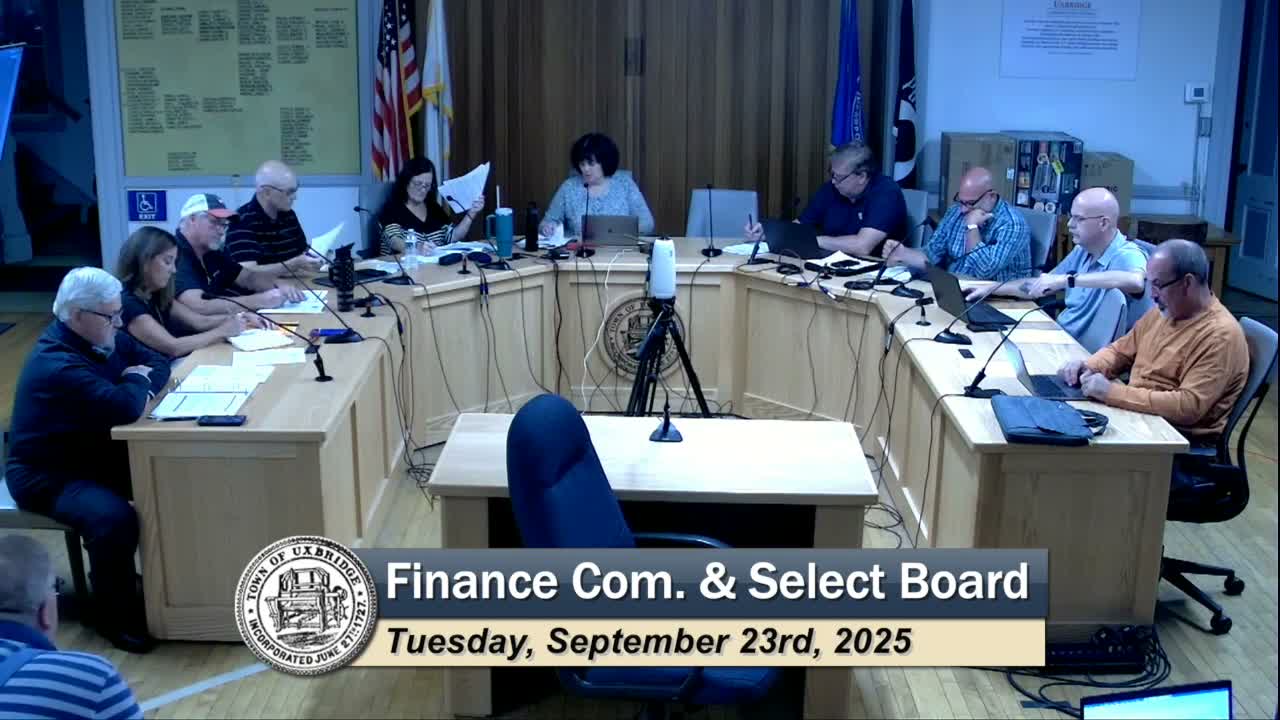
Uxbridge Select Board and Finance Committee recommend against broad noncriminal-disposition bylaw after heated public hearing
Summary
After lengthy discussion and public comment, the select board and finance committee recommended unfavorable action on Article 12, a proposed bylaw to allow non‑criminal disposition (local fines) for certain bylaw violations, citing concerns the draft is too broad, risks uneven enforcement and needs clearer department‑specific provisions.
The Town of Uxbridge’s select board and finance committee on Sept. 23 recommended unfavorable action on a proposed general bylaw that would authorize non‑criminal disposition (local fines) for select bylaw violations, after more than two hours of discussion and an extended public comment that criticized the draft as vague and ripe for abuse.
Supporters, including a staff presenter identified in the hearing as Steve, said the tool would give departments such as the building commissioner and board of health an alternative to costly, slow court proceedings. Steve described the mechanism as a “tool in the toolbox” that could be used to bring property owners or contractors into compliance—citing an example of unpermitted roof work where lengthy enforcement through the courts had delayed remedy.
Opponents — both board members and members of the public — said the current warrant language is written too broadly. Resident Ray Talke, who addressed the board during public comment, urged rejection of the article and pointed to legal and practical risks, including the need to accept M.G.L. chapter 40U for a local hearing officer, the potential for escalating fines to become a revenue stream, and examples from other jurisdictions where fines ballooned to the detriment of affected residents. “Poorly written and poorly considered laws will result in bad consequences,” Talke said, listing court cases and municipal examples he said show how broad enforcement provisions can be misused.
Board members pressed for specifics: which departments would use the authority, which violations would be subject to non‑criminal disposition, the size and escalation of fines, and whether an independent appeals process would be available. Several select board members and finance committee members said they would support narrower, department‑by‑department articles that enumerate specific offenses and penalties rather than a single, omnibus bylaw. One board member said the town already has some non‑criminal dispositions in the bylaws — for example, false‑alarm fees and hydrant‑clearing requirements — and argued the committee should build on those, tailoring language to the needs of each department.
The select board recorded an unfavorable recommendation by roll call after the public hearing; the finance committee likewise noted the article was too broad and recommended further collaboration among departments before resubmitting any bylaw to the warrant. Board members suggested drafting department‑specific provisions, defining the hearing‑officer role and appeals process, and adding guardrails to prevent selective enforcement.
Next steps: The article will appear on the town meeting warrant as submitted, but both boards urged sponsors to return with revised, more specific language after consultation with departments and legal counsel. The board set a joint meeting with the select board for Oct. 14 to continue other warrant business.