Get Full Government Meeting Transcripts, Videos, & Alerts Forever!
Get email alerts on the Student Attendance topic
No spam. Unsubscribe anytime.
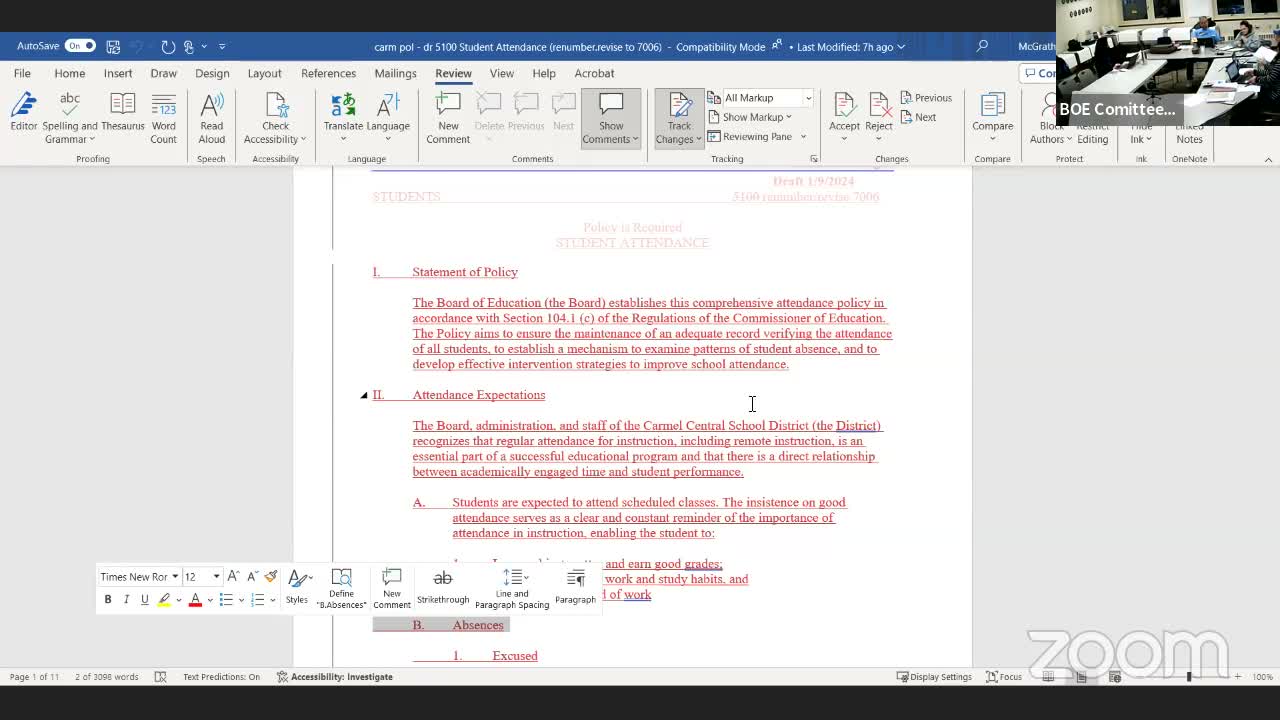
Carmel committee advances revised student-attendance policy, asks for annual per‑building report
Summary
The Carmel Central School District policy committee agreed to move a revised student attendance policy (to be numbered 5100) for a first reading, clarified that incentives language will be dropped in favor of 'disciplinary sanctions,' and required an annual per‑building attendance report to appear in a summer board report.
Unidentified Speaker 1 (policy committee moderator) said the committee will present a revised student attendance policy, to be renumbered as policy 5100, for a first reading after clarifying wording and reporting requirements. The draft replaces earlier language and reconciles different versions that appear in members' binders and online.
Committee members focused on three substantive edits. They agreed to remove a separate incentives paragraph and retitle the section to disciplinary sanctions, with Unidentified Speaker 1 summarizing the change: "scratch incentives and just put disciplinary, and then we don't need this yellow thing with it." The group also clarified the policy should require coding of absences, tardiness and early departures so administrators can "recognize patterns" and develop interventions, with staff noting ParentSquare and dismissal-manager systems already record period-level attendance.
On implementation, the committee directed that an annual per‑building report be provided to the board each summer showing rates of full‑day absence, partial‑day absence and tardiness, both excused and unexcused. Unidentified Speaker 2 (administrative staff) urged a concise standard for the report so the board can identify buildings with persistent trends. The policy text was revised to require the superintendent to provide a plain‑language summary to parents and to supply teachers with copies of the issued policy.
Unidentified Speaker 2 noted the policy service’s version renumbers the document and that some recently adopted policies do not yet appear consistently in the public index; staff agreed to correct online indexing. The committee voted informally (no roll-call recorded) to move the revised attendance policy for a first reading at the next board meeting, with final wording and any legal comments to be resolved prior to adoption.
The committee also directed administration to include training or guidance so building leaders, coaches and staff understand how to apply coding and how accommodations interact with attendance reporting. The policy will return for a formal vote after legal review and final edits.