Get Full Government Meeting Transcripts, Videos, & Alerts Forever!
Get email alerts on the Taxation topic
No spam. Unsubscribe anytime.
House bill 27 would change how Montana taxes agricultural land; supporters say fairness, opponents warn of harm to small farms
Summary
House Bill 27 would end many automatic, size-based agricultural property classifications, require applicants to demonstrate bona fide agricultural use (including a $1,500 annual gross-income threshold for smaller parcels), create an "idle land" class taxed at seven times the agricultural rate for certain large parcels, and establish application and periodic-review processes. Supporters highlighted fairness and production incentives; opponents — including small farmers, outfitters and land trusts — warned the changes could burden subsistence and small operators and increase administrative costs.
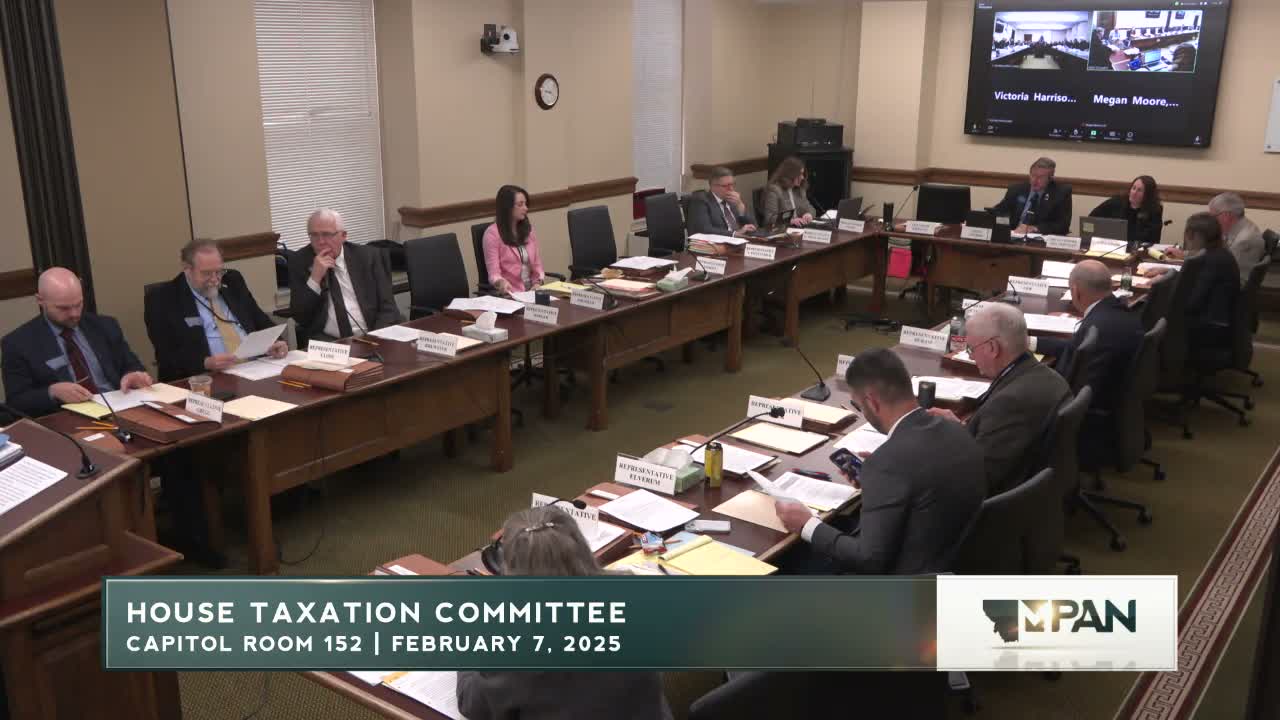
Representative Esman opened the House Taxation Committee hearing on House Bill 27, describing the measure as a working-group-driven cleanup that would tie preferential agricultural tax treatment to demonstrable, bona fide agricultural production rather than parcel size. "What this bill does do is it eliminates the automatic ag classification based on parcel size and requires all those who wish to take advantage of the ag classification to apply to the Department of Revenue and to prove they earn at least $1,500 gross income per year in bonafide ag production," Esman said.
Department of Revenue Director Bridal Beatty and other executive-branch witnesses said the bill reflects the working group's consensus and aims to align tax treatment with legislative intent. Lieutenant Governor Kristin Juras, who attended working-group meetings, said the intent was to ensure fairness across taxpayers: "Whenever you provide a lower tax rate for 1 group of taxpayers, that's a policy decision," she said, and added that the bill seeks to restore preferential rates to bona fide agricultural producers.
DOR staff presented technical details and examples showing large disparities created by the current size-based rules; Bryce Katz, bureau chief, illustrated a pair of nearly identical parcels where qualifying for agricultural classification produced a roughly 20-times tax difference. The amendment before the committee returned the small-parcel gross-income threshold to $1,500 and added an "idle land" classification for parcels above 640 acres taxed at seven times the agricultural rate but still valued on a productive value basis.
A long series of opponents — including small farmers, dude-ranch operators, conservation organizations and county and forest-owner representatives — argued the bill as drafted could unintentionally harm subsistence and small-scale producers, push landowners to subdivide or sell, and create administrative burdens. Steve Skinner, a Helena resident seeking to farm, said the $1,500 floor could be difficult for subsistence producers and asked for clearer protections: "It's so the economy's a scale for for smaller farmers. It's imperative that we do have, you know, tax protections for them," he told the committee.
Several witnesses pressed the committee on implementation details and the fiscal estimate. Representative Kerry White noted the fiscal note assumes two ongoing FTEs and the department's periodic-review process could require tens of thousands of property reviews: "I question whether 2 FTEs will be enough," White said, citing an estimate of roughly 52,000 property owners who might be affected by reviews. DOR staff and the sponsor said some of these concerns would be addressed by an amendment and that many current automatic qualifiers would still be eligible if they document bona fide production and meet the income thresholds.
Opponents also raised concerns about specific exclusions listed in the bill — for example, whether conservation uses or recreational activities (corn mazes, pumpkin patches, dude-ranch rec offerings) would be treated as non-agricultural if they are the exclusive use, and how the department would assess "primary" purpose. DOR witnesses stressed the bill excludes only uses that are exclusive and that bona fide mixed-use parcels could still qualify if the agricultural production meets the threshold.
Representative Esman closed by saying an additional amendment to protect subsistence and small producers would be filed before executive action; the committee closed the hearing on House Bill 27 to consider those changes further.