Get Full Government Meeting Transcripts, Videos, & Alerts Forever!
Get email alerts on the Public Service Commission topic
No spam. Unsubscribe anytime.
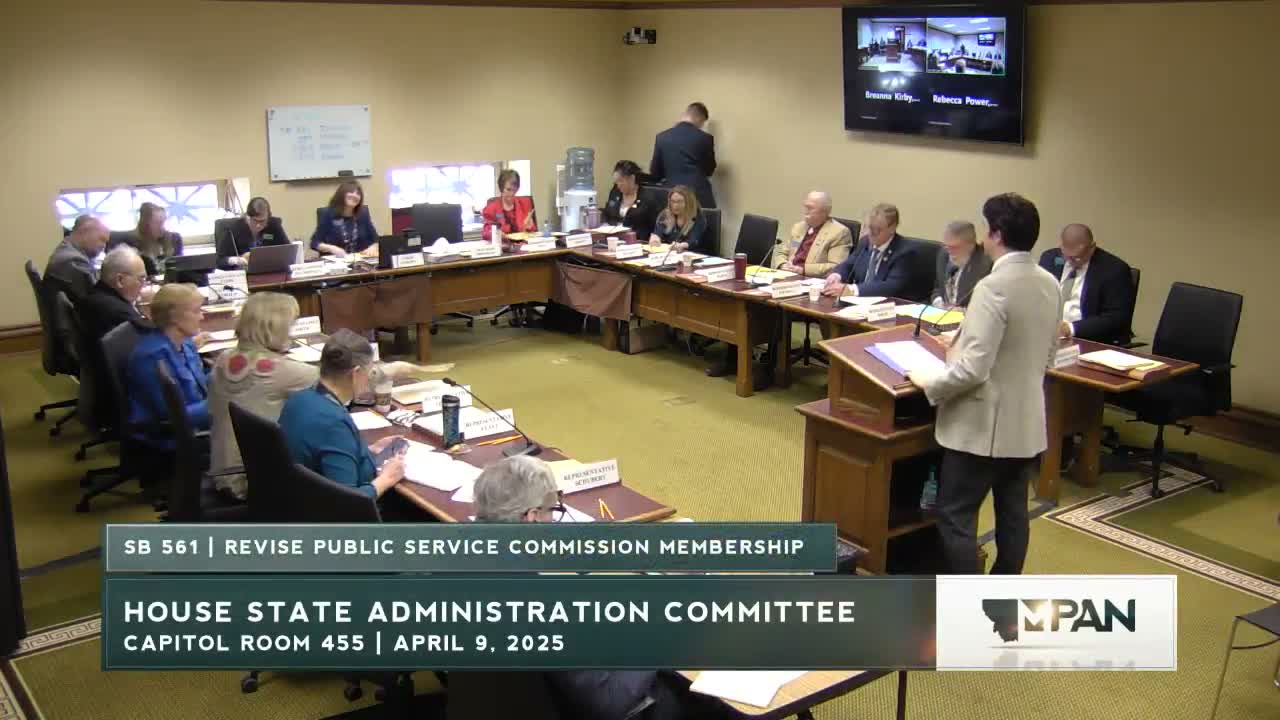
Proposal to shift Public Service Commission majority to gubernatorial appointments prompts heated testimony
Summary
Senate Bill 561 would convert the Public Service Commission to a hybrid model (two elected seats, three gubernatorial appointments confirmed by two-thirds of the Senate); proponents said appointments improve technical expertise, opponents warned of loss of voter accountability and potential capture by regulated utilities.
Senate Bill 561, introduced by Sen. Daniel Zomikov, would change the composition of the Public Service Commission (PSC): two commissioners would be elected (Eastern and Western districts) and three would be appointed by the governor with staggered six‑year terms and two‑thirds Senate confirmation. The bill also prescribes qualification standards for appointed commissioners and cooling-off/conflict restrictions.
Proponents including the Montana Chamber of Commerce and renewable developer Pattern Energy urged the change to secure technical expertise and policy stability. Senator Zomikov said appointing a qualified majority would allow the PSC to function more like quasi‑judicial technical boards in other states, and he argued staggered six‑year terms provide continuity.
Opponents included Brad Molnar (PSC president), current commissioners, consumer advocates and conservation groups who argued the change removes direct electoral accountability, risks cronyism, and reduces consumer protections. Molnar presented comparative data and argued that appointed commissions nationally have not consistently produced better outcomes for consumers, and that Montana’s historical shift to elected commissioners in 1975 followed problems with appointments.
Several current commissioners and the Northern Plains Resource Council urged the committee to reject the bill citing the PSC’s technical training program, recent strategic planning, and the role of elections as a public accountability mechanism. Dr. Annie Bugacek, a sitting commissioner, described agency improvements since 2021 and urged retaining elected accountability.
The committee heard both proponent and opponent testimony and engaged in questioning. No executive action or committee vote on SB 561 was recorded in the transcript; the hearing was closed.