Get Full Government Meeting Transcripts, Videos, & Alerts Forever!
Get email alerts on the Local Governance Accountability topic
No spam. Unsubscribe anytime.
Montana bill would let county commissioners seek court orders to force special-district boards to follow meeting and rate rules
Summary
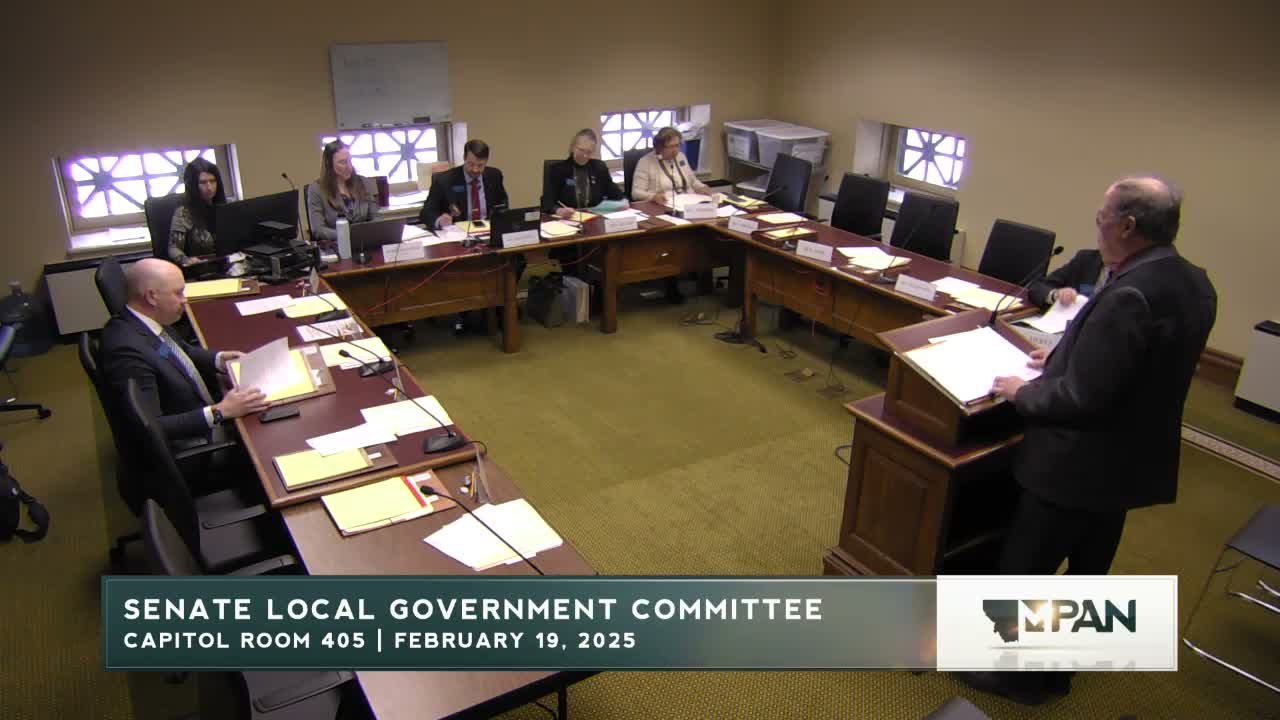
Representative Steve Gist told the Senate Local Government Committee HB68 pairs training requirements with a new enforcement tool — a writ of mandamus and recall pathway — to compel publicly funded special-district boards that ignore open-meeting, notice or rate-change duties to comply.
Representative Steve Gist, sponsor of House Bill 68, told the Senate Local Government Committee that the bill pairs earlier training and transparency efforts with a new enforcement mechanism for publicly funded special-district boards. "Definition of written mandamus is a court order that compels a government official or entity to perform a legal duty or refrain from doing an illegal action," Gist said, explaining the remedy the bill would make available to county commissioners.
The bill is framed as the "stick" to complement House Bill 32's "carrot" of training and public-participation requirements. Gist said HB32 asks boards to publish meetings and rate changes and directs the Local Government Center to help train board members; HB68 would allow the county commission to file a writ of mandamus if the board continues to ignore legal duties after education and outreach. "So we've asked you, we've helped train you, and now we can't," Gist said. "There's gotta be a remedy."
Dan Clark, director of the Montana State University Extension Local Government Center, described how the earlier training program has been used: "We received notification from a county attorney who informed us that there were 12 petitions that were filed against a local district and 11 of those were found to have merit," he said, adding that the center provided education to special districts on those petitions. Clark said HB68 answers the question of "now what" when training does not change behavior.
Committee members pressed staff on practical limits. Senator Weber asked whether the state or county could withhold funding from a recalcitrant special district; Clark said, "From my understanding, currently, there is nothing in the law that would allow withholding resources to a special district for inappropriate or inconsistent behavior." Clark and the sponsor emphasized that the bill does not apply to counties, consolidated city-counties, incorporated towns or school districts.
The committee did not take executive action on HB68 at the hearing; Representative Gist asked for a due pass and the chair said executive action would likely be scheduled later. The hearing record shows proponents and opponents were not present online and no formal vote was taken during the hearing.