Get Full Government Meeting Transcripts, Videos, & Alerts Forever!
Get email alerts on the Conservation Easements topic
No spam. Unsubscribe anytime.
Sponsor Tables Bill That Would Limit Conservation Easements to 40 Years After Large Turnout
Summary
Senator Tony Tzak introduced SB209 to cap conservation easements at 40 years and to prohibit certain agricultural restrictions; after extensive in-room and online testimony from ranchers, timber companies, conservation organizations and tax experts, the committee approved a motion to table the bill at the sponsor's request.
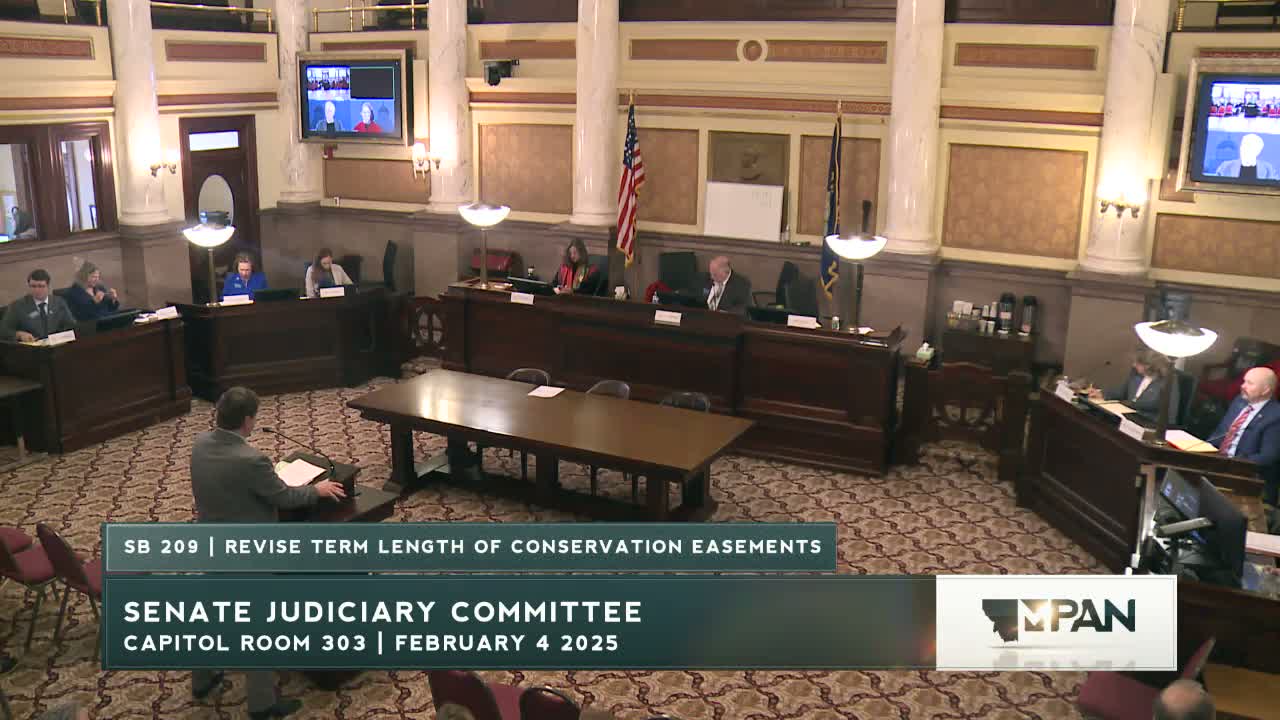
Senate Judiciary Chair Usher opened a public hearing on Senate Bill 209, a measure introduced by Senator Tony Tzak (for the record identified as 'Tony Tzak') that would limit conservation easements to a maximum 40-year term and bar some restrictions on agricultural uses. The sponsor told the committee he intended to table the bill to continue work with stakeholders but asked the committee to hear public testimony because the topic generated "a lot of interest and passion on both sides."
The committee heard an extended series of proponent and opponent statements. Charles Denow of United Property Owners of Montana said long-term or perpetual easements can shortchange landowners because "there's no price discovery" and argued term easements give landowners more leverage at future renewals. Jay Redding of Citizens for Balanced Use said the committee should consider how some easement terms can constrain working ranch operations. Several proponents framed the issue as protecting landowner bargaining position and taxpayer concerns about syndicated easement abuses elsewhere.
Opponents included timber companies, ranching families and many conservation organizations. Jason Callahan (Green Diamond Resource Company) described easements as a key financing tool that allows long-term forestry stewardship and mill supply continuity. Ranchers and family landowners described how perpetual easements enabled estate planning, reduced taxable valuations used to transfer ranches to heirs and, in multiple accounts, made it possible to keep multi-generation ranches economically viable. Randy Newberg, a CPA with decades of estate-planning experience, told the committee that federal tax and estate-planning benefits generally require perpetual easements to qualify.
Conservation groups including the Montana Land Reliance, The Nature Conservancy, Rocky Mountain Elk Foundation, Ducks Unlimited and others described perpetual easements as an essential, voluntary tool for protecting habitat, military training buffers and public access. Mary Hollow of Prickly Pear Land Trust explained the use of perpetual easements near Fort Harrison under the U.S. Army's Readiness and Environmental Protection Initiative.
After more than 100 in-room and online witnesses and an extended committee discussion, a member moved to table SB209. The committee took a voice vote; the chair recorded multiple proxy 'aye' votes and declared the motion passed. Chair Usher confirmed the bill is "on the table" with agreement from the sponsor that the bill will not be brought up immediately, and the committee adjourned.
What happens next: SB209 was tabled by committee voice vote at the sponsor's request; stakeholders and the sponsor signaled intent to continue discussions outside committee and for the sponsor to rework the proposal if needed.