Get Full Government Meeting Transcripts, Videos, & Alerts Forever!
Get email alerts on the Education Discrimination topic
No spam. Unsubscribe anytime.
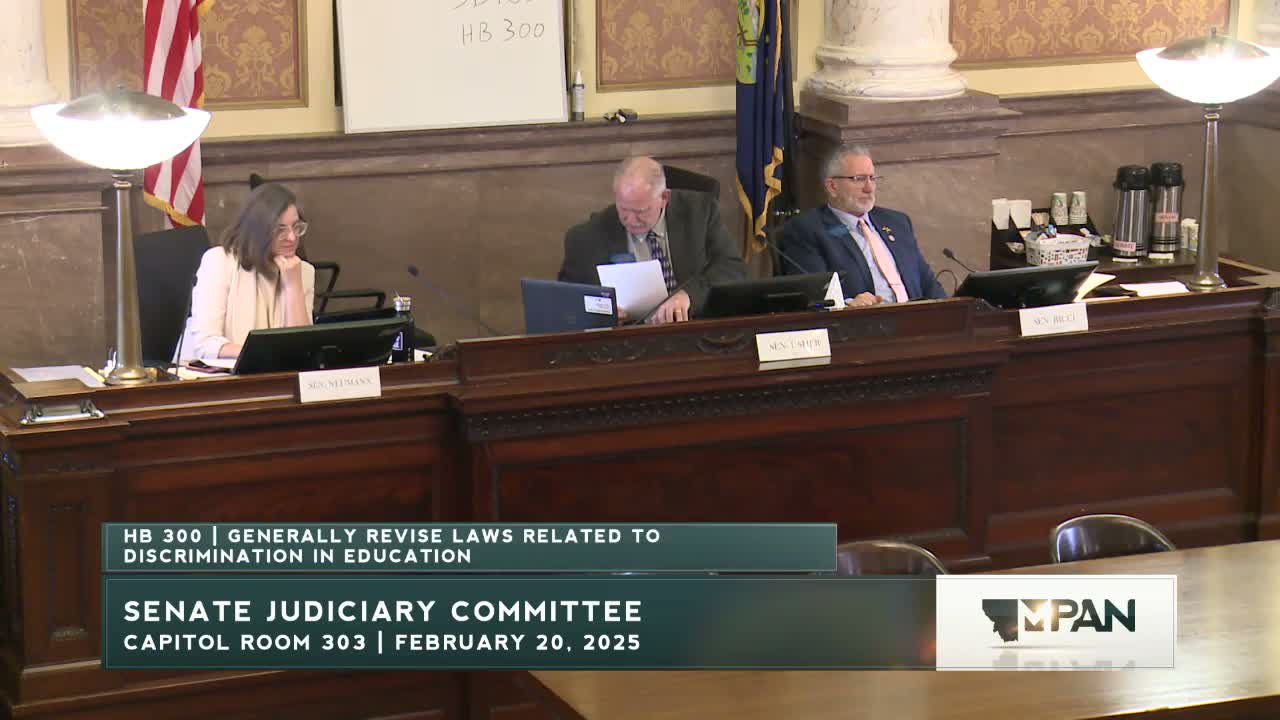
Senate Judiciary advances House Bill 300 after hours of testimony on sex‑based nondiscrimination in education
Summary
The Judiciary Committee heard broad testimony on HB300, which would define sex‑based discrimination in education (including athletic participation and access to private spaces) and create a complaints pathway under state human‑rights law; proponents argued it protects women’s sports and privacy, opponents said it would harm and legally target transgender students and raise constitutional and operational problems.
Representative Carrie Seekins Crow opened House Bill 300 by saying the bill clarifies discrimination protections in education to ensure ‘‘no student, educator, or staff member faces discrimination on the basis of sex,’’ and to preserve equal athletic opportunity and private spaces for females. She told the Senate Judiciary Committee the bill is intended to align state law with Title IX and to provide clarity for schools and the Board of Regents.
Proponents that followed — attorneys and policy advocates including Erica Steinmiller Perdomo (Alliance Defending Freedom), officials from the governor’s office and the Office of Public Instruction, and representatives of conservative policy groups — argued HB300 restores common‑sense protections. Steinmiller Perdomo told the committee the bill is “blind to a person’s gender identity” and focuses on biological sex, asserting that biological males have a measurable performance advantage in many sports and that the measure protects privacy for girls in bathrooms, locker rooms and sleeping quarters.
Opponents including Legal Voice, ACLU of Montana, Planned Parenthood Advocates Montana and LGBTQ organizers urged the committee to reject HB300. Robin Turner (Legal Voice) said the bill would “compromise the safety, the privacy, and the dignity” of transgender and gender‑diverse students and flagged constitutional equal‑protection concerns. Witnesses cited research and personal experience arguing that exclusionary policies harm mental health and educational opportunity and that the bill could invite costly litigation and intrusive school enforcement practices.
Committee members extensively questioned witnesses on legal risks and implementation. Senators asked proponents how many Montana athletes would be affected, whether the bill targets current athletes (sponsors said they could not identify a current Montana athlete subject to the bill), and what evidence shows performance advantages persist after medical transition. Proponents cited national examples and legal claims of competitive harm; opponents warned the state may face court challenges and said the bill could impose difficult investigations and privacy intrusions for school administrators.
Executive action: after debate on multiple bills later in the session, the committee voted by roll call to concur in HB300. The roll call recorded five yes votes and three no votes on concurrence; committee minutes show Senators Ricky, Emrich, Mansella, Vinton and Chair Usher voting yes; Senators Olson, Newman and Smith recorded no votes (some by proxy). That concurrence advances HB300 to the next stage in the legislative process.
What’s next: HB300’s policy and legal contours — how the bill defines protected categories and how schools would implement complaint and enforcement procedures — are likely to determine forthcoming court challenges and administrative guidance. Proponents framed the bill as protecting women’s opportunities and privacy; opponents called it discriminatory and constitutionally vulnerable.