Get Full Government Meeting Transcripts, Videos, & Alerts Forever!
Get email alerts on the Civil Liberties topic
No spam. Unsubscribe anytime.
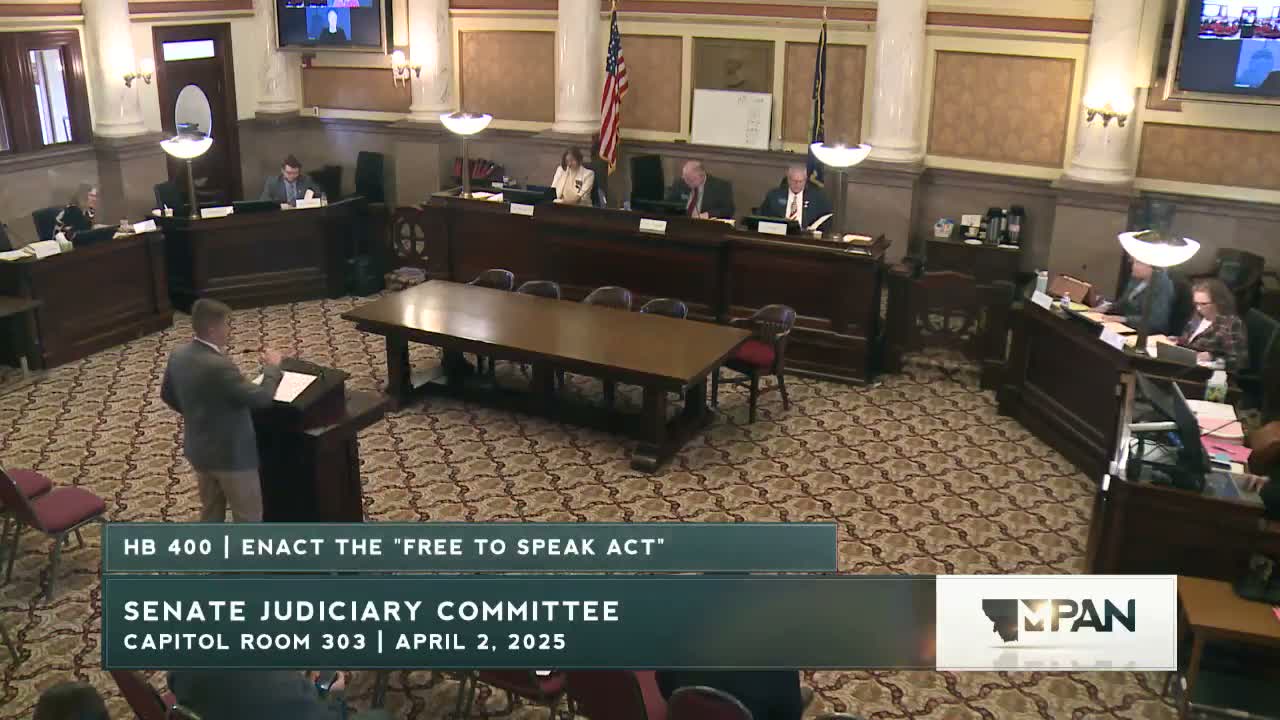
Heated debate in Helena as committee considers HB 400, a 'Free to Speak' bill on pronouns
Summary
HB 400 would prohibit punishment for declining to use a person's preferred pronouns and create a private right of action; supporters call it protection from compelled speech, while opponents — including school administrators, teachers and advocacy groups — say it would legalize harassment and restrict schools' ability to address bullying.
House Bill 400 generated an extended and often contentious hearing in the Senate Judiciary Committee. Representative Braxton Mitchell described the bill as a First Amendment protection preventing schools and state employers from compelling employees or students to use names or pronouns they do not accept.
Supporters — including student activists, Alliance Defending Freedom attorneys and some former students who said they faced discipline — argued the bill prevents compelled speech and is a reasonable protection for conscience. One proponent cited prior litigation in which a university settled a student dispute as evidence the problem exists.
Opponents — including the School Administrators of Montana, the Montana Federation of Public Employees, the Montana Coalition Against Domestic and Sexual Violence, ACLU of Montana and others — said the bill would hamstring educators' ability to address pervasive or intentional harassment, leave schools unable to intervene when repeated misgendering becomes bullying, and create legal exposure that would drive up liability and insurance costs for districts. School administrators warned that the private right of action in HB 400 could prompt litigation over routine student discipline.
Committee exchanges probed how the bill would work in K‑12 settings, the difference between a mistake and intentional harassment, and whether existing law already protects both free speech and student safety. Representative Mitchell said the bill targets compelled speech, not harassment, while opponents urged amendments to allow school flexibility to address pervasive bullying.
The hearing closed without a committee vote; members asked technical questions and requested additional drafting clarifications.