Get Full Government Meeting Transcripts, Videos, & Alerts Forever!
Get email alerts on the Water Adjudication topic
No spam. Unsubscribe anytime.
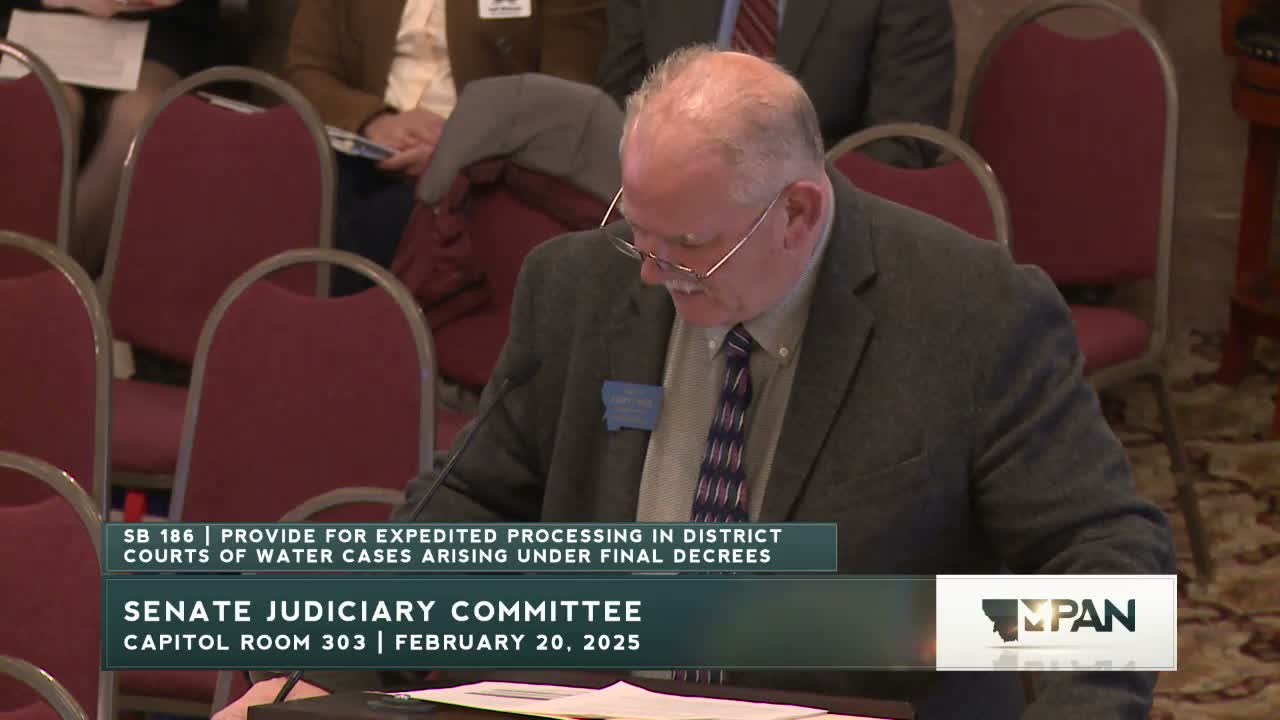
Senate Judiciary hears wide testimony on bill to move post‑adjudication water cases from Montana Water Court to district courts
Summary
Supporters told the Senate Judiciary Committee Senate Bill 186 would restore local control and reduce redundancy by returning enforcement and post‑decree water litigation to district courts once basins receive final decrees. Opponents warned the bill’s drafting risks clerical chaos, venue conflicts across judicial districts, and loss of centralized Water Court services.
Senator Barry Usher introduced Senate Bill 186, telling the Senate Judiciary Committee the measure would “transition jurisdiction over water rights enforcement, administration and any post‑decree litigation back to the district courts” as final decrees are issued for Montana’s basins. Usher said the bill honors the original, temporary intent behind the Water Court and aims to “reduce unnecessary government structure” while preserving tools such as pro tempore judges and special masters for complex matters.
Proponents — a coalition of ranchers, ditch companies and water‑rights stakeholders — repeatedly urged the committee to support SB186. Ross Salmond, president and ditch rider for the El Dorado Cooperative Canal Company, said the bill “ensures local control by an elected district court judge” and that “it is a much better option than a centralized, division court with appointed judges.” Water commissioners and long‑time water users from basins such as the Teton testified that local enforcement has worked smoothly and that district courts should resume the duties once adjudication is complete.
Water‑rights lawyers and some stakeholders said the current Water Court system was created to bring specialized expertise and timeliness to a statewide adjudication that began in 1979. In written and oral testimony, opponents pressed the committee on technical drafting and practical effects: Ryan McLean, a private water‑rights attorney, said the bill’s language risks re‑opening final decrees and “blow[ing] up the adjudication” by inviting relitigation; Chief Water Judge Steve Brown warned the measure could prevent the Water Court from adjudicating newly filed “exempt‑from‑filing” stock and domestic claims in basins already using final decrees, for example in the Powder River basins.
Opponents also highlighted operational services the Water Court currently provides — centralized record‑keeping, rapid clerical corrections and production of basin tabulations (so‑called “red books”) — that would have to be replicated by district courts. Judge Brown told the committee that clerical errors in final decrees are often corrected by the Water Court within days; under the bill those corrections could require new district‑court cases, filing fees and docket delays. Several stakeholders urged amendments to preserve centralized tools or to create a clear option so water users can rely on the Water Court when appropriate.
Committee members probed both sides on jurisdictional mechanics and capacity. Colleen Coyle, a water‑rights attorney who testified for proponents, said district courts already use special masters and pro tempore judges and that processes for judges to confer across districts exist where rivers cross judicial boundaries. Opponents pointed to the mismatch between hydrological basins and judicial districts, warning of potential “judge shopping” or multi‑venue filings if venue and transfer rules are not clarified.
Senator Usher closed by repeating that the Water Court was created as a temporary adjudication body and that SB186 simply sets rules for folding that work back into district courts once adjudication in a basin finishes. He asked for a due‑pass recommendation. The committee did not take a final vote on SB186 at the hearing.
What’s next: the committee discussion record shows proponents and opponents agree on an overall goal — finishing adjudication — but disagree sharply on implementation details. Any amendments to SB186 will likely focus on jurisdictional definitions, clerical‑correction authority, publication requirements for final decrees, and whether the Water Court remains an option or resource during the transition.