Get Full Government Meeting Transcripts, Videos, & Alerts Forever!
Get email alerts on the Hunting Regulation topic
No spam. Unsubscribe anytime.
Bill to ban same‑day use of motion-tracking devices in hunting advances through hearing
Summary
Sen. Pat Flowers told the committee SB 63 would prohibit using or relaying information from motion-tracking devices (including thermal imaging, remote cameras, seismic and telemetry devices) within the same calendar day as hunting to preserve 'fair chase.' FWP and sportsmen's groups supported the measure; committee debate focused on definitions, enforcement and whether 'calendar day' is sufficient.
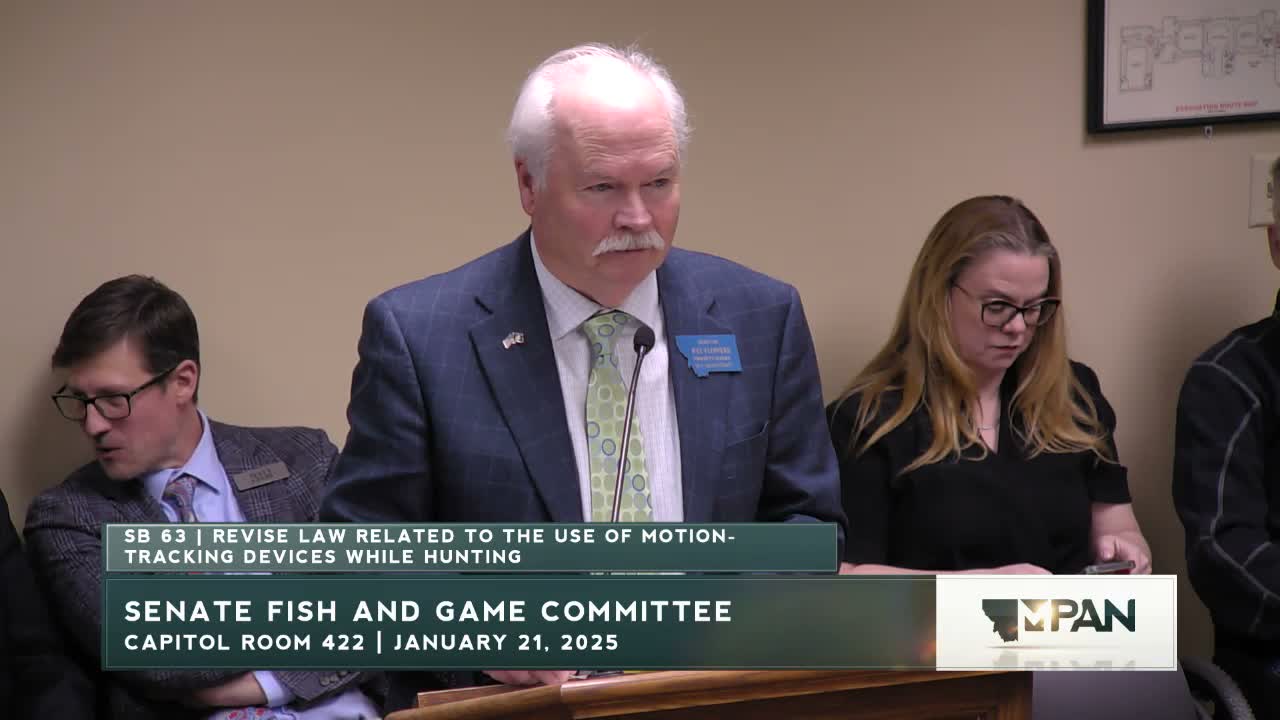
Senator Pat Flowers (Senate District 31) told the Senate Fish and Game Committee that Senate Bill 63 would prohibit the use of motion-tracking devices while hunting within the same calendar day and would bar relaying information from such devices to another person as an aid in hunting. "One of the underlying foundations for hunting in our country and for sure in Montana is the concept of fair chase," Flowers said, explaining the bill’s purpose and reading the Fish and Wildlife Commission rule–based definition of motion-tracking technology.
Montana Fish, Wildlife & Parks law enforcement chief Ron Howell testified the bill closes a loophole where hunters could use thermal or other detection devices before legal hours to locate animals and then hunt them during legal hunting hours. "This bill helps to ensure Montana upholds fair chase principles while technology continues to advance," Howell said, and FWP recommended a due pass.
Conservation groups and sportsmen’s organizations backed SB 63. Tom Jacobson of the Montana Wildlife Federation described the bill as updating Montana code to keep pace with technology. Matt Leo, representing Backcountry Hunters & Anglers, said the bill prevents "bad actors" from gaining unfair advantages by using tracking technology before hunting hours.
Online testifiers described field experience. Guy Stickney of Miles City recounted first learning of nighttime thermal use in 2018 and warned declining device costs and increasing capability have made this practice more common; he suggested a longer prohibition (24 or 48 hours) rather than a calendar-day rule. "Game changer" was how he characterized the technology's effect on locating elk. Jess Wagner said thermal optics have removed darkness as a sanctuary for animals and called SB 63 "a step in the right direction," though she said it falls short because it still allows locating animals late at night and hunting the next morning.
Committee members pressed FWP on technical definitions and enforcement. Senators asked whether image-stabilizing binoculars or dual-use optics would be covered; Howell said stabilizing binoculars simply gather light and are not motion-tracking devices, but that use of thermal capability for locating game within the same calendar day would be prohibited by the bill. Howell said the department has issued 13 citations in the last 10 years for this specific situation and that the calendar-day standard is enforceable and consistent with enforcement language used previously by the department. Senators raised concerns about penalties (statutory fines and possible imprisonment or privilege forfeiture) and about protecting vulnerable defendants; Howell said fines and revocation ranges are set by lawmakers and enforcement discretion is applied in the field.
Flowers closed by saying the bill focuses on ethical fair chase, not game management, and urged committee members to support passage; the transcript records the hearing but no committee vote in the provided text.