Get Full Government Meeting Transcripts, Videos, & Alerts Forever!
Get email alerts on the Cybersecurity topic
No spam. Unsubscribe anytime.
Coweta IT briefs commissioners on phishing, malware and ransomware risks, outlines new defenses
Summary
County IT director Philip Dingler and cybersecurity specialist Tierra Moore updated commissioners on county IT capacity, recent upgrades and initiatives to counter phishing, malware and ransomware — including MFA, EDR/MDR deployment and staff training.
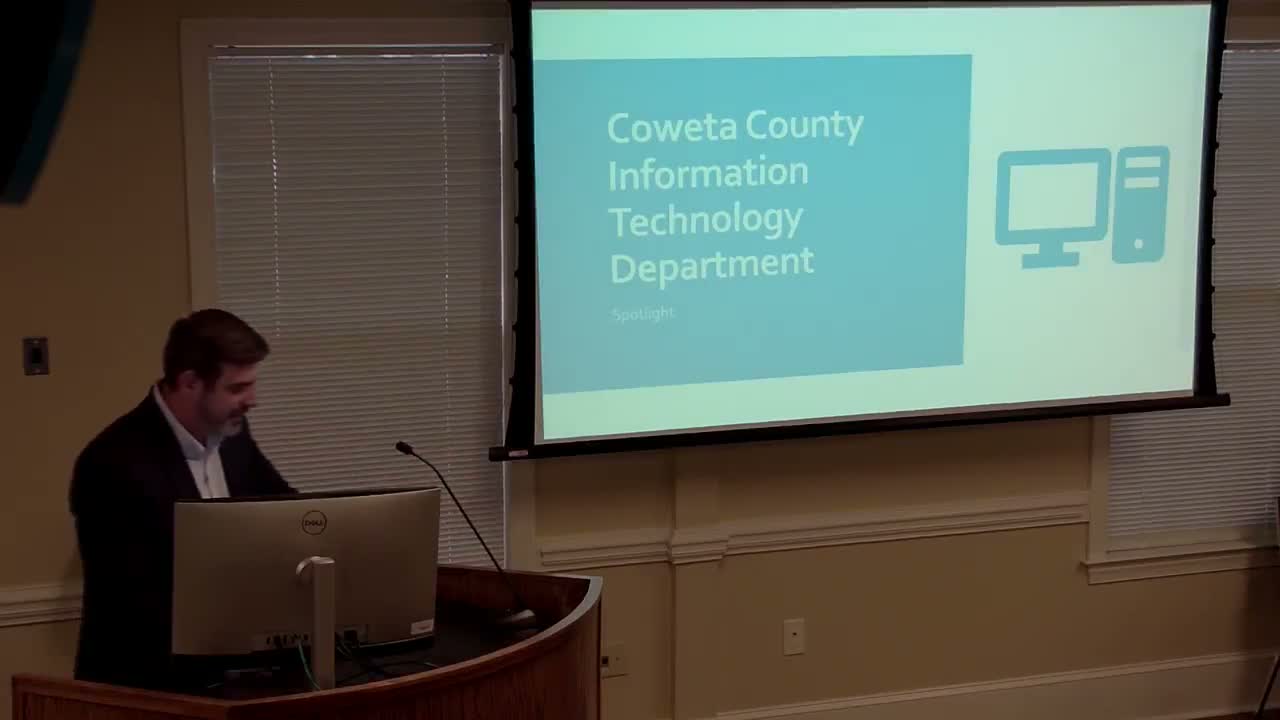
Coweta County’s Information Technology director, Philip Dingler, and cybersecurity specialist Tierra Moore presented an overview of the IT department’s role and current cybersecurity initiatives during the Oct. 21 commissioners meeting.
Dingler said the county IT team supports roughly 1,200 user accounts and 3,000 devices across more than 40 facilities, manages over 50 mission‑critical applications and handles about 300 service‑desk tickets a month. He described recent investments that include managed detection and response, next‑generation antivirus, core network upgrades, improved courtroom technology and increased data redundancy.
Tierra Moore emphasized “human risk” — employees as the primary vectors for phishing, malware and ransomware — and outlined the county’s layered defenses: multi‑factor authentication, phishing awareness training, email filtering, endpoint detection and response (EDR) tools and managed detection and response (MDR) for network‑wide monitoring. Moore cited industry statistics during the presentation: an estimated 21% of employees click on phishing links and the average downtime for ransomware incidents can be measured in weeks; the department cited average ransom‑demand and incident‑cost figures reported by industry sources.
In response to the presentation, commissioners thanked the IT team; later in the meeting the board approved a handbook amendment requiring multi‑factor authentication for staff accounts and supported procurement of software to integrate text‑to‑911 services and a new website contract to modernize county digital services.
What happens next: IT will continue MFA roll‑out and training; staff said tokens and app‑based authenticators will be offered and alternatives provided for employees who cannot use personal devices.