Get Full Government Meeting Transcripts, Videos, & Alerts Forever!
Get email alerts on the Taxes Millage topic
No spam. Unsubscribe anytime.
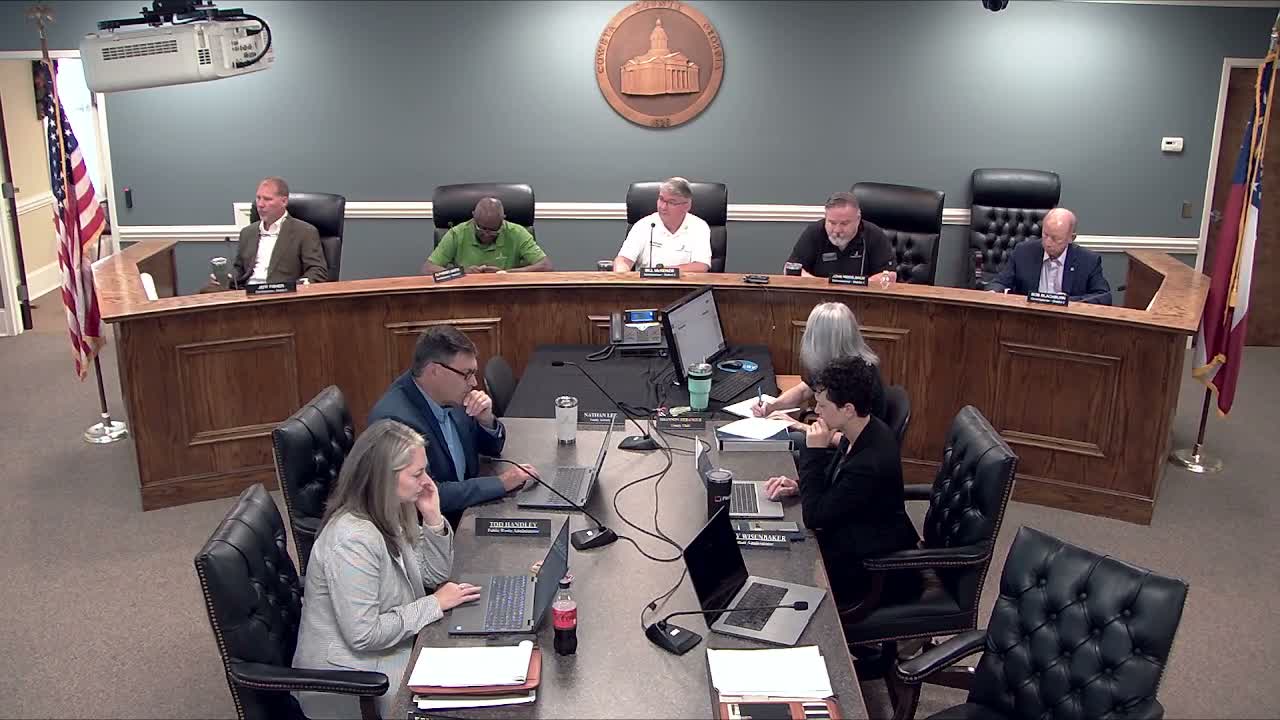
Coweta commissioners hold second millage-rate hearing; staff presents draft FY2026 budget and tax examples
Summary
County staff presented a proposed 2025 millage rate and the FY2026 budget framework at an Aug. 19 public hearing, explaining the effects of the floating homestead exemption, special service districts and an estimated $27 million proposed referendum revenue; the board closed the hearing and set a final adoption vote for 6 p.m. the same day.
Coweta County officials held the second of three public hearings on Aug. 19, 2025, on a proposed 2025 millage rate after county staff presented the draft FY2026 budget and the factors driving the proposed change. Chairman called the hearing to order and county staff led a slide presentation explaining state law changes, digest growth and how proposed rates translate into dollars for homeowners.
County staff member Mister Fouts said the county is required to hold three public hearings if a proposed millage rate exceeds the states rollback rate and walked commissioners and the public through the tax digest and millage calculations. He told the board the net digest rose from just over $10.0 billion in 2024 to about $10.4 billion in 2025, roughly $450 million in growth, and that the countys new growth remains predominantly residential (about 69% of the digest).
Fouts reviewed changes from the 2024 state legislative session and a Department of Revenue ruling that affect annual notices and exemptions, including House Bill 581 (the floating homestead measure) and HB 92. He said the floating homestead is intended to limit annual increases in assessed value for qualifying residential properties but does not "freeze" property taxes or limit what taxing authorities may set as a millage rate.
Using examples from the slides, staff said the floating homestead created roughly $192 million in exemption value in the current digest. Fouts also noted the local school system opted out of the floating homestead, so school homestead exemptions and county homestead exemptions are applied differently and some taxpayers may see different effects on their school portion of tax bills.
On rates, the presentation showed the countys proposed general M&O (maintenance and operations) millage at 4.817 mils. When the three newly created special service districts are added on the illustrative table, the combined shown rate was 5.937 mils (a year-over-year combined change of about 1.249 mils). For unincorporated properties under contract with the county the total illustrative rate was presented as 8.626 mils. Using assessor numbers, staff showed an example: a $400,000 homestead would have had an approximate county M&O tax of $703 last year and the proposed county M&O tax would be about $890.55 under the presented rates (an increase of roughly $187.55, roughly $15 per month).
Fouts explained the budget math behind the millage proposal: the countys FY25 general fund need was presented as about $46.8 million, with roughly $4.75 million of fund balance used to balance that years budget; FY26 needs across funds were presented at roughly $61.7 million and the countywide proposed FY26 budget figure shown in presentation materials was about $117 million. Staff said nonproperty revenues represent a plurality of the funding mix (sales tax the largest single nonproperty revenue line) and that the millage is set by taking the property-tax need and dividing by the net digest.
During the presentation staff raised a potential local referendum revenue stream repeatedly referred to in the transcript as "FLOS" (transcript term). Staff said if voters approve the local referendum this November, it would add an estimated $27 million a year to nonproperty tax revenue and would reduce how much property tax revenue would be required. The transcript uses the term "FLOS" and the board referenced a local referendum; the presentation did not expand the acronym in the recorded remarks, so the transcripts term is reported as stated.
The presentation also addressed common misconceptions: that the new state measures freeze property taxes (they do not), that Coweta pays the highest taxes in Georgia (staff said state DOR data show that is not generally true), and that the budget process is not public (staff pointed to public work sessions, streamed meetings and online budget documents).
During public comment, Herb Cranford, district attorney for the Coweta Circuit, spoke in support of the budget increases for his office, saying his office remains understaffed for its caseload and asking the commissioners to remember that need during final budget adoption. After comments, the board had a motion and second to close the millage public hearing; the board voted by voice and the motion carried unanimously. Chairman reminded the public that the final public hearing and adoption would be held at 6 p.m. that evening and that tax bills are mailed in October and due in December.
Later in the meeting the board entered executive session to discuss personnel matters; upon return the board ratified the related affidavit and approved the personnel actions discussed in executive session by voice vote. The meeting moved to adjournment afterward.
What happens next: the board scheduled the final public hearing and adoption vote for 6 p.m. on Aug. 19, 2025; if adopted then, staff will process the millage and tax bills will be mailed in October per the schedule discussed in the presentation.
Quotes used in this article are verbatim from the recorded public hearing presentation and public comment as delivered to the board and are attributed to speakers who spoke on the record.