Get Full Government Meeting Transcripts, Videos, & Alerts Forever!
Get email alerts on the Property Tax topic
No spam. Unsubscribe anytime.
Committee receives in‑depth training on property‑tax mechanics, valuation and data tools
Summary
Department of Revenue and Legislative Fiscal Division staff briefed the committee on property‑tax basics, valuation approaches, mill‑levy mechanics (including 95‑mill equalization), the 15‑10‑4‑20 calculation, carryover rules, property‑tax assistance programs, and interactive data dashboards for county and class analysis.
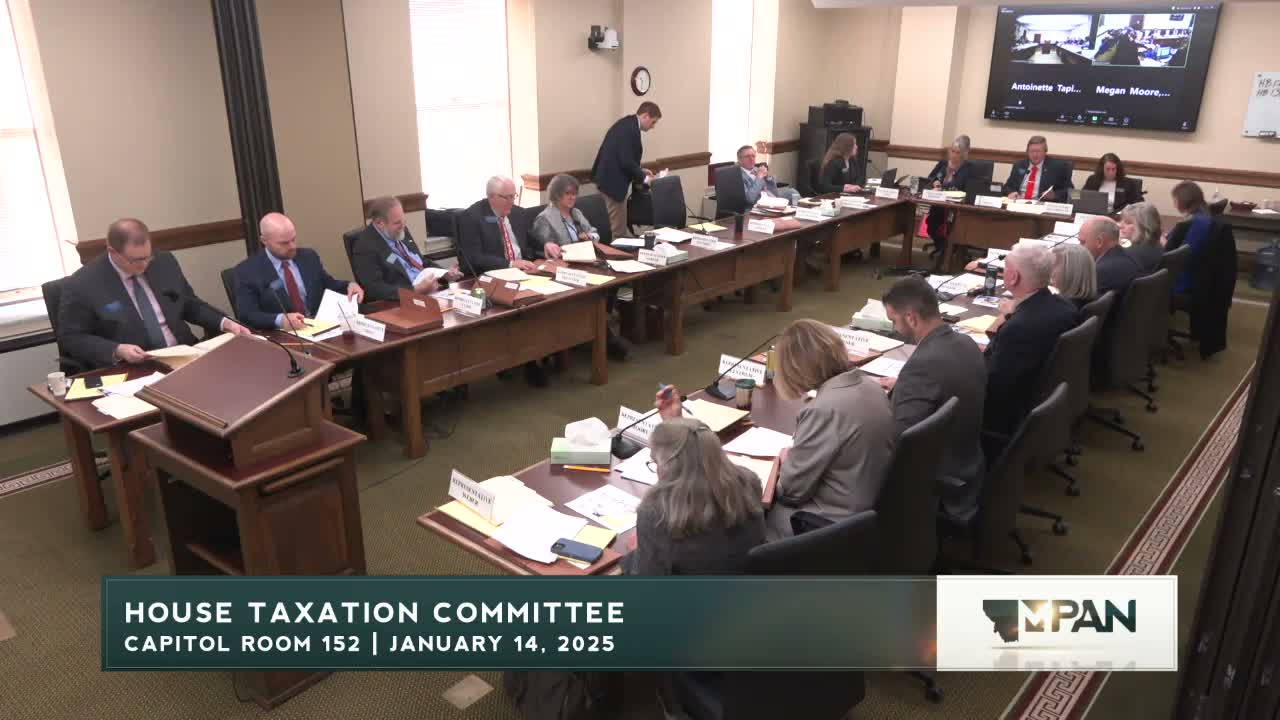
Megan Moore of the Department of Revenue and Curt (Kurt) Swimley of the Legislative Fiscal Division delivered a multi‑part training for the House Taxation Committee covering property‑tax fundamentals and data tools.
Moore began with the basic property‑tax equation and valuation responsibilities (market value → taxable value → mills ÷ 1,000 = taxes due), and reviewed the three approaches to value (sales comparison, cost, income). She described property tax classes and statutory tax rates (residential typically taxed at 1.35%; special statutory treatments for high‑value residences, agricultural/forest treatment, and business equipment). Moore noted constitutional authority (Article 8, Section 3) for state appraisal and the Department of Revenue’s notification and reappraisal cycles.
Moore and Swimley explained mill levies, including the statewide ‘‘95 mills’’ (structured across three statutory authorities), the 6‑mill university levy (voter‑approved statewide), and the 1.5 mills for vocational technical education in certain counties. They walked through the statutory fifteen‑ten‑four‑twenty calculation for permissive local levies: prior‑year revenue adjusted by an inflation factor (half the three‑year CPI average), subtract newly taxable value and certain exclusions (TIF, net/gross proceeds), divide to compute mills, then adjust for carryover (unused mills can be carried forward; the Supreme Court has ruled carryover applies to the 95 mills in contested cases).
Swimley demonstrated Legislative Fiscal Division dashboards that allow committee members and staff to inspect assessed and taxable values by tax class, taxes paid by entity and class, county and town breakdowns, newly taxable property metrics, effective tax rates, taxes per capita, and scenario modeling (for example, estimated impacts of lowering residential tax rates). He highlighted a significant reappraisal uptick reflected in 2024 data and showed how the tools can be filtered by county and class for local analysis.
Moore reviewed property‑tax assistance programs (Property Tax Assistance Program with exemptions up to $350,000 of market value with income tiers; Disabled Veteran exemptions; the intangible land‑value exemption for up to five acres; and the refundable Elderly Homeowner/Renter income‑tax credit (2EC)). She noted the 2023–24 rebate program data and linked DOR reports for participation and cost figures.
Ending: Committee members asked detailed follow‑ups about calculations, carryover practice, and data availability. Staff provided links and contact information for follow‑up; the Chair thanked presenters and closed the meeting.