Get Full Government Meeting Transcripts, Videos, & Alerts Forever!
Get email alerts on the Rulemaking Legislative Oversight topic
No spam. Unsubscribe anytime.
Montana committee concurs on bill to increase legislative role in rulemaking
Summary
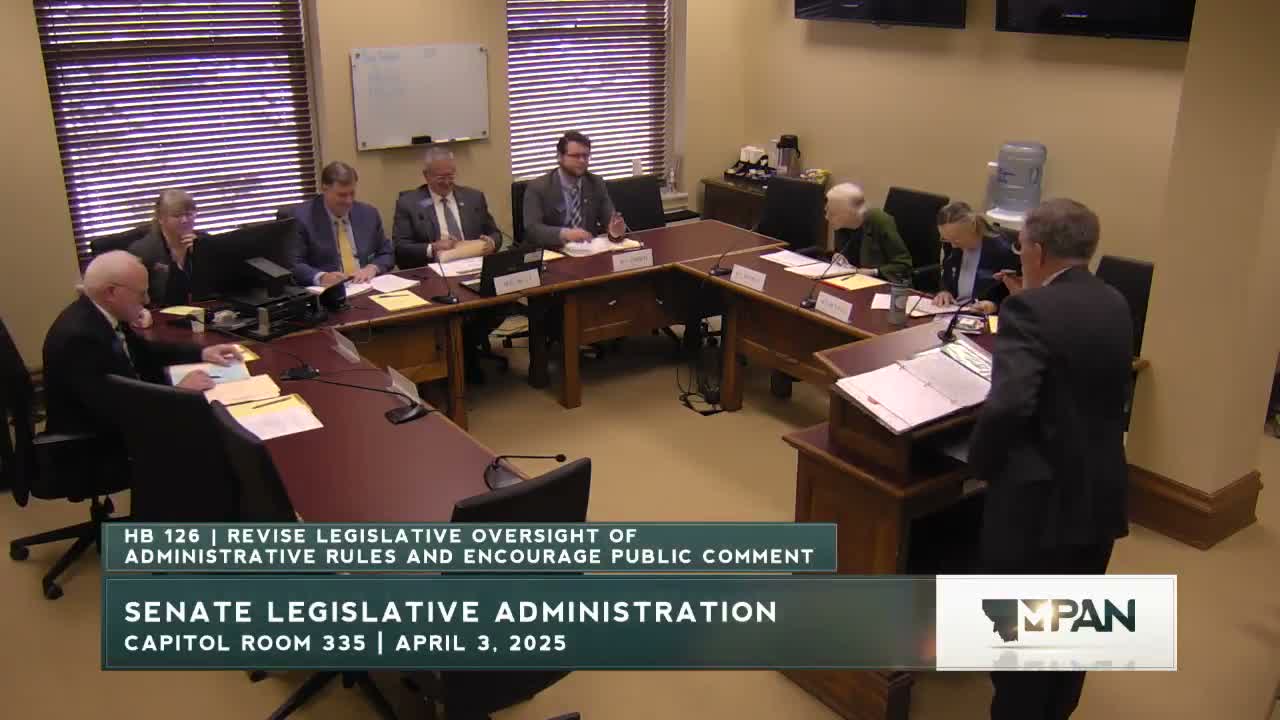
The Senate Legislative Administration Committee concurred in House Bill 126, a measure by Rep. David Beatty that would require agencies to coordinate with bill sponsors before substantive rulemaking, publish legislators' comments alongside proposals and, if requested, respond in hearings. The bill will be carried to the floor.
Representative David Beatty asked the Senate Legislative Administration Committee to concur in House Bill 126, which he said would increase legislative involvement and public participation in the rulemaking process. "Coordination with the legislator must be done before substantive rulemaking is accomplished," Beatty told the committee during a hearing.
Beatty said the bill would require agencies, when a legislator disagrees with a proposed rule, to post the legislator's comments alongside the proposed rule and, if opposition persists, to post unredacted legislative comments next to an adoption notice. He also said the bill permits an agency to make a presentation or respond during rule proposal hearings if requested by an interested member of the public. "I was shocked when I drove ... to a rules hearing to find that there was a hearing officer ... who knew nothing about the rules and told me that [the officer] was not required and would not respond to the public," Beatty said.
Quinlan O'Connor, chief legal counsel for the Department of Labor and Industry, appeared as an informational witness and said the department does substantial rulemaking work and is available to answer committee questions. O'Connor noted coordination with House Bill 592, a separate, more extensive measure, and said the proposal in HB 592 would likely hold the coordination language instead of adding it to HB 126.
Senators asked clarifying questions about plain‑language notifications and about how the bill would interact with existing law. Senator Dunwell asked if notifications about rulemaking could be written in plain language; Beatty replied that HB 126 is more narrowly focused and suggested pursuing plain‑language requirements in the broader bill. Several senators praised the bill's practicality and public‑input provisions.
In executive action the committee moved to concur in HB 126. After discussion and a voice vote with proxies noted, the committee concurred in the House bill. Senator Dunwell volunteered to carry the bill on the Senate floor.
The committee did not take further amendments during this meeting; Beatty said an earlier amendment had been incorporated into the current 0.2 version of the bill. The bill now advances to the Senate floor for further consideration.