Get Full Government Meeting Transcripts, Videos, & Alerts Forever!
Get email alerts on the State Budget HB2 topic
No spam. Unsubscribe anytime.
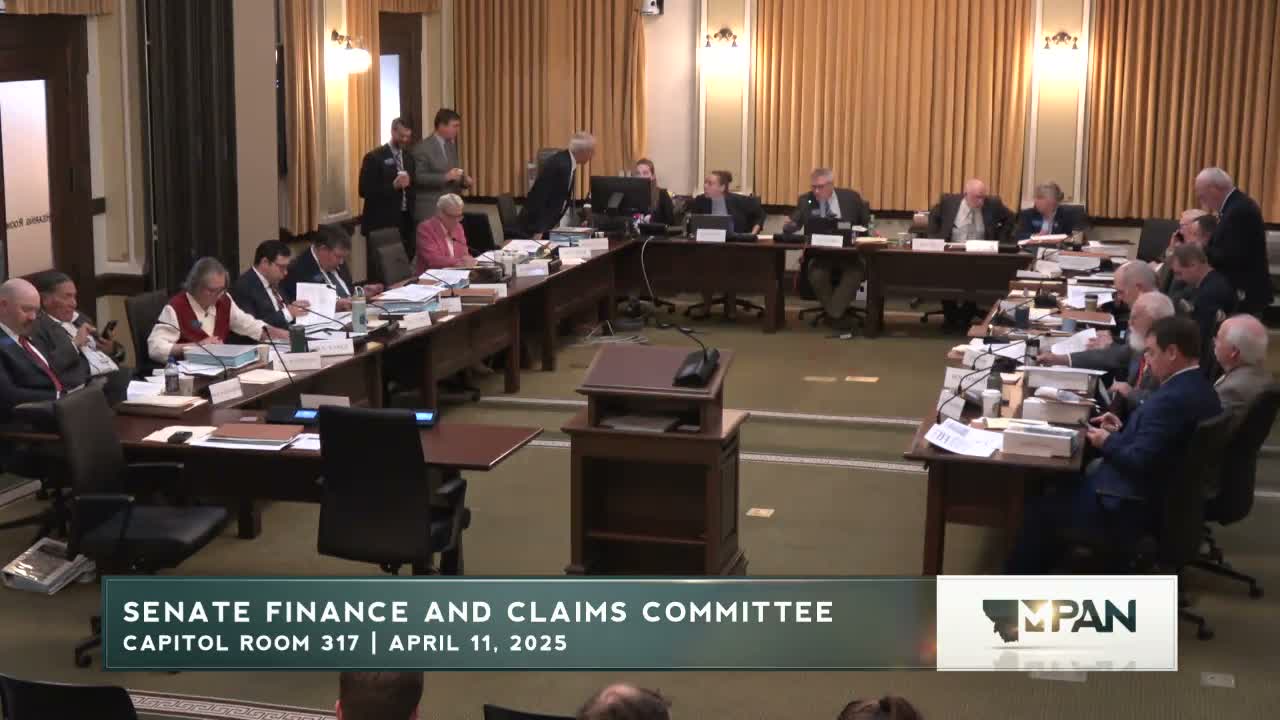
Senate committee amends and concurs in HB 2 after section‑by‑section votes
Summary
After a lengthy executive‑action session, the Senate Finance and Claims Committee adopted multiple amendments to the biennial budget (House Bill 2) — including funding for after‑school programs, rural water, meat‑processing at MSU Northern and community college formula adjustments — and concurred in the bill as amended (13–9).
The Senate Finance and Claims Committee completed section‑by‑section executive action on House Bill 2, adopting a series of amendments across budget sections A through E before voting to concur in the bill as amended (13–9). Chair and vice‑chair directed the committee through a sequence of roll‑call votes on amendments and then a final roll‑call on the full bill.
Key amendments adopted: The committee passed amendment A.003 (appropriation to reimburse an employee from a prior biennium); B.001 to reintroduce evaluation and diagnostic clinics for children with developmental disabilities; B.006, adding a $1,000,000 one‑time appropriation for tobacco‑prevention efforts tied to teen vaping (contingent on federal funding); C.001 increasing funding for Montana Rural Water by $65,000; D.002 adding $300,000 to the Montana Board of Crime Control for after‑school youth program grants; E.002 providing $200,000 one‑time to MSU Northern for a meat‑processing program and E.004 adjusting the community college funding formula to avoid penalizing career‑technical education growth. Several other proposed D‑section amendments failed on close votes.
Debate highlights and fiscal context: Committee members questioned fund balances, long‑term sustainability and whether one‑time funds should be used; fiscal staff explained the tobacco settlement fund balance (~$21 million) and how federal contingency language would operate. Members also debated the merits of continuing OTO (one‑time only) programs versus creating ongoing funding streams. After a caucus and final discussion, the committee concurred in HB 2 as amended and adjourned until the noon session.