Get Full Government Meeting Transcripts, Videos, & Alerts Forever!
Get email alerts on the Mandatory Reporting topic
No spam. Unsubscribe anytime.
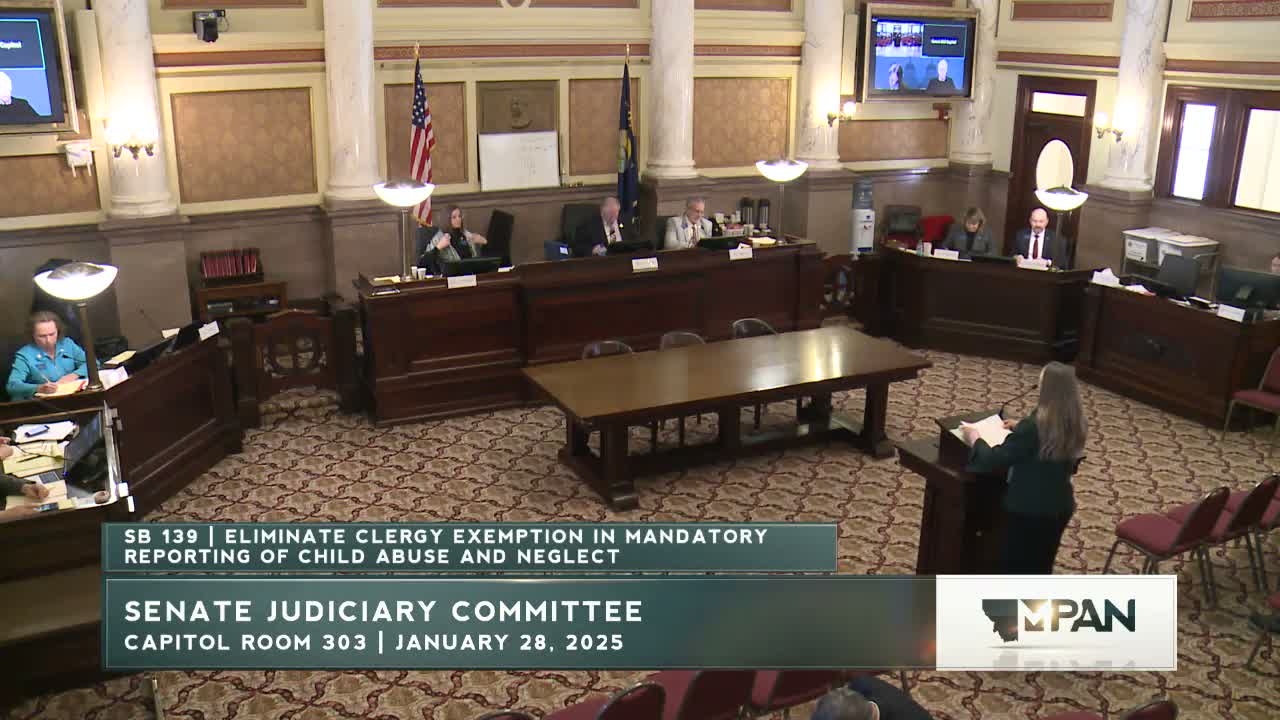
Lawmakers weigh removing clergy reporting exemption; amendment narrows but opponents warn of constitutional risks
Summary
Senators considered SB 139, which would narrow the clergy exemption from mandatory child-abuse reporting; the sponsor offered an amendment preserving the sacramental seal of confession while removing other clergy exemptions, prompting divided testimony from religious groups, legal advocates and survivors' advocates.
Senate Bill 139 would eliminate broad clerical exemptions to Montana's mandatory child-abuse reporting law. Sponsor Sen. Mary Ann Dunwell presented an amendment negotiated with the Montana Catholic Conference that preserves the sacramental seal of confession while removing other clergy exemptions for mandatory reporting.
Proponents — including the Montana American Indian Caucus, clergy and survivors' advocates — said the change advances child protection and prevents institutions from shielding abusers. "Freedom of religion should not protect criminal conduct by religious ministers," Sen. Dunwell said, citing a state supreme-court case (Nunez v. Watchtower) as an example of clergy-based concealment.
Opponents argued the bill, even as amended, raises First Amendment and penitent-privilege concerns and could chill people from seeking pastoral help. Legal counsel for the Montana Family Foundation and the Pacific Justice Institute cautioned that forcing clergy to report some confidential pastoral communications could deter vulnerable people from seeking counsel and that courts should not be placed in the role of judging religious doctrine.
The Montana Catholic Conference supported the amended bill, saying the amendment reflects diocesan practice to report outside sacramental confession and that the amendment balances religious practice with child safety. Several clergy testified they or their institutions already have policies to report suspected abuse outside the seal of confession.
Committee members questioned the scope of the amendment (how "confession" or "doctrine" is defined and applied to minority faiths), potential chilling effects, and the constitutional line between religious exercise and public-safety interests. The sponsor asked the committee to pass the bill with the amendment for further work; no decision was reached during the hearing.
What happens next: The committee could adopt amendments to clarify doctrinal definitions and protections for minority faiths, then take executive action. The measure remains under committee consideration.