Get Full Government Meeting Transcripts, Videos, & Alerts Forever!
Get email alerts on the Medical Malpractice topic
No spam. Unsubscribe anytime.
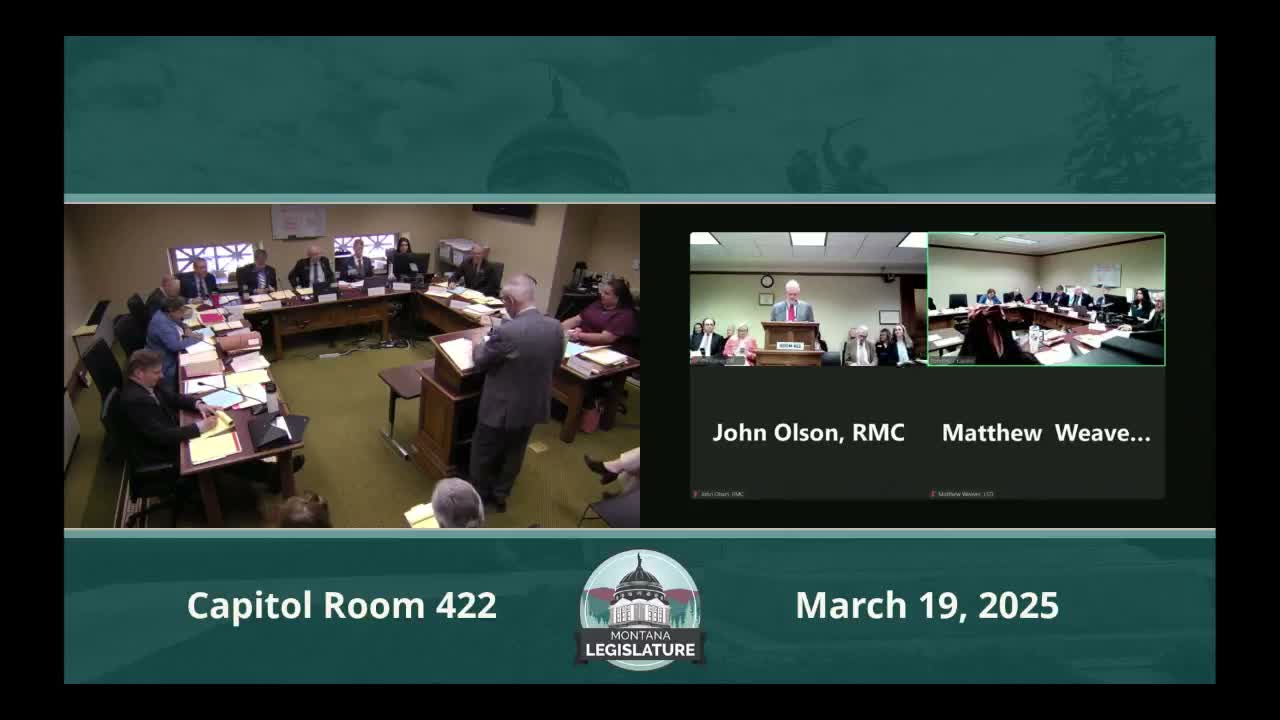
Senate committee hears debate on bill to restore pre‑Cayman medical‑malpractice jury instruction
Summary
Lawmakers and medical groups sparred over House Bill 342, which would codify a pattern jury instruction that sponsors say restores the prior standard for medical‑malpractice duty after the Montana Supreme Court’s Cayman decision; physicians warned of lost rural providers, opponents called the change unnecessary and legally intrusive.
Representative Bill Mercer urged the Senate Business and Labor Committee to concur on House Bill 342, saying it would ‘‘reset’’ how juries are instructed in medical‑malpractice cases so the standard of care is determined by expert testimony rather than a foreseeability‑based instruction adopted by the Montana Supreme Court in Cayman v. Glacier Eye Clinic.
Mercer told the committee the bill would reestablish a longstanding jury instruction that asks whether a provider used the learning and skill ‘‘ordinarily used by doctors practicing in the same or a similar community’’ and that the Cayman decision introduced a higher or different approach that could confuse juries.
Proponents from hospitals, physician groups and specialty societies told the committee the change is necessary to protect access to care in rural Montana. Stacy Anderson of the Montana chapter of the American College of Obstetricians and Gynecologists said maintaining the traditional standard helps keep malpractice costs down and preserves obstetrics services in smaller communities. ‘‘Maintaining the standard of care to be proportionate to the physician’s training … will allow continued OBGYN care to rural parts of Montana,’’ she said.
Physician and insurer representatives including the Montana Hospital Association, Montana Medical Association and emergency physicians argued the bill preserves the role of expert testimony in defining the standard of care and prevents a single foreseeable risk from effectively shifting the legal duty beyond reason.
Opponents, including trial‑bar representatives, said district courts have long used proportional‑care instructions in appropriate cases and that the Cayman decision reflects a legitimate legal development. Al Smith, representing plaintiff‑side attorneys, warned that the bill would amount to another layer of special protections for medical defendants and argued existing case law and district‑court practice already provide appropriate guidance.
Committee members asked technical questions about the history and sources of the jury instruction, how it relates to statutory negligence concepts, and whether the Legislature should override a Supreme Court interpretation. Mercer said the bill is a policy choice to restore what proponents consider a settled practice.
The committee did not take a final floor vote on HB342 during this hearing; sponsors and interested parties were invited to provide written materials and return for further consideration.
The committee’s next step is to decide whether to move the bill as introduced to the full Senate.