Get Full Government Meeting Transcripts, Videos, & Alerts Forever!
Get email alerts on the Energy topic
No spam. Unsubscribe anytime.
Central Coast Community Energy tells Grover Beach it’s expanding renewables, storage and customer incentives
Summary
A 3CE representative told Grover Beach officials the agency delivered roughly 409 megawatts of renewable energy in 2024, detailed battery storage’s role in avoiding expensive fossil fuel generation during peaks, outlined customer electrification incentive programs and warned of federal tax‑credit changes that could affect EV and utility‑scale projects.
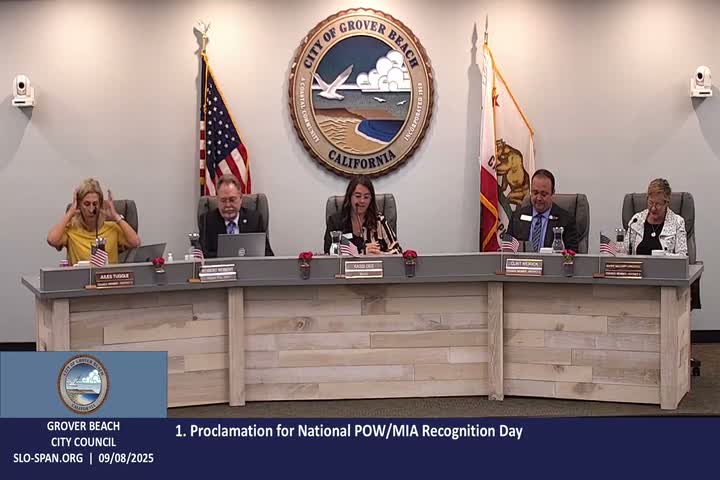
Spencer Brandt, community relations manager for Central Coast Community Energy (3CE), briefed the Grover Beach City Council on Sept. 8 about 3CE’s programs, renewable generation and storage work on the Central Coast.
Brandt said 3CE serves about 1.2 million people across 30 cities and five counties and that in 2024 it delivered roughly 409 megawatts of renewable electricity — which staff described as enough to power more than 350,000 homes — and avoided more than 445,000 metric tons of carbon emissions.
Energy storage: Brandt emphasized energy storage’s role in reliability and affordability, saying storage helps capture renewable generation during the day and discharge during evening peak hours when demand and prices are highest. "Energy storage is essential for California's transition to carbon free electricity," Brandt said.
Local programs: Brandt reviewed customer programs that help with electric‑vehicle purchases and home electrification, fleet electrification assistance for public agencies and incentives for electric bus deployments and reach‑code technical assistance for local governments. Staff noted up to $300,000 per year may be available to Grover Beach for electrification projects such as EV chargers and fleet transitions; officials were told 3CE provides outreach and assistance through partner nonprofits.
Federal policy: Brandt flagged changes in federal tax credits described in HR 1 (the legislative package referred to in the presentation) that could affect EV and utility‑scale project incentives and encouraged customers to use current incentives before deadlines staff quoted in the presentation.