Get Full Government Meeting Transcripts, Videos, & Alerts Forever!
Get email alerts on the Water Resiliency topic
No spam. Unsubscribe anytime.
Grover Beach directs staff to start a water‑supply resiliency study, budgets $300,000
Summary
Council agreed on a scope for a multi‑year water supply resiliency study that will assess supply and demand, contingency planning, conservation, and alternatives (desalination, recycled water, state water purchases) and include a public engagement program. Staff budgeted $300,000 for the study, with a final report anticipated by July 2026.
Grover Beach City Council on Sept. 8 directed staff to proceed with a draft scope of work for a water supply resiliency study designed to evaluate the city’s long‑term ability to meet water demand and recommend feasible supply alternatives.
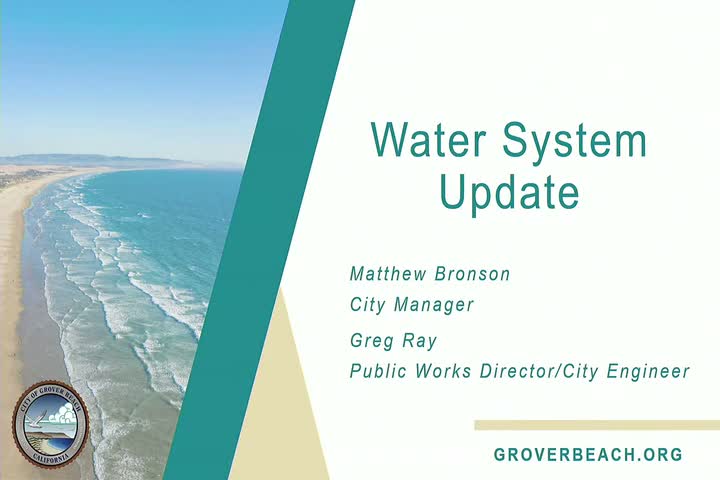
City Manager Matt Bronson said the work begins a multi‑year effort to address water system needs beyond recent sewer priorities. Public Works Director and City Engineer Greg Ray told council the city operates about 48 miles of water mains, many system components are more than 40 years old, and the city experienced a recent increase in unexpected service interruptions. Ray said Lopez Lake — the city’s surface supply — is at about 84–85% of capacity and that groundwater from the Santa Maria basin is currently sufficient, but staff expects longer‑term pressure on supply as development proceeds and litigation over Lopez Lake operations could reduce available deliveries.
"We do not currently have any supply buffer available to serve existing customers during extended periods of drought," Ray said, summarizing the city’s vulnerability and the purpose of the proposed study.
Study scope and timing: staff presented a draft scope that includes an in‑depth supply and demand analysis, a recommended water supply buffer and buffer policy, a cost‑benefit analysis of alternatives (conservation, desalination, Lopez Lake spillway modifications, state water purchases, recycled water and stormwater retention), preliminary designs and cost estimates for shortlisted options, peer review, and a final recommendation to council. The scope also includes a public information and engagement program (forums, focus groups and surveys). Staff said an RFP will be released in the month following council direction, the consultant agreement will be returned to the council by the end of 2025, and the final study would be expected by July 2026.
Budget and rates: staff said the water enterprise currently has roughly $4.5 million in reserves but a budgeted deficit near $145,000 for the year. The council was reminded that the current rate structure reverts to 2021 levels under Measure D24 and that any future rate changes beyond 2021 levels would require a separate Proposition 218 process and council direction; staff emphasized that a resiliency study's findings would inform — but would not automatically trigger — a rate study.
Council direction and public input: council members asked that the study explicitly examine contamination/emergency contingency scenarios (following a May boil‑water event tied to Lopez Lake distribution), the nexus study requirements for a development impact fee, and potential grant and external funding sources. Members also requested robust community engagement and clarity on conservation incentives and multifamily metering. Residents in the room reiterated concerns about new multi‑story development and water availability and asked that the study reflect actual existing conditions as well as projected growth.