Get Full Government Meeting Transcripts, Videos, & Alerts Forever!
Get email alerts on the School Funding topic
No spam. Unsubscribe anytime.
Staff briefing: how GTB, the SEPTA (95‑mill) account and levies shape Montana school funding
Summary
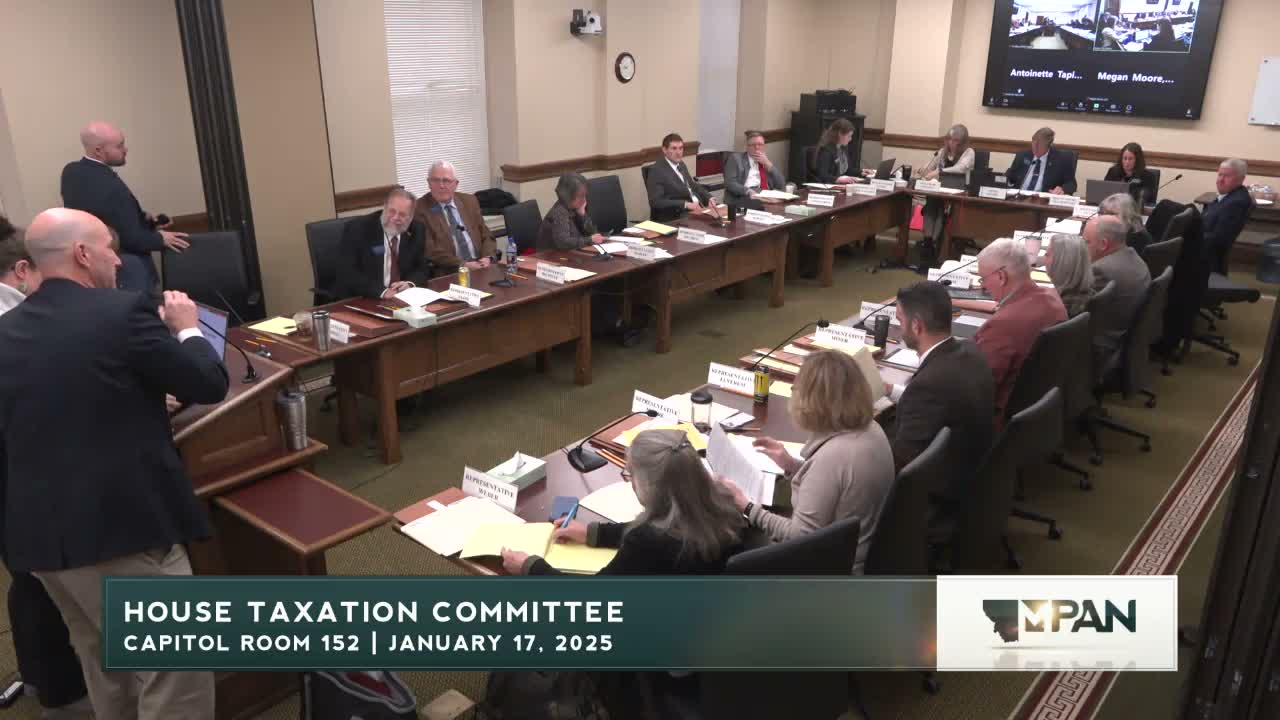
Legislative analysts Pat McCracken and Julia Patton briefed the House Taxation Committee on K‑12 funding mechanics, explaining Guaranteed Tax Base (GTB), the SEPTA 95‑mill account trigger and how state and local revenue streams interact to set district levies and taxpayer bills.
Legislative staff told the House Taxation Committee that Montana’s K‑12 funding system balances multiple sources — local levies, a state guarantee account, the 95‑mill School Equalization and Property Tax Reduction account (SEPTA) and the State General Fund — to produce a statewide package of roughly $1 billion in school funding.
Deputy Research Director Pat McCracken and fiscal analyst Julia Patton framed GTB as the state’s main equalization tool. Patton said GTB "is an equalization mechanism that equalizes revenue generating capacity by providing a state subsidy," and illustrated the point by comparing two districts: Ennis (a large taxable base) and Superior (a small taxable base). For 2025, she said Ennis received no GTB while Superior received roughly $823,000, demonstrating how GTB reduces the mills a less‑wealthy district must levy to raise a given dollar amount.
The presenters also walked members through the SEPTA (95‑mill) account and its trigger mechanism enacted in 2023. Patton described the statutory dial: when 95‑mill revenues grow beyond a prior‑year threshold, about 55% of the incremental revenue is applied to reduce local property tax burdens through a sequence of GTB multipliers (first retirement GTB, then major maintenance aid, then debt service assistance). She explained the reverse — a drop in 95‑mill revenue — would dial those allocations back and shift costs to local taxpayers.
Staff emphasized cash‑flow realities: property taxes are collected in two installments (Nov. 30 and May 31) while school payments are spread over 11 months (Aug.–June), so the State General Fund often fronts payments to smooth district cash flow. McCracken used a classroom visual analogy to show how state contributions and local levies fill a district budget "bucket," and directed members to an interactive Legislative Fiscal Division school‑funding tool that allows inspection of district budgets, revenues and GTB impacts over time.
Key figures cited in the briefing included illustrative FY2024 and FY2025 numbers used by presenters: the SEPTA account produced roughly $430 million in FY2024; the guarantee account typically provides about $50 million (FY2024 was noted as ~$64 million); federal Impact Aid and other federal streams were listed (Impact Aid ~$96M, school food ~$55M, IDEA ~$41M, Title I ~$87M) and the presenters said statewide state support plus local taxation move roughly toward a billion dollars in K‑12 funding when combined.
Members asked detailed operational questions — how the inflation indexing in levy language would be applied (in the earlier HB20 exchange), how mills convert to dollars in individual districts, and whether the department had the data and processes to implement reporting changes. Staff repeatedly advised that the interactive tool and the school‑funding and property‑tax resource libraries are available for members to review specifics and run district‑level scenarios.
The briefing concluded after roughly an hour with the presenters posting materials in the committee’s team folder and the fiscal division website for follow‑up.
What to watch: changes to the 95‑mill revenue in a reappraisal cycle and any subsequent statutory adjustments to GTB multipliers or the SEPTA trigger could materially shift local property tax levies, county retirement mill rates and district budgets in the coming biennium.