Get Full Government Meeting Transcripts, Videos, & Alerts Forever!
Get email alerts on the Committee Votes topic
No spam. Unsubscribe anytime.
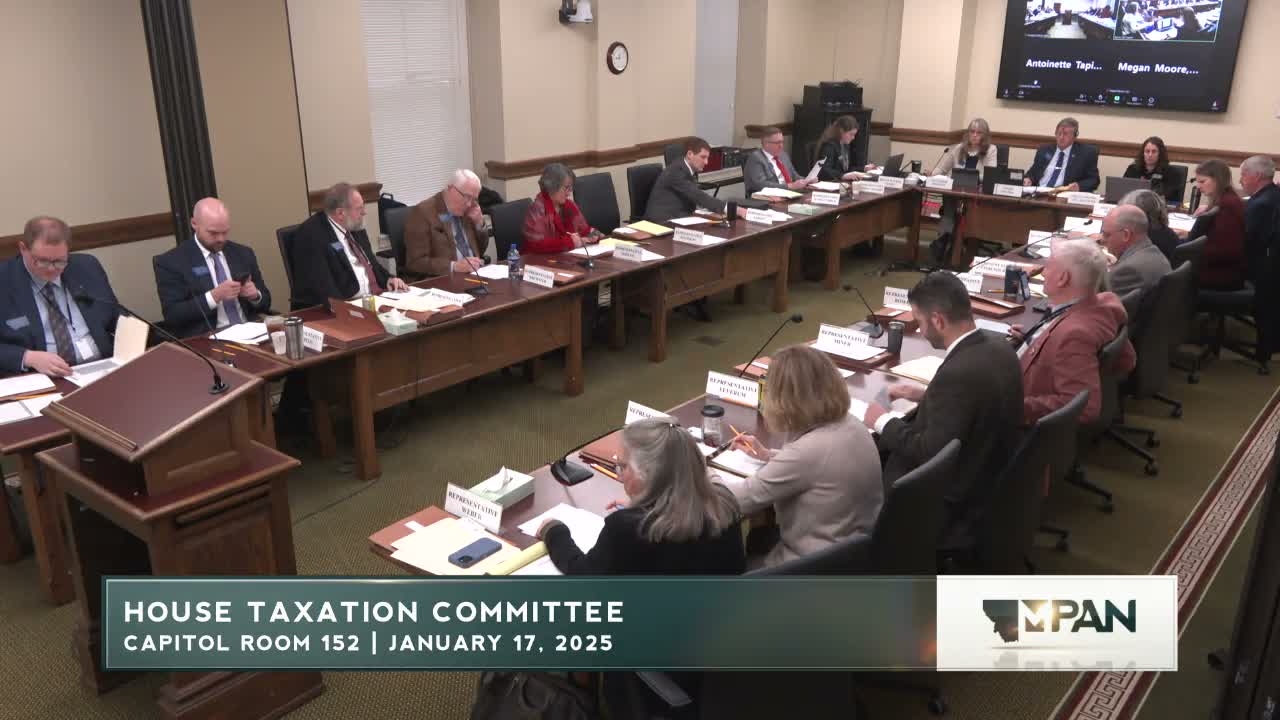
House Taxation Committee advances HB20, tables HB25 and sends HB90 and HB129 out of committee
Summary
The House Taxation Committee on Monday voted HB20 out of committee after two amendments, tabled HB25 after debate and a failed final vote, and advanced HB90 and HB129 unanimously. The panel then received an hour‑long briefing on school taxation and funding mechanics.
The House Taxation Committee on Monday completed executive action on four bills, approving three and tabling one after debate over scope and reporting requirements.
House Bill 20, carried by Representative Brewster, was amended twice in committee. The first amendment removed school‑funding references to narrow the bill’s focus; the committee approved that amendment 20–1. A second amendment changed an inflation adjustment in the bill from one half of the historical inflation measure to three quarters for new, voter‑approved levies expressed in dollars; the committee approved that amendment 20–1. After limited debate, the committee voted by roll call to advance the twice‑amended bill in executive action (16 in favor, 5 opposed).
Representative Brewster described the inflation amendment as narrowly targeted: it "applies to new, voted levies going forward that are voted with dollars instead of mills," and, he told colleagues, the change was intended to give jurisdictions more flexibility while keeping the statute’s reach limited.
House Bill 25, carried in the transcript by Representative Esman, drew prolonged discussion about whether the measure merely clarifies reporting or could lead to additional taxation of entities leasing publicly owned property. Staff clarified the bill was intended primarily as a reporting‑requirement change so the department of revenue would receive better data on lessees; the committee recorded that the underlying fiscal note was $0 but that a revised note could be requested if the amendment materially changed impacts. On a roll‑call vote the bill (once amended) failed in committee, 9–12. Members then approved a substitute motion to table the bill 21–0, leaving open the possibility it could be brought back at a later date.
House Bill 90 was approved by voice vote, recorded 21–0. House Bill 129 passed by voice vote, 21–0; members described HB129 as a modest measure in support of local volunteers and expressed broad support for moving it forward.
The committee clerk recorded the votes and proxies on the record; where recorded in the transcript, the committee relied on a combination of in‑person responses and proxy votes to reach the tallies above.
Next steps: HB20, HB90 and HB129 were reported out of committee to the next legislative stage; HB25 remains tabled in committee pending potential future action.
Votes at a glance - HB20 (sponsor: Rep. Brewster) — Passed in committee after two amendments; committee vote 16–5. - HB25 (sponsor: Rep. Esman) — Amendment adopted; final vote failed 9–12; substitute motion to table passed 21–0 (bill tabled). - HB90 (sponsor listed in the committee record) — Passed 21–0. - HB129 (sponsor: Jones per committee record) — Passed 21–0.
What the record shows: All formal motions, amendment numbers and vote tallies listed above are drawn from the committee transcript. Proxies were used and announced in several votes and are reflected in the committee tallies as recorded by the clerk.
The committee adjourned and reconvened for a staff presentation on school taxation and funding mechanics.