Get Full Government Meeting Transcripts, Videos, & Alerts Forever!
Get email alerts on the Procurement topic
No spam. Unsubscribe anytime.
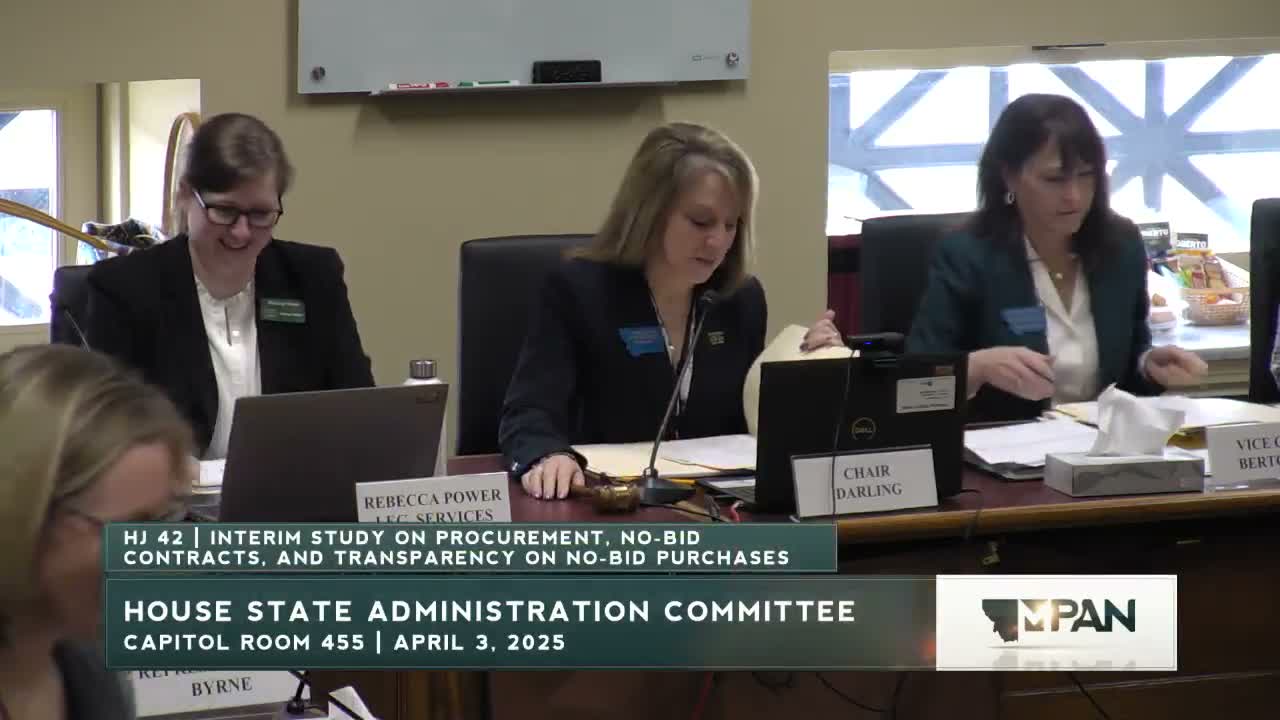
Montana committee hears HJ 42 to study state procurement after high-dollar exemption concern
Summary
Lawmakers heard sponsor Rep. Becky Edwards and agency witnesses on House Joint Resolution 42, an interim study of state procurement rules, transparency and delegated contracts after testimony that a near-$50 million lottery contract was briefly exempted from competitive procurement.
Representative Becky Edwards opened the hearing on House Joint Resolution 42, saying the interim study would direct legislative counsel to form an interim committee to examine administrative rules, policies and procedures used by state agencies under the Montana Procurement Act and to develop recommendations to reduce deviations from the procurement law.
"This bill directs legislative counsel to designate an interim committee to review the administrative rules, policies, and procedures state agencies use during the procurement process," Edwards said in her opening remarks. The sponsor told the committee the study would include an accounting of money paid to vendors outside the standard procurement process and options to standardize and centralize contracts.
Proponents told the committee the review is needed. Attorney and lobbyist John Metropoulos cited a recent amendment that briefly exempted the state lottery vendor contract from the procurement system, jeopardizing a roughly $50,000,000 contract and said, "I support this wholeheartedly." Nonprofit and small-business groups said clearer, consistent procurement practices affect their ability to compete for state contracts and deliver services.
Informational witnesses from the Department of Administration — Director Misty Anne Giles and Division Administrator John Thomas — described the current transparency tools and the practical limits of DOA's reach. Thomas said the state posts contracts and solicitations on the state's transparency website and that DOA delegates contracting authority to agencies; "Not everything lives in our e procurement system," he said. Giles stressed volume: she told the committee that, in one-year snapshots, there are on average more than 4,200 contracts in the $25,000–$150,000 range and warned that a four-year review at a $25,000 threshold would be "voluminous" and might require a fiscal note.
Committee members sought clarity on definitions and process. Representatives asked who would define "waste, fraud and abuse" for the study; DOA witnesses said statutory rules and the state's internal audit and hotline processes are triggers for executive-branch determinations, but the committee or legislative council would set committee parameters for a legislative study. DOA also described compliance review procedures and the agency's authority to revoke procurement authority for noncompliance.
The hearing closed with the sponsor urging the committee to pass the study resolution. The committee did not take final action on HJ 42 at the hearing; staff and members discussed the likely interim committee assignment and the resources a full four-year, $25,000 threshold review would demand.