Get Full Government Meeting Transcripts, Videos, & Alerts Forever!
Get email alerts on the Youth Behavioral Health topic
No spam. Unsubscribe anytime.
Worcester nonprofit Choices outlines youth behavioral‑health services and use of Uxbridge opioid‑abatement match
Summary
Choices founder Billy Beers told the Uxbridge Board of Health that a new partial‑hospitalization pathway in partnership with UMass is rapidly filling and that Choices used a $150,000 RISE match to leverage opioid‑abatement funds for adolescent services in the Blackstone Valley.
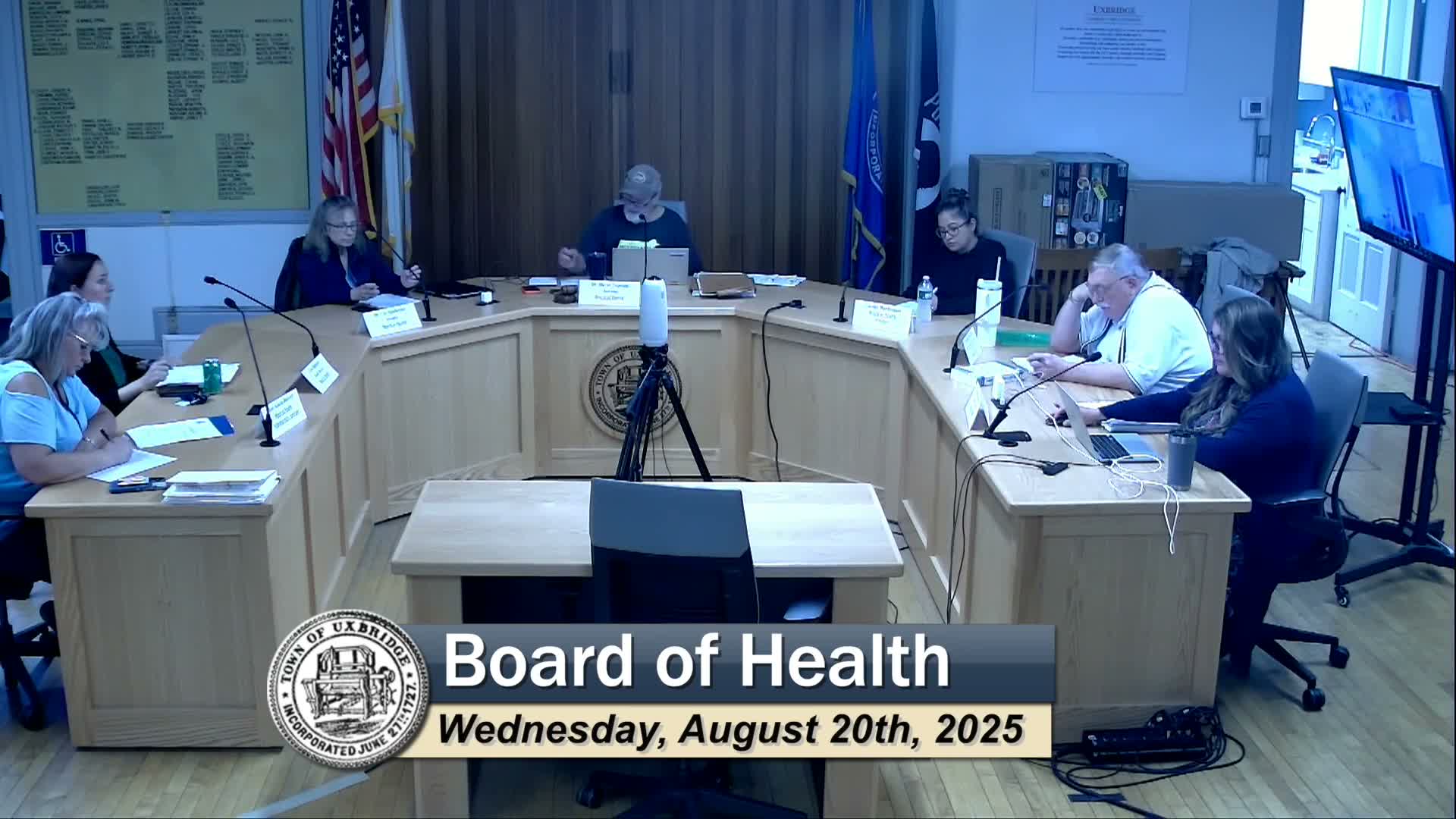
The Uxbridge Board of Health on Aug. 20 heard from Billy Beers, founder of Worcester‑based nonprofit Choices, about an expanding program the organization says is designed to treat adolescents with substance‑use and co‑occurring mental‑health needs.
Beers described a stepped continuum that begins with partial hospitalization (PHP), moves to intensive outpatient (IOP) treatment and adds in‑home behavior services, after‑school peer supports and educational alternatives including a recovery high‑school option. “Our partial hospitalization program right now has a max of 14 kids,” Beers said, adding that the program reached 10 enrollments within three weeks and will soon create a waiting list unless capacity expands.
Beers told the board Choices has aligned medically with UMass hospitals, which will “act as our medical arm” and support medication‑assisted treatment and emergency coordination when needed. He said Choices secured the RISE grant that provided a $150,000 local match for Uxbridge opioid‑abatement funds and that those dollars will be used for youth access to care, transportation, and staff deployment across the Blackstone Valley.
Board members asked about eligibility and referrals. Beers said referrals typically come from primary‑care providers or a court diversion process the group operates, and that services are not limited to substance use: “It could be mental health, it could be suicidal,” he said, adding that Choices screens new clients with standardized assessments (SBIRT plus depression and anxiety measures) and provides special‑education supports while clients are in the program.
Beers also described operational constraints: staffing and funding limit PHP capacity, and Choices is preparing to scale to a larger facility through the UMass partnership that could serve many more youths. He urged municipal collaboration with police, schools and emergency departments so that first responders and school staff know how to refer youths into the Choices intake pathway.
The board expressed support and asked staff to help connect Choices with local schools, community health workers and outreach channels so families and first responders are aware of the program and referral mechanisms.
The board did not take a formal funding vote at this meeting; Beers said he would circulate electronic materials and contact information for follow‑up.