Get Full Government Meeting Transcripts, Videos, & Alerts Forever!
Get email alerts on the Housing topic
No spam. Unsubscribe anytime.
Montana committee hears split testimony on SB 243 allowing six‑story buildings in commercial zones
Summary
Supporters said SB 243 would add predictable rules for developers and help add housing in urban commercial centers; opponents warned a statewide six‑story floor would strip local zoning tools, risk neighborhood transitions and may not produce affordable units without linked requirements.
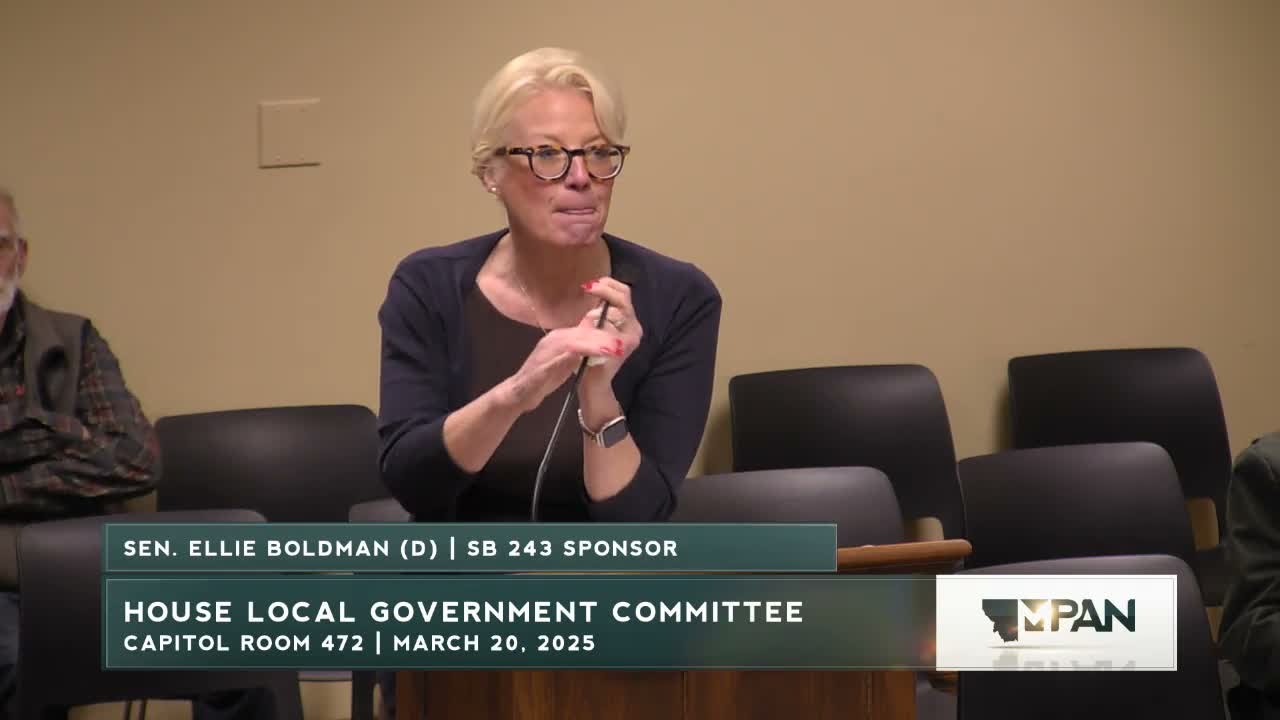
Senator Ellie Boldman, sponsor of Senate Bill 243, told the House Local Government Committee the measure would allow taller buildings — up to six stories by right — in defined urban commercial zones to promote predictability for developers and support "smart growth." "This bill passed 47 to 3 in the Senate," Boldman said, arguing the change builds on last session's reforms and on recommendations from the governor's housing task force.
Proponents told the committee taller commercial‑zone limits could increase housing supply. Jake Brown of Shelter Whitefish said SB 243 would let widely used building types, such as the 5‑over‑1 design (ground‑floor commercial with apartments above), be built more easily and “reduce the per‑unit land cost.” Tanner Avery of the Frontier Institute said the bill "does not mandate taller buildings; it allows for them if there's demand." Sage Bennett of For Montana and Missoula City Councilor Sandra Vazeka also urged passage, saying the measure would expand multifamily options in population centers.
Opponents argued the bill is overbroad and would erode local control. Kelly Lynch, executive director of the Montana League of Cities and Towns, cautioned that the statutory term "commercial" covers many zone types beyond dense downtowns — including neighborhood commercial — and that a uniform six‑story floor could force inappropriate outcomes in those areas. David Fine, economic development manager for the City of Bozeman, testified that taller buildings often raise land values and that construction costs jump at five and six stories because of structural and fire‑safety requirements; he said without affordability mandates, extra height alone is unlikely to lower unit costs.
Resident testimony highlighted local effects. Lisonbee Sweeney, a Bozeman resident, told the committee her city built substantial new housing in the past decade but remains unaffordable, arguing investor‑targeted 5–6 story projects had not reduced rents.
Committee members pressed witnesses on whether height increases alone produce affordable housing and asked about local examples including Bozeman and Kalispell. Witnesses and the sponsor agreed outcomes vary by market; several committee members asked whether the bill could be amended to include affordability components. Boldman said she was open to amendments and described the measure as setting a reasonable floor for urban commercial areas while preserving local design guidance. The committee closed the hearing on SB 243 and moved on to subsequent bills.