Get Full Government Meeting Transcripts, Videos, & Alerts Forever!
Get email alerts on the Traffic Safety topic
No spam. Unsubscribe anytime.
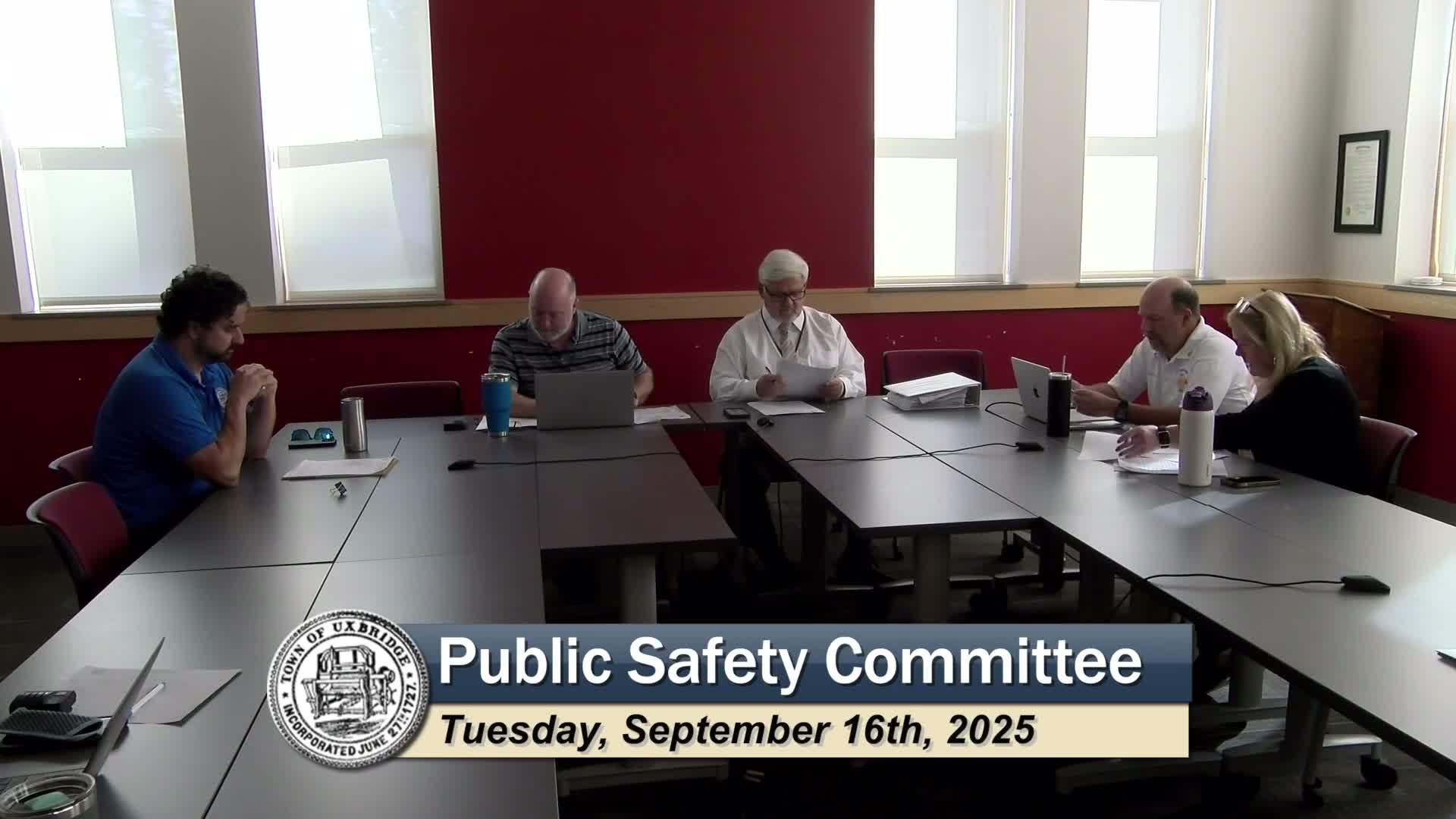
Uxbridge board reviews neighborhood safety issues, seeks data before major changes
Summary
Select board members reviewed multiple resident complaints about sight lines, skewed intersections and delivery-driver cut-throughs and asked staff to collect crash data, prepare marking sketches and combine site visits before pursuing major changes.
Select board members in the Town of Uxbridge spent much of the meeting weighing neighborhood traffic and intersection safety concerns, emphasizing data collection and low-impact fixes before any structural changes.
Several residents’ complaints were discussed, including delivery drivers cutting the corner at the Teresa Drive/Rockmeadow extension and sight‑distance problems at the West Hartford/Rivulet and Lynnwood/Granite intersections. Speaker 1 said the Teresa Drive problem “is not a speed issue” but noted drivers unfamiliar with the area may be surprised by geometry. Speaker 3 said staff will pull historical crash data from the past five to six years to determine whether engineering changes are warranted.
On geometry at skewed intersections, participants repeatedly noted that the shape of New England roads and existing stop‑bar placement limit sight lines. Speaker 4 cautioned that simply relocating a stop sign could “go right back to people getting crushed” at adjacent approaches and urged careful study before removing or adding stop controls.
For the specific Hazel Street and Crossroad complaint, Speaker 1 described a resident’s request for a stop sign to address restricted sight distance when making left turns. Speakers 3 and 4 said the location likely would not meet stop‑warrant criteria and recommended vegetation trimming, pavement markings or signing as first steps. The group agreed to produce a sketch of potential pavement markings and review options on site before advancing a formal engineering change.
Participants also discussed traffic‑calming alternatives including painted “stop ahead” legends, dashed centerlines and gradual speed tables; Speaker 2 noted such measures must balance plowing and emergency‑vehicle needs. Several speakers emphasized that any permanent pavement marking or stop‑control changes would require broader stakeholder input and likely a traffic study during the next budget cycle.
The meeting concluded with staff commitments to collect crash data, develop marking sketches for the affected intersections and combine site visits so stakeholders can evaluate proposed mitigations in the field.