Get Full Government Meeting Transcripts, Videos, & Alerts Forever!
Get email alerts on the Security topic
No spam. Unsubscribe anytime.
Capitol Commission explores drone detection tools and legal limits on enforcement
Summary
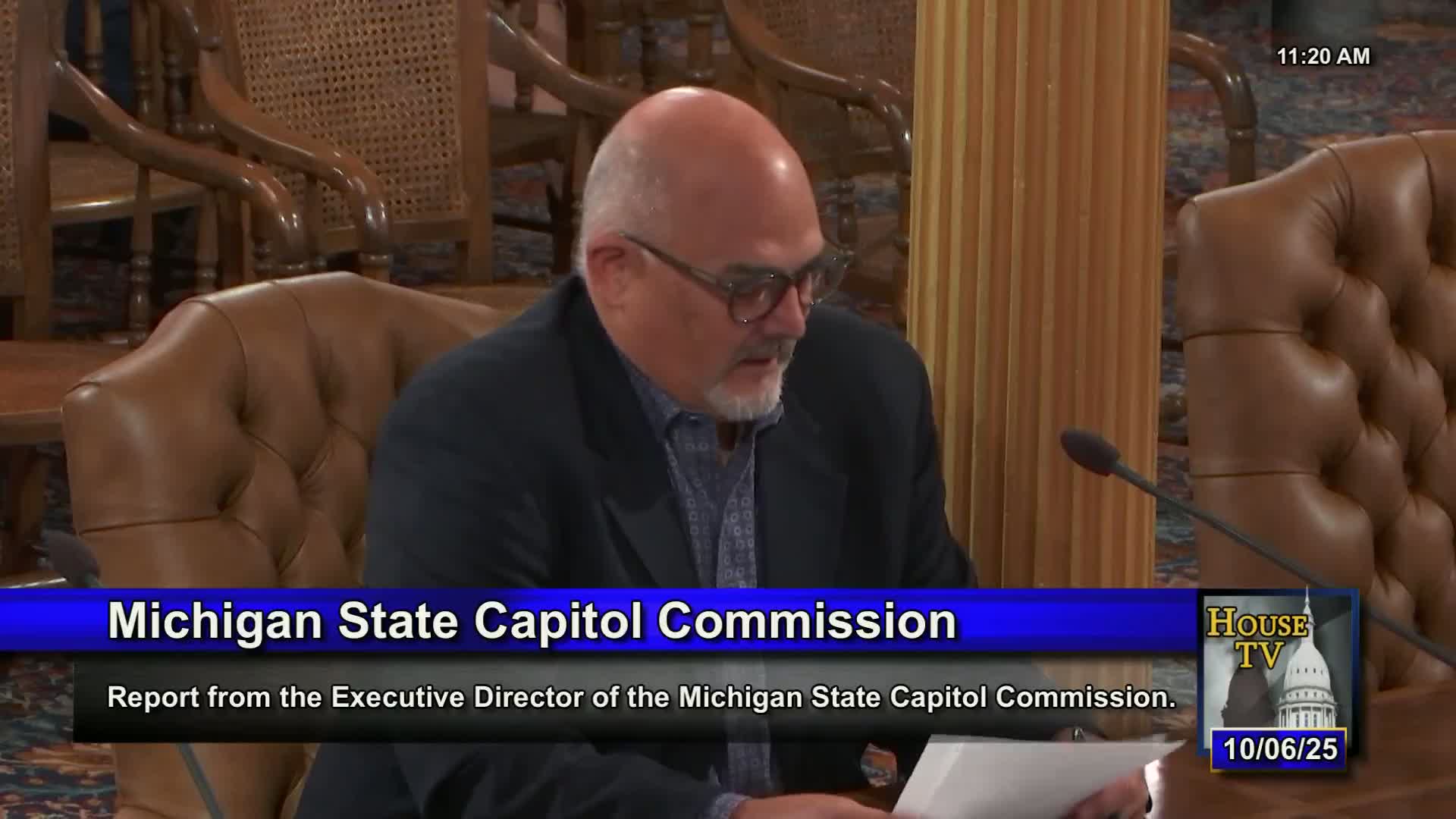
Executive Director Rob Blackshaw briefed the commission on drone risks and a demonstration with Airspace Link; he said current enforcement rests with the FAA and FBI and staff will meet Michigan State Police and Chair Candler to evaluate detection tools and next steps, while State Rep. Bill Brock is reportedly working on legislation.
The Capitol Commission spent a substantive portion of its meeting on drone detection and how the building should respond to increasing unmanned aircraft activity.
"This next topic I wanna spend a little bit of time on, and it's about drone education and drone detection," Executive Director Rob Blackshaw said, outlining questions about permitted airspace, delivery landing zones, and drone use during rallies.
Blackshaw described meeting with Airspace Link, a company that demonstrates software to track drone flight paths and, he said, can trace flights back to pilot locations. "They've created a software system that tracks the flight of all drones in an area that illustrates a drone flight path and even tracks it back to where the drone pilot is located," he said, and said he is arranging a demonstration for Michigan State Police and Chair Candler.
On legal authority, Blackshaw cautioned the commission that enforcement options are limited. "Our policies and procedures are in place where we can't even enforce the use of drones in our airspace because the FAA monitors the the drone flights, but it's the FBI who is their enforcement arm," he said. He added that classification of the Michigan State Capitol as critical infrastructure could enable measures such as geofencing, but that would require legal and interagency steps.
Commissioner Bauer questioned the practical scope of enforcement: "So, I guess I would have assumed that above our capital would have been a no fly zone for drones." Blackshaw answered that while staff deny many requests to fly over rallies, there is no internal enforcement arm and the commission needs legislation or agreements with law enforcement to gain stronger authority.
Blackshaw said State Representative Bill Brock is "already starting to work on legislation that'll address a lot of these questions," and that staff will return with findings and recommendations after the demonstration with Airspace Link and consultation with Michigan State Police.
No formal policy changes or binding agreements were adopted during the meeting; the discussion concluded with direction to continue exploring technical and legal options.