Get Full Government Meeting Transcripts, Videos, & Alerts Forever!
Get email alerts on the Land Use topic
No spam. Unsubscribe anytime.
Committee hears bill to move RV and mobile‑home park review into 'buildings for lease or rent' process
Summary
Sen. Forrest Mandeville told the Senate Local Government Committee SB 174 would shift review of RV and mobile‑home parks from subdivision law into the buildings‑for‑lease‑or‑rent (BLR) statute to streamline permitting while leaving zoning authority intact; proponents said it could help affordable housing, and county officials asked for clarifying amendments to protect public participation and growth‑policy alignment.
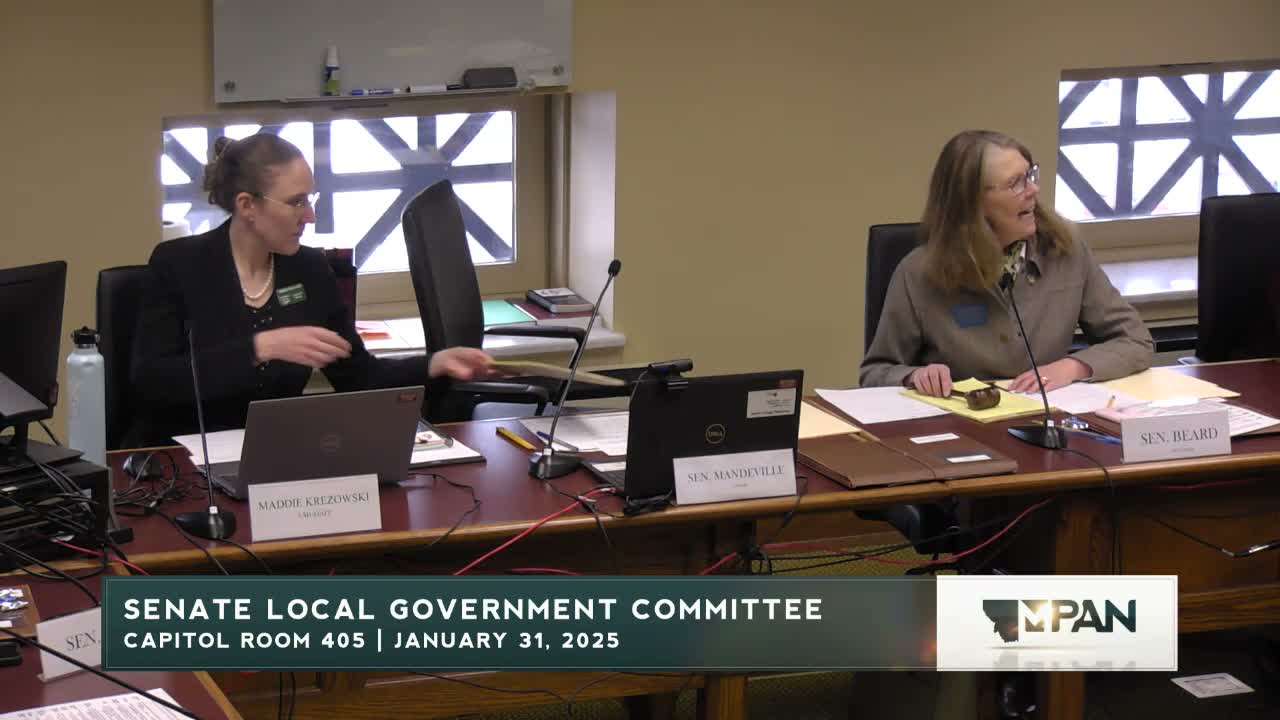
Senator Forrest Mandeville, sponsor of Senate Bill 174, told the Senate Local Government Committee the bill would move review of recreational‑vehicle parks and mobile‑home parks out of the subdivision framework and into the state’s buildings‑for‑lease‑or‑rent (BLR) statute to simplify review while preserving local zoning oversight. "BLR is subject to zoning," Mandeville said, meaning local zoning would continue to govern where such developments are allowed.
Proponents including Daniel Cox of the Montana Association of Realtors and Jake Brown of Shelter Whitefish told the committee they support the change. Cox said the measure will streamline approvals for property owners and developers; Brown and online proponent John Sinrud argued the change could encourage new mobile‑home parks and lower lot rents, which they described as an affordable housing tool for households at risk of homelessness.
Karen Alley, associate general counsel for the Montana Association of Counties (MACo), expressed "soft opposition" and urged clarifying amendments. Alley said the bill, as drafted, reads as if it applies to buildings, not the creation of spaces with hookups—an important distinction for mobile‑home and RV parks. She recommended adding explicit language that the statute cover multiple spaces for lease or rent under single ownership and suggested adding statutory cross‑references and a requirement that BLR procedures be consistent with county growth policies so local public scrutiny and participation are preserved.
Aaron Wilson, president of the Montana Association of Planners, and Kelly Lynch of the Montana League of Cities and Towns also urged limited clarifications but said they broadly support the bill’s intent to match the level of review to the type of development. Lynch gave historical context: BLR was created circa 2009 as a lighter‑touch alternative for counties that could not adopt traditional zoning; RVs had initially been excluded during the Bakken energy boom.
During committee questions, members sought to clarify when the BLR path would apply if lots or spaces were later subdivided or sold. Mandeville said the 2023 land‑use planning act addresses those transitions and that any subsequent division of lots would become subject to standard subdivision or zoning review. He told the committee he was open to narrow amendments to clarify definitions and process, adding that he wanted to "keep it simple" in drafting.
The hearing closed without a committee vote. Committee members signaled interest in technical amendments that would explicitly cover the creation of leaseable spaces, ensure notice and public participation, and reference the growth policy; the sponsor indicated he is willing to work on those clarifications before further action.
Next steps: the committee recorded the hearing and invited any proposed amendments; no final action was taken on SB 174 at this session.