Get Full Government Meeting Transcripts, Videos, & Alerts Forever!
Get email alerts on the Judicial District Reconfiguration topic
No spam. Unsubscribe anytime.
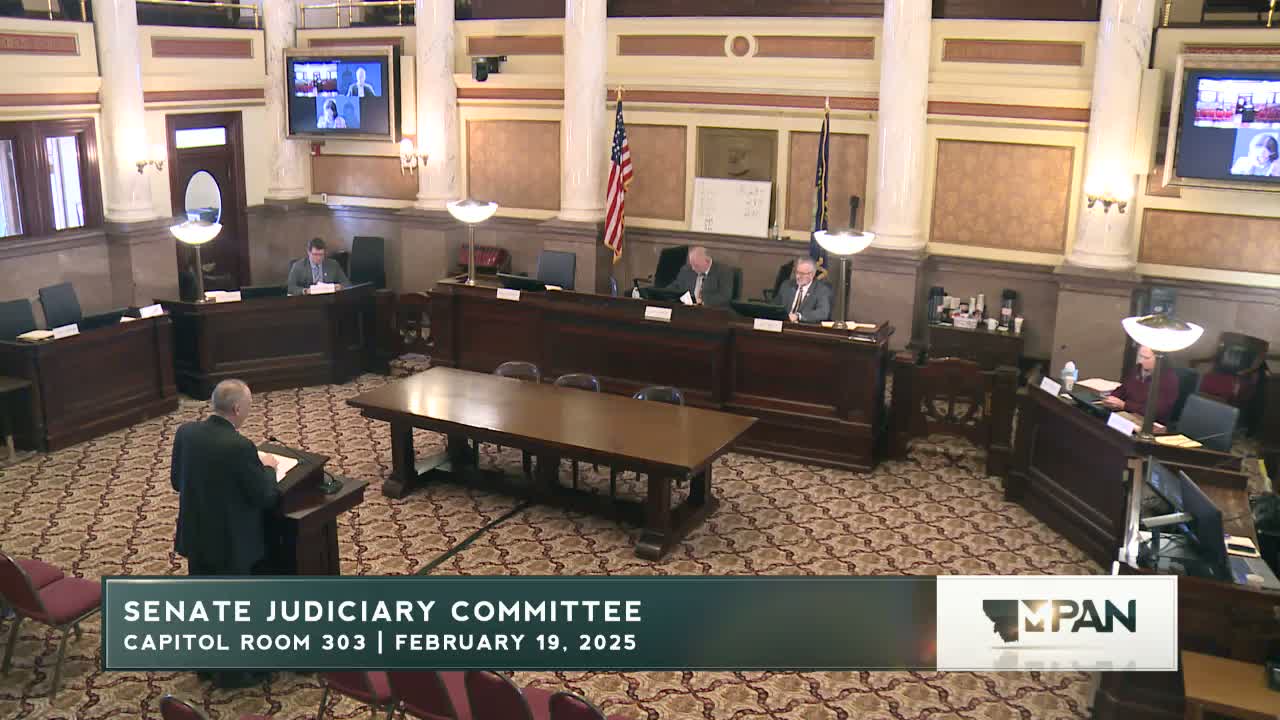
Montana Senate Judiciary hears proposal to move district judge to Yellowstone County; local clerks and lawyers urge study
Summary
Sponsor introduced a plan to reassign one judicial position to Yellowstone County to help Billings; the State Bar, county clerks and local residents warned the change could burden six rural counties and urged a comprehensive study rather than an immediate reassignment.
An unidentified sponsor opened the Senate Judiciary hearing on Senate Bill 284 by saying the bill would reallocate judgeships based on a judicial workload study and would transfer a position to Yellowstone County to address a shortage in Billings.
The sponsor said the court-administrator study shows a combined judge demand of about 1.1 judges across the Tenth and Fourteenth Judicial Districts and described the measure as “low hanging fruit” intended to move one judge where caseloads are highest. The sponsor acknowledged drafting errors in the bill that would renumber districts and said an amendment would be needed to ‘‘reserve’’ one district slot rather than renumber existing courts.
Opponents told the committee the bill's approach is premature and could harm rural access to justice. Bruce Spencer, representing the State Bar of Montana and the Montana Judges Association, said the courts should reexamine district boundaries in a deliberative way rather than combine multiple counties without a full study. "That one judge is gonna have to travel tremendous distances," Spencer said, warning that litigants in the affected six counties may not be able to see a judge face to face.
Cynthia Neste, clerk of district court for Sanders County, speaking for the Montana Association of Clerks of District Court, described a "soft opposition" position and flagged an apparent drafting error that would shift judge counts and require costly changes to documents and seals. "The proposed amendment would keep the Fourteenth District reserved, ensuring that no districts need to be renamed," she told the committee.
Several residents and local officials also opposed the bill. John Marshall, a Sanders County resident, argued that reducing a district to a single judge fails to account for periods when a judge may be on medical or parental leave. Ross Butcher, a Fergus County commissioner, said the current judge in District 10 is already overburdened and a single judge covering a large geography would not provide adequate justice.
Committee members questioned how the court administrator's prior studies (cited from 2012 or 2014) factored into the proposal and whether judges and county officials had been consulted; Bruce Spencer said the court administrator has produced workload reports and that a top-to-bottom review of judicial districts is under consideration but gave no timeline. The sponsor acknowledged that both affected judges had recently been reelected and said the bill would only take effect if one of those judges left office before the end of their term; the sponsor also said an amendment or a study-directed approach could be used instead.
No committee vote was held on SB 284 during the hearing. Chair Usher closed the bill's hearing after testimony and discussion. The committee staff and members indicated amendments and a potential study bill may follow.
What happens next: The hearing record for SB 284 was closed with no committee action; the sponsor and staff indicated an amendment is forthcoming and members discussed converting part of the proposal into a study directive for the judiciary.