Get Full Government Meeting Transcripts, Videos, & Alerts Forever!
Get email alerts on the Community Corrections topic
No spam. Unsubscribe anytime.
Montana committee advances bill allowing earned-time credits for probationers and parolees
Summary
The Senate Judiciary Committee advanced SB217 after proponents argued work-tied credits reduce recidivism; witnesses described verification and fiscal questions, and the sponsor said the proposal leaves verification to probation officers and can be amended by the committee.
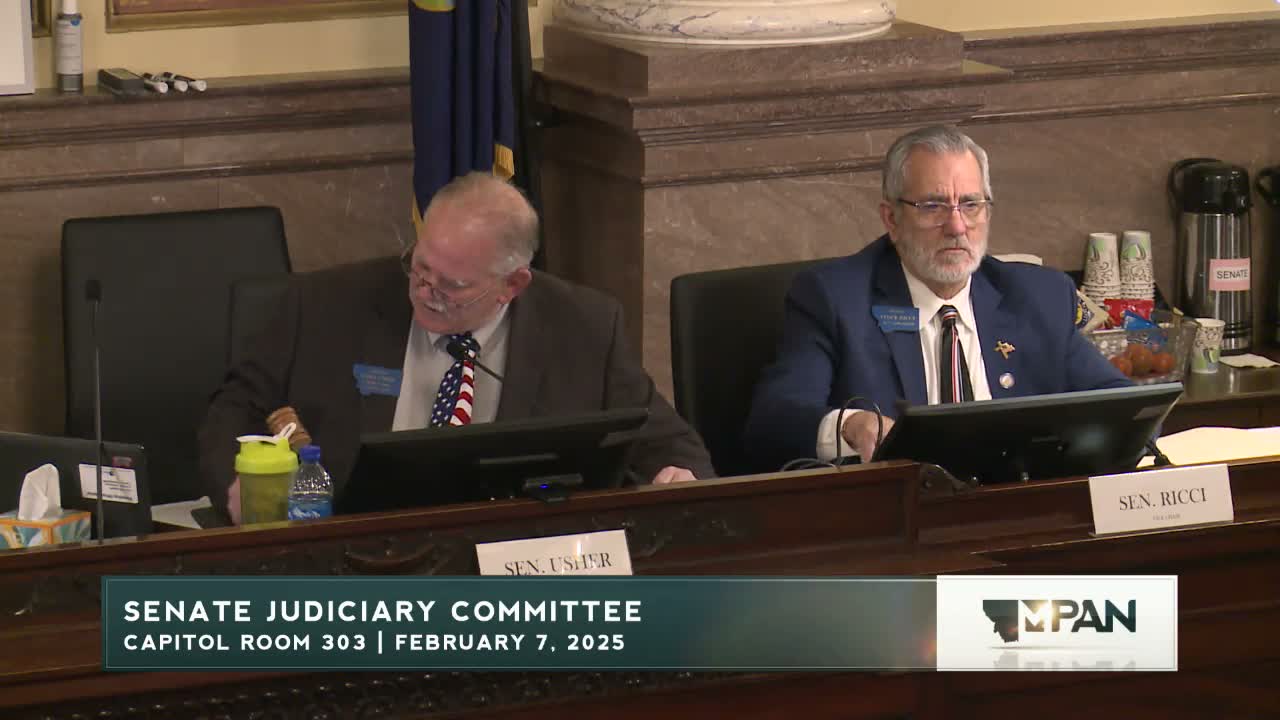
Senator Daniel Zolnickon, sponsor of SB217, told the Senate Judiciary Committee that the bill would allow people on probation or parole to earn time off supervision for verified employment, proposing one day of credit for each 40 hours of work completed. "The goal here is to incentivize...work," Zolnickon said in his opening remarks.
Proponents testified the policy promotes reentry and reduces revocations. Jacob Dupuis, a visiting fellow with the Cicero Institute, told the committee that employment is a strong predictor of desistance and cited studies and state comparisons, including Arizona and Kentucky, as examples of similar policies. Don Capes of the Coalition for Safety and Justice urged support, saying the bill "rewards 1 day of a sentence credit for every 40 hours worked" and that credits may be revoked after violations.
Informational witnesses from the Montana Department of Corrections and probation-and-parole leadership said the department currently verifies employment in some contexts but would need to adapt records and processes to implement SB217. Senators pressed witnesses about a fiscal note; witnesses said Arizona implemented a similar policy without a fiscal note while Kentucky noted two additional FTEs in its fiscal note. Department officials said they had withdrawn or delayed posting Montana's fiscal note while studying operational options and consulting other states.
Sponsor Zolnickon emphasized discretion and flexibility: the bill ties verification to the supervising officer and excludes certain categories (youth-court cases, lifetime supervision, and misdemeanor-only probation as drafted). He told the committee the 40-hours-for-1-day formula was intended to be a modest, reasonable incentive. "A week for a week, that's a little bit much," he said, explaining the committee could change the rate.
The committee did not divide the bill for amendment in that hearing stage and later advanced SB217 in executive action. Next steps include consideration of fiscal and implementation details in subsequent hearings and any amendments the committee chooses to adopt.