Get Full Government Meeting Transcripts, Videos, & Alerts Forever!
Get email alerts on the Health Regulation topic
No spam. Unsubscribe anytime.
Committee advances bill to explicitly ban sale of fetal tissue and whole bodies
Summary
The Senate Judiciary Committee voted to advance SB154, updating state law to prohibit sale or purchase of fetal tissue and whole bodies to align state code with the Uniform Anatomical Gift Act; proponents cited ethical and law‑enforcement concerns, opponents said federal law already prohibits commercial trade.
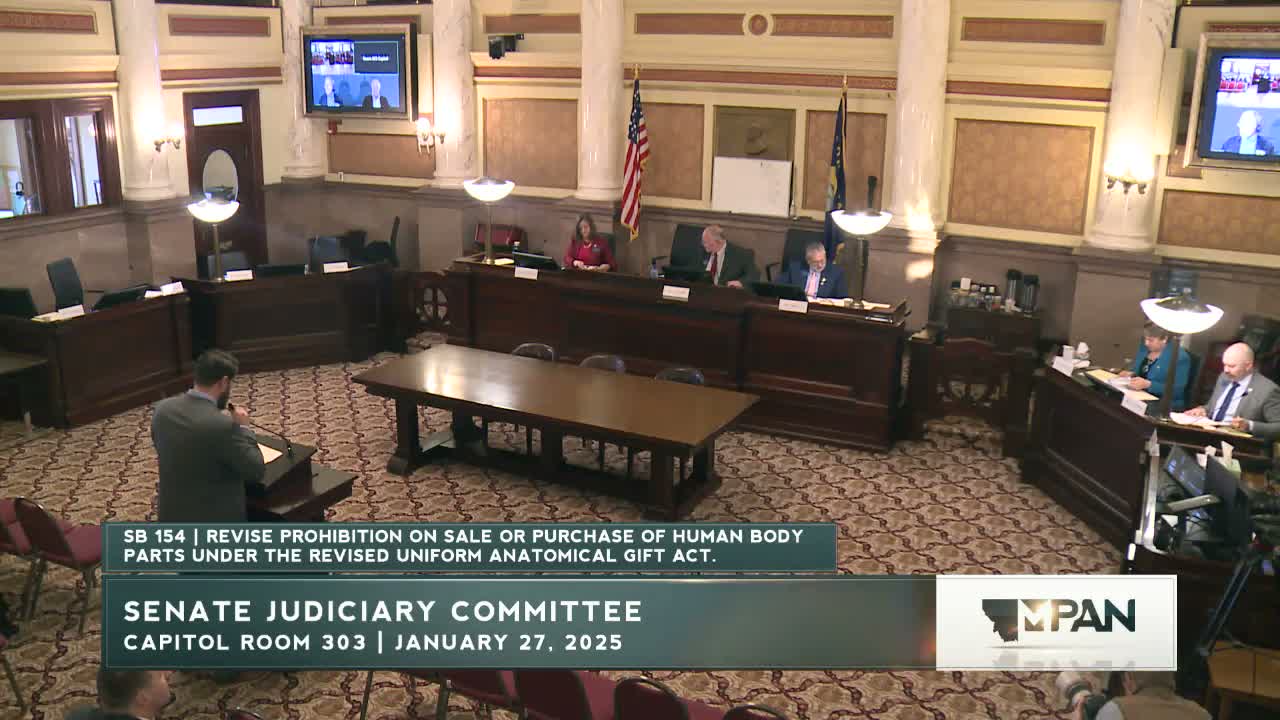
The Senate Judiciary Committee voted to advance SB154, a bill that revises state law to prohibit the sale or purchase of human fetal tissue and whole human bodies and to clarify how Montana’s statute aligns with the Uniform Anatomical Gift Act.
Sponsor said the bill tightens statutory language to prevent trafficking or commercial trade in fetal tissue or entire bodies while still allowing donation for research and educational uses. Derek Oestricher of the Montana Family Foundation urged passage, calling sale of fetal tissue "unethical" and warning of exploitative markets reported elsewhere. Don Cape (Coalition for Safety and Justice) told the committee the measure provides law enforcement tools to target organizations that profit from illicit procurement.
Quinn Leighton of Planned Parenthood Advocates of Montana opposed the bill, noting federal law (the Uniform Anatomical Gift Act) already governs sale and donation of tissue and arguing the state law is therefore unnecessary. An informational witness from LifeCenter Northwest, the organ procurement organization serving Montana, described how organ and tissue recovery is handled and confirmed federal frameworks govern procurement practices.
Committee members asked whether the state statute could affect activities in federal facilities or purchases crossing state lines; witnesses said state criminal jurisdiction applies within Montana but not to federal government operations. The bill’s sponsor said state clarification is needed so citizens and law enforcement understand what is allowed and prohibited.
The committee conducted a roll‑call vote and advanced SB154 (6 yes, 3 no). The sponsor and proponents characterized the measure as a clarification of state law intended to supplement federal protections and to provide explicit tools to address local abuses if they arise.