Get Full Government Meeting Transcripts, Videos, & Alerts Forever!
Get email alerts on the Night Vision Thermal Scopes topic
No spam. Unsubscribe anytime.
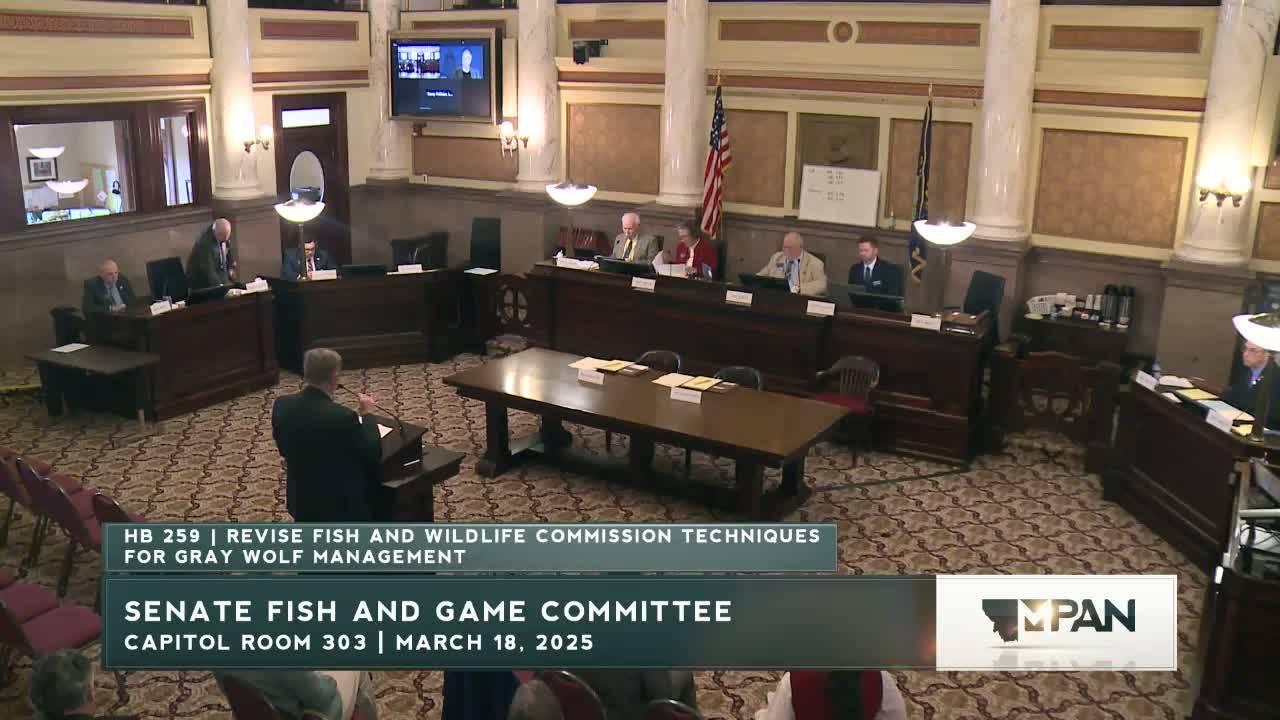
Lawmakers debate night-vision, thermal scopes for private-land wolf hunting in HB259 hearing
Summary
HB259 would explicitly allow infrared and thermal-imagery scopes for hunting wolves on private lands. Proponents framed it as a narrow 'cleanup' to protect landowners; opponents and several wildlife groups said it undermines fair chase and could lead to unlimited take and public-safety risks.
Representative Paul Fielder presented House Bill 259 as a technical clarification to state statute, saying a recent district court decision required explicit statutory language to include infrared and thermal-imagery scopes within "night vision". "Night vision" had been understood to include these devices, he said, and HB259 would put that understanding into the text.
Proponents including landowners and hunting organizations said the bill is limited to private land and helps ranchers and landowners protect livestock. Jeff Darragh, representing Montana Sportsman for Fish and Wildlife, described HB259 as a cleanup and said well-trained hunters and licensees could apply the tool responsibly to address depredation.
Opponents — conservation groups, outfitters, tourism businesses and tribal representatives — said the bill extends military-grade optics to wildlife killing, undermining longstanding fair-chase ethics. Multiple witnesses warned that private lands cover a large share of Montana and that allowing infrared and thermal imagery could be used by trophy hunters and drive negative publicity for Montana. The Gallatin Wildlife Association and others highlighted language changes that would replace "may" with "shall," warning that mandatory phrasing could force broad implementation and allow unlimited take under a single license.
Quentin Kudula of Fish, Wildlife and Parks appeared as an informational witness and described potential administrative effects; he explained how mandatory language could restrict commission discretion and affect license revenues that fund management activities.
During closing remarks, Representative Fielder said he would accept retaining the stronger "shall" wording in one place (line 21) while reverting the other change back to "may" (line 23) to address committee concern about unnecessary mandatory language.
The committee heard over an hour of testimony for and against the bill and closed the hearing without an immediate vote; members signaled concern about ethics, agency discretion and unintended consequences.
What happens next: The bill remains under committee consideration; sponsor offered to modify language to address concerns raised by opponents and agency staff.