Get Full Government Meeting Transcripts, Videos, & Alerts Forever!
Get email alerts on the Wolf Season Extension topic
No spam. Unsubscribe anytime.
Montana hearing on HB258 pits sportsmen seeking longer wolf hunts against tribes, conservationists
Summary
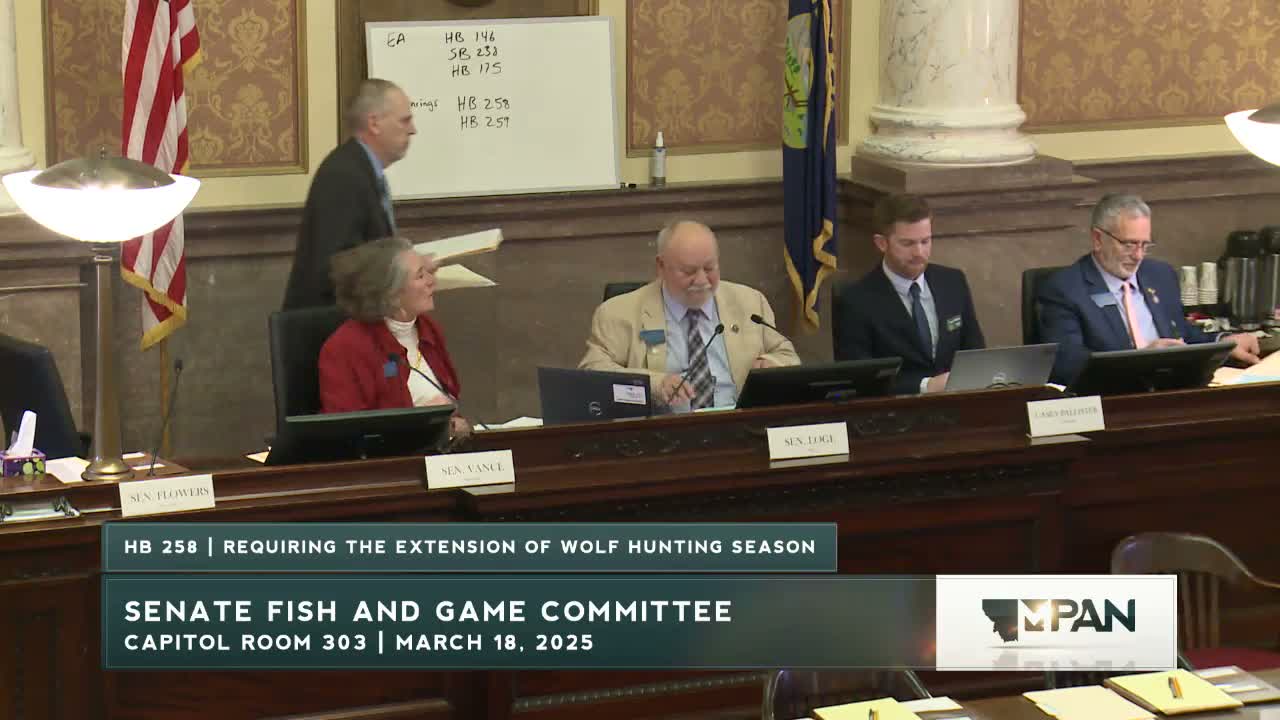
A packed Senate Fish, Wildlife and Parks hearing on HB258 drew hours of testimony. Sponsor Rep. Paul Fielder said the bill would let the commission align wolf hunting with spring bear seasons; opponents warned it would allow killing lactating females and pups, undermine population estimates and harm tourism.
Representative Paul Fielder, the bill sponsor, told the Senate Fish, Wildlife and Parks Committee that House Bill 258 restores longer, regionally adjusted wolf hunting seasons by directing that the commission authorize seasons that end in concurrence with the spring bear hunt. "We've got a wolf population in this state," Fielder said, arguing recent court decisions shortened trapping and left hunting as a primary tool.
The bill would remove a 15-mile buffer the House added around national parks and let the Fish, Wildlife and Parks (FWP) Commission set wolf season dates by management unit. Fielder cited the U.S. Fish and Wildlife Service delisting guidance and the 2003 Montana Wolf Management Plan to justify managing wolves by the state and said his aim is to "follow the science, not emotion."
Proponents, including hunting and outdoor-conservation groups, urged the committee to give the bill a due pass. Chris Killorn of SCI said extending hunting into the spring helps make up for a shortened trapping season; Jeff Darragh of Montana Sportsman for Fish and Wildlife told lawmakers the bill is a way to provide "another tool" for managing wolves in high-density areas.
Opponents gave lengthy testimony arguing the proposal risks unintended ecological and social consequences. Patrick Yawake, representing several tribal governments, said the bill "does not respect the natural order" and warned it could lead to slaughter of female wolves carrying pups. Doug Smith, a retired Yellowstone wildlife biologist, said wolves breed in mid-April and that a spring season would risk killing nursing females at a vulnerable time.
Quentin Kudula, chief of conservation policy for FWP, testified as the department's informational witness. He said the department uses an integrated patch-occupancy model (IPALM) for population estimates and that a spring hunt that kills lactating females or pups could produce undocumented pup mortality and reduce the model's effectiveness in the short term. Kudula told the committee the department "does not lightly offer opposition" but recommended a do-not-pass on HB258 because of the added risk to state management of wolves.
Committee members asked witnesses to clarify what specific population numbers mentioned in testimony represented. Doug Smith said historical recovery planning used expert opinion as a delisting trigger rather than a management target; Kudula said the department treats roughly 450 wolves as the minimum floor needed to maintain state management, while delisting guidance had called for different numeric triggers.
The committee closed the hearing without taking a final vote. Fielder said the bill responds to concerns raised by sportsmen in northwest Montana and other regions and framed it as a targeted management tool rather than a statewide eradication plan.
What happens next: The committee concluded the public testimony and moved the bill forward in the meeting schedule; no committee-level passage or roll-call outcome on HB258 was recorded during this hearing.