Get Full Government Meeting Transcripts, Videos, & Alerts Forever!
Get email alerts on the Wolf Management topic
No spam. Unsubscribe anytime.
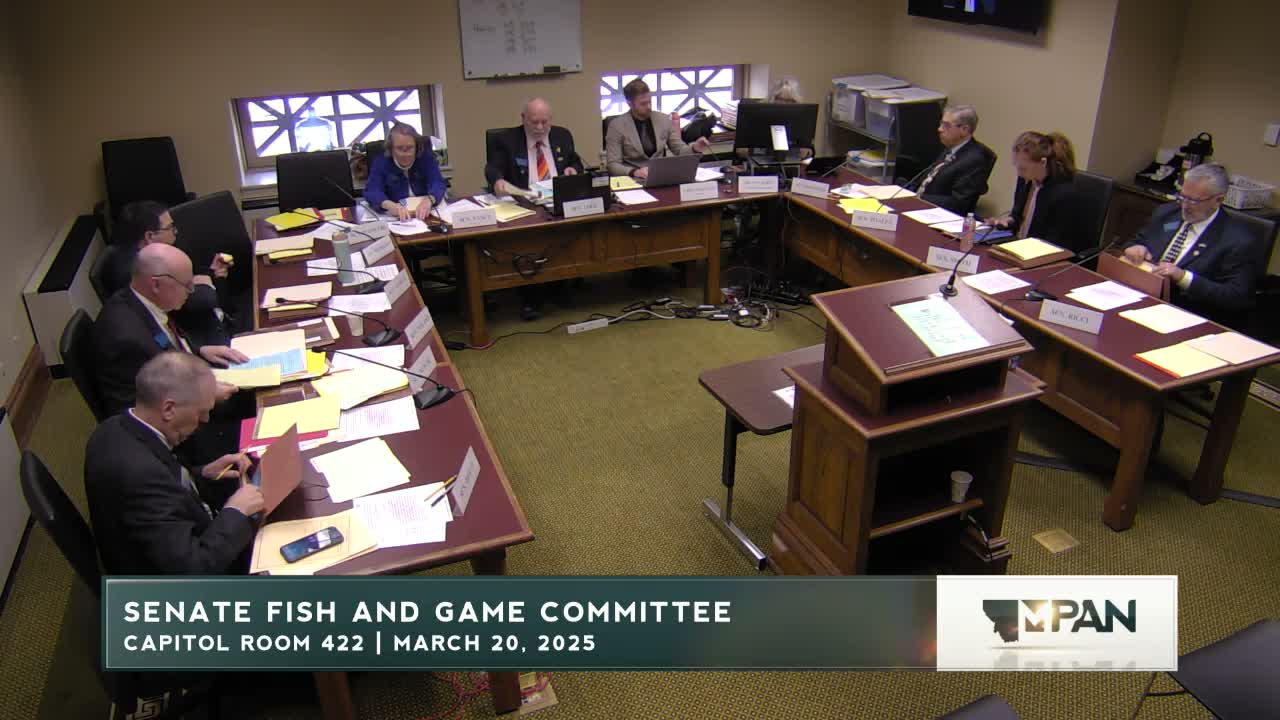
Senate Fish and Game Committee backs amended wolf-management bill, 8–4
Summary
The Senate Fish and Game Committee voted 8–4 to concur in an amended House Bill 176 allowing the Fish and Wildlife Commission greater authority to reduce wolf numbers and to authorize expanded management tools when statewide estimates hit statutory thresholds.
The Senate Fish and Game Committee voted to send House Bill 176 to the Senate floor after adopting an amendment that restores language granting the Fish and Wildlife Commission authority to set an unlimited statewide quota when the wolf population reaches 550 and to pursue expanded management tools.
Casey, committee staff, told members the bill would enable the commission to reduce the state’s wolf population toward a target of 450 and to authorize management practices including trapping or snaring more than one wolf, unlimited harvest by a single-license holder, use of bait and hunting outside daylight hours, while noting exceptions around Yellowstone National Park (Units 313 and 316 north).
Debate spotlighted divergent views about whether such statutory authority is necessary. Senator Ricky said he supported the bill but emphasized, “I don’t hate wolves,” and complained that Fish, Wildlife & Parks had not been managing depredations to residents’ satisfaction. Senator Flowers urged a no vote, arguing the state’s wolf population has been “stable or slightly declining over the last 10 years,” that depredations have decreased and that wolves provide economic and recreational value to the state.
Other senators described personal or regional concerns about depredation and rural impacts; several members warned that aggressive state management could invite federal relisting if done incorrectly. After the amendment passed, the committee took a roll-call vote on the amended bill and recorded an 8–4 concurrence. The bill will proceed to the Senate floor for further consideration.
The committee’s action included the amendment (3.001) that restored original commission-authority language and explicitly preserved geographic exceptions near Yellowstone.