Get Full Government Meeting Transcripts, Videos, & Alerts Forever!
Get email alerts on the Data Center Ordinance topic
No spam. Unsubscribe anytime.
Coweta County seeks tight zoning and utility safeguards in draft data‑center ordinance; staff told to refine definitions, water and power language
Summary
Commissioners directed staff to revise the draft data center ordinance to exclude crypto mining, treat data centers as conditional uses in LM (campuses permitted in M), require community meetings for rezonings, require environmental pre‑assessments, favor closed‑ or hybrid‑loop cooling over open‑loop, and to work with utilities on 'will‑serve' verification and utility capacity language.
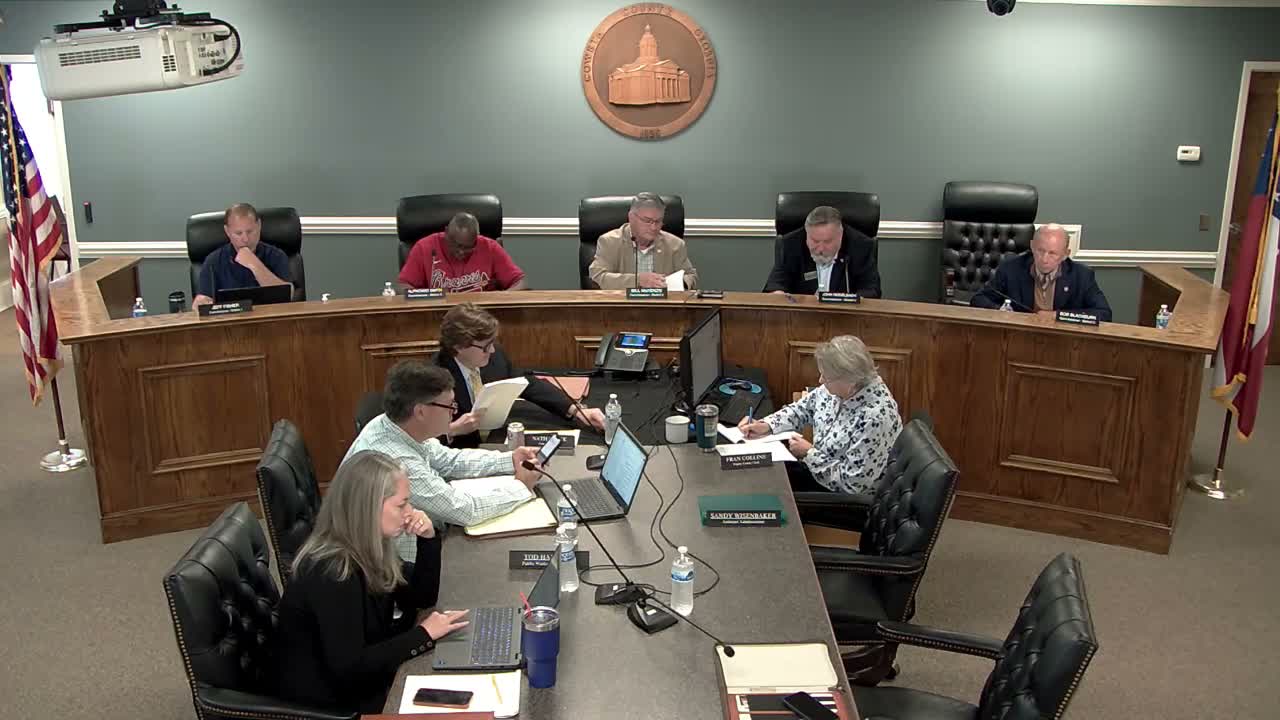
Coweta County commissioners spent the bulk of the meeting reviewing a detailed draft data center ordinance, asking staff to tighten definitions and siting conditions and to work with utility partners and emergency services before the next draft.
Staff (Mister Fouts) recapped the process: the county enacted a moratorium in May that expires in early November, ran multiple public hearings and collected extensive public feedback via a website and written comments. He framed several foundational questions for the board: whether to explicitly exclude cryptocurrency mining, how to define the size/scale of a data center or campus, whether data centers should be allowed by right or require conditional use approval in light industrial (LM) or heavy industrial (M) zoning, and how to address utilities, water use and decommissioning.
On definitions and scale, commissioners agreed they want cryptocurrency mining excluded from the ordinance’s data‑center definition. Staff presented one example threshold — single buildings up to 500,000 square feet and below 50 megawatts — but the board expressed concern that power figures are variable and could require repeated amendments. Multiple commissioners favored removing the power metric and relying on building footprint and zoning district to differentiate small, medium and large facilities.
Zoning and public engagement: commissioners generally directed that a data center be treated as a conditional use in LM (so the board may impose site‑specific conditions) while a data‑center campus could be a permitted use in M if the property already meets heavy‑industrial standards. Commissioners also favored requiring developer‑led community meetings before public hearings for rezonings and for LM conditional‑use requests, and they agreed rezonings should trigger community outreach in all cases.
Utilities and water: county and investor‑owned utility representatives explained practical limits to what commercial providers will disclose (proprietary commercial terms), but said they can provide letters of availability and conduct system studies. Georgia Power’s representative explained that infrastructure costs for loads above 100 MW are allocated to the commercial customer (per recent PSC guidance). The county water authority (Jay Born) and its CFO (Roger Dawson) explained the long lead times and capital costs to expand treatment and transmission capacity (examples cited include Chattahoochee intake and BT Brown improvements). Commissioners debated cooling systems (open/hybrid/closed loop); several favored prohibiting open‑loop cooling or otherwise limiting high‑water methods, while the water authority cautioned that limiting industrial users shifts infrastructure costs to ratepayers and that will‑serve letters are the standard method to confirm serviceability.
Environmental and safety: commissioners asked staff to require pre‑application environmental assessments and to work with state EPD permitting for air quality; one commissioner suggested requiring stricter generator testing standards (EPA Tier 3 rather than a Tier 2 default), and staff said it will research enforceability. The fire chief described ongoing planning for large structures, mutual aid, suppression systems and access requirements and recommended applicants be required to meet fire protection standards and, when appropriate, to contribute to needed apparatus or training as zoning conditions.
Decommissioning and surety: board members supported requiring decommissioning plans and financial surety (bond or similar) for rezonings that convert rural/ag properties to industrial uses so that future site remediation is funded if a data center ceases operation.
Next steps: staff will draft revisions that reflect today's direction — excluding crypto mining, relying on footprint/zoning rather than a strict power cap, requiring community meetings for rezonings/LM conditional uses, proposing closed/hybrid cooling restrictions with clear thresholds, adding pre‑application environmental reviews, and coordinating with utilities and the water authority on will‑serve language — and return with a revised ordinance for further board consideration. The meeting concluded with a motion and second to adjourn that passed unanimously.