Get Full Government Meeting Transcripts, Videos, & Alerts Forever!
Get email alerts on the Judiciary topic
No spam. Unsubscribe anytime.
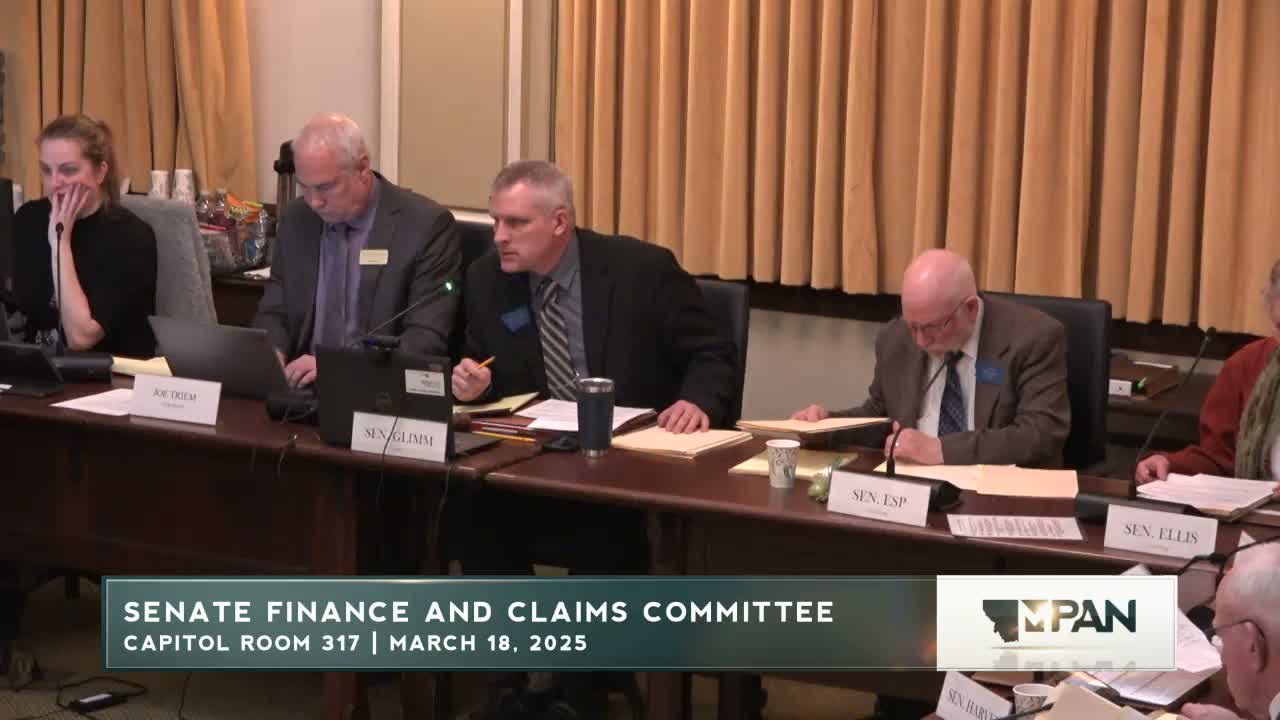
Senate committee hears fiscal debate over proposal to create Montana government claims court
Summary
Senators and witnesses sparred over SB385which would create a three-judge government claims court based in Helena; proponents say it will ease district-court workloads and save money long-term, while opponents question a costly fiscal note, a 20% pay premium for judges and potential constitutional issues.
Senator Tom McGillivray introduced Senate Bill 385, which would establish a government claims court with three appointed judges based in Helena and a three-judge panel for en banc appeals, and asked the Finance and Claims Committee to consider the fiscal note accompanying the bill. "Senate bill 385 sets up a government claims court," McGillivray said, outlining an initial year cost of about $1 million and higher recurring costs in year two.
Proponents and some legal advocates told the committee the new court would function as a specialty forum for complex constitutional and government-claims litigation, potentially freeing district courts to prioritize family law, criminal and dependency cases. Derek (recorded as Derek A. Oestreicher) of the Montana Family Foundation called the court a "pressure release valve" for overworked district judges and argued the state could see cost savings over time by moving certain complex civil litigation out of the general trial docket.
But most testimony focused on the fiscal note and structure. Opponents, including Anne Sherwood of Friends of the Third Branch, criticized the salary assumptions and implementation costs. "These judges are going to be some of the most highly paid employees in state government," Sherwood said, noting the fiscal note assumes judges would be paid 20% more than Montana Supreme Court associate justices and that a bespoke e-filing system and underestimated jury costs are not sufficiently justified.
Several witnesses raised constitutional and practical concerns. Heather O'Loughlin of the Montana Budget and Policy Center and other opponents said the fiscal note omits likely costs—traveling the court to other counties during session, jury-administration systems, and litigation expenses if the court's structure is challenged. Attorneys and Libby-area residents urged removal of asbestos claims from the bill, saying the Libby asbestos court is functioning locally and a transfer could impose travel burdens and unnecessary expense.
Judicial-branch staff told the committee many caseload elements remain uncertain because the court concept is new and case volumes for categories such as asbestos, constitutional and business claims are hard to project. Court administrator Dave McAlpin said the fiscal note uses conservative estimates but acknowledged key assumptions—including caseload and appellate workflow—are speculative.
Senators pressed the sponsor on the 20% pay premium and asked for concrete caseload and Yellowstone County impacts. McGillivray told the panel he sought specialized judges and that pay was designed to attract practitioners in technical fields; he also said he intended to remove the asbestos jurisdiction in later action to address Libby-area concerns.
The committee heard extensive public testimony and technical questions but took no vote on SB385; the hearing closed after committee members debated fiscal assumptions and constitutional questions. The sponsor signaled willingness to amend the bill's asbestos provisions before it moves further in the process.