Get Full Government Meeting Transcripts, Videos, & Alerts Forever!
Get email alerts on the Ethics Investigation topic
No spam. Unsubscribe anytime.
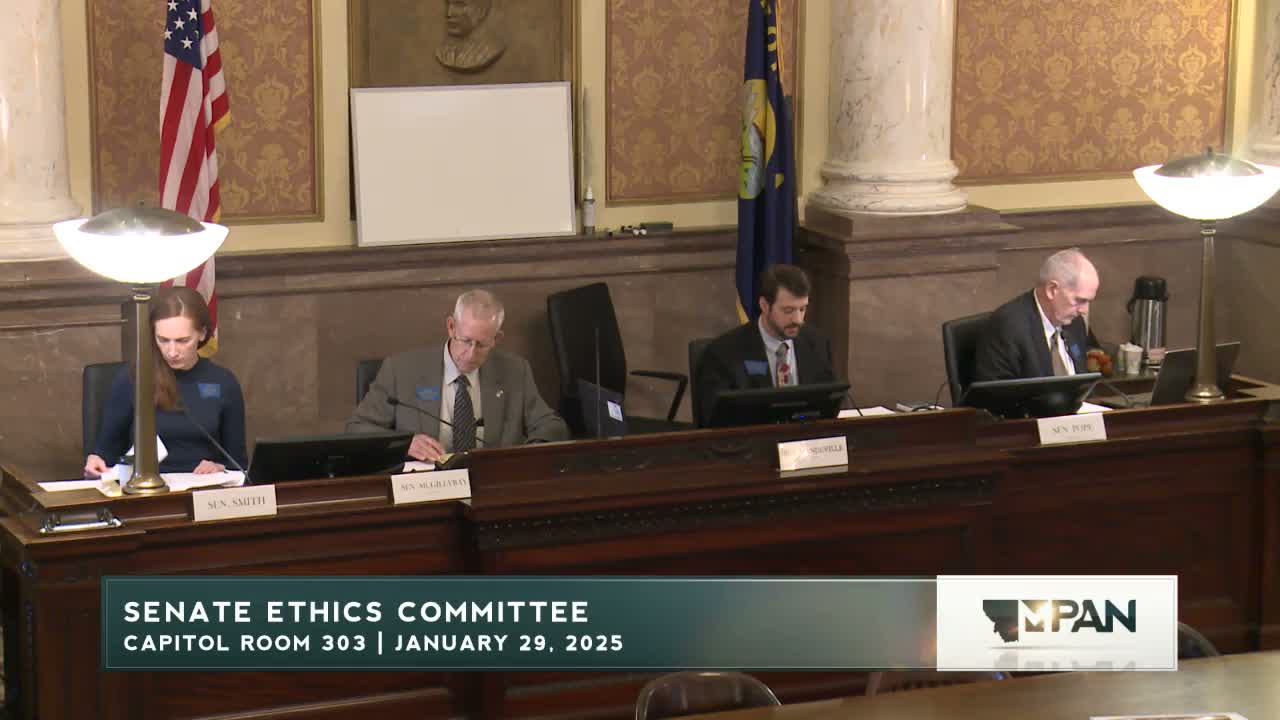
Senate Ethics Committee adopts preliminary rules, sets Feb. 3 initial meeting
Summary
The Senate Ethics Committee adopted preliminary procedural rules and approved Feb. 3 as its initial meeting date to begin an investigation into a senator from Senate District 43; members debated timelines and the effect of a 10-day subpoena window on scheduling.
The Senate Ethics Committee adopted preliminary rules and approved Feb. 3 as the committee's initial meeting date during an organizational session on Jan. 27.
Chair Mandeville opened the meeting by describing the committee's charge: following a unanimous 49-0 Senate floor vote, the panel will investigate whether the senator from Senate District 43 "violated or potentially violated" the Montana Code of Ethics, the Legislature's joint rules, Senate rules, or any other applicable law or administrative rule. The chair noted the committee has investigatory powers in statute, including issuing subpoenas.
Legislative staff attorney Mr. Carroll reviewed the preliminary rules (E10-10 through E10-40), explaining they outline meeting notice, the initial meeting duties, an initial four-legislative-day response timeline for the respondent, and processes for issuing subpoenas and subpoenas for production of records. Carroll told the committee, "It should be noted that there is a 10 day window from a subpoena issuing to it expiring," a constraint several members cited when discussing hearing dates.
Vice Chair McGilvery moved to adopt the preliminary rules. After discussion about the fairness of the four-legislative-day timeline and assurances that the four days would run from the initial meeting rather than from today, the committee approved the rules by roll-call vote.
The committee then considered a proposed schedule. Mr. Carroll outlined tentative hearing dates of Feb. 11'12 and potential executive action on Feb. 13'14, while recommending the initial meeting to provide notice and trigger response timelines be set for Monday, Feb. 3 at 11:00 a.m. in Room 350. Members debated whether to approve the entire tentative schedule now or simply vote to set the initial meeting date so the committee could assess the volume of materials and witnesses before finalizing hearing dates. A substitute motion to limit approval to the Feb. 3 meeting date failed on a 2'2 vote, after which the full motion to approve the Feb. 3 initial meeting passed with four "yes" votes.
The committee will meet Feb. 3 at 11:00 a.m. in Room 350; that meeting will be "the initial meeting" described in the adopted rules and will include notice to the respondent and further procedural planning. Mr. Carroll and multiple members noted subpoenas'ten-day effectiveness and the four-legislative-day response period as scheduling constraints.
The committee's action so far is procedural: it adopted rules and scheduled the initial meeting. No hearings on facts, witness testimony, or executive action outcomes occurred at this session.
The committee adjourned at the close of the Jan. 27 organizational meeting; the initial meeting on Feb. 3 will provide an opportunity to identify witnesses, documents, and any subpoenas to be issued.