Get Full Government Meeting Transcripts, Videos, & Alerts Forever!
Get email alerts on the Paid Family Leave topic
No spam. Unsubscribe anytime.
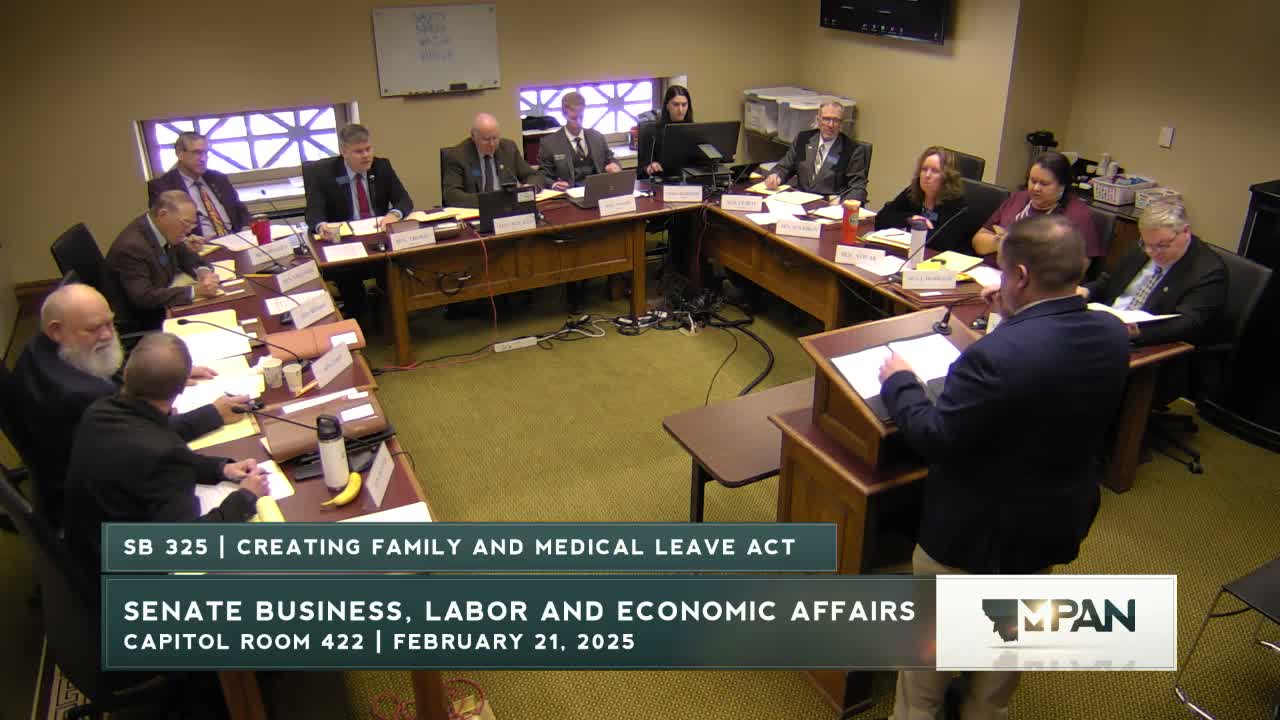
Senate committee hears hours-long testimony on Montana Family and Medical Leave Insurance Act
Summary
Senate Business and Labor heard hours of testimony on SB 325, the Montana Family and Medical Leave Insurance Act, which would create a fund paid by employer and employee contributions (capped at 1% of wages split 50/50) to provide up to 12 weeks of paid leave. Supporters cited workforce retention and family health; opponents warned of small‑business costs. No vote was taken.
Sen. Derek Harvey, sponsor of Senate Bill 325, told the Senate Business and Labor Committee the bill would create a statewide insurance fund to provide paid family and medical leave to eligible Montana workers.
"An eligible worker would be able to take a maximum of 480 hours or 12 weeks in one benefit year," Harvey said. He told the committee contributions would be split equally between employers and employees and that the contribution rate is capped at 1 percent of wages. The bill sets a $1,000 weekly benefit cap and directs the Department of Labor and Industry (DLI) to administer benefits, contribution rates and eligibility rules.
Proponents who testified included tribal representatives, early‑childhood advocates, the Montana Budget and Policy Center, labor unions, nurses and small‑business owners. Heather O'Loughlin of the Montana Budget and Policy Center described the bill's benefit design and cited comparisons with other states, saying most jurisdictions set contribution rates well below 1 percent.
"Most of those states, their contribution rate is below 1% — well below 1%," O'Loughlin said. Supporters also offered an example of a worker earning $30,000 annually, for whom the sponsor calculated a monthly contribution of about $12.50 split between employee and employer.
Opponents, including representatives of the National Federation of Independent Business, warned that even modest contribution rates are effectively a payroll tax small employers may not want to shoulder. Rhonda Wiggers, representing NFIB, cautioned about administrative burdens and replacement costs for very small firms, and urged lawmakers to allow businesses more local flexibility.
Agency witnesses described how the program could be implemented. Commissioner Sarah Swanson of DLI told senators the department estimates startup staffing of five full‑time positions that would grow as the program begins taking contributions. She also gave fiscal projections: the department estimates roughly $119 million in premium revenue in 2027 and about $131 million by 2029; projected claims and program costs were presented in the committee's materials.
"We're estimating that we would collect just over a $119,000,000 a year in revenues in the first year," Swanson said during questioning, and later described benefit and staffing projections tied to likely claim volumes.
Committee members pressed on definitions, including the statutory reference for 'covered employer' and enforcement mechanisms if employers do not restore jobs when employees return. Senators also asked about whether employers with existing leave policies could opt out; sponsors said the bill does not include a statutory opt-out but that the department could pursue opt‑out rules for qualifying employer plans during rulemaking.
The bill would set contributions to begin collecting July 1, 2026, with elective coverage for self‑employed people phased in by Jan. 1, 2027. The committee did not take final action on SB 325 in the hearing transcript.
What comes next: the committee scheduled executive action on multiple bills at a later date; lawmakers asked for additional fiscal material and follow‑up information from the sponsor and DLI before any vote.
Sources: Sponsor presentation by Sen. Derek Harvey; testimony from Heather O'Loughlin, Montana Budget & Policy Center; testimony and fiscal and staffing estimates from Sarah Swanson, Commissioner, Department of Labor and Industry.