Get Full Government Meeting Transcripts, Videos, & Alerts Forever!
Get email alerts on the Return To Work topic
No spam. Unsubscribe anytime.
House bill would end post'Rainey job-analysis delays when doctors clear injured workers
Summary
House Bill 197 would clarify that a treating physician's release to full duty allows return to work without a separate job analysis; sponsors and State Fund argued the 2021 Rainey decision added months of delay and administrative cost, and a negotiated 14'day-notice amendment secured conditional support from labor and industry.
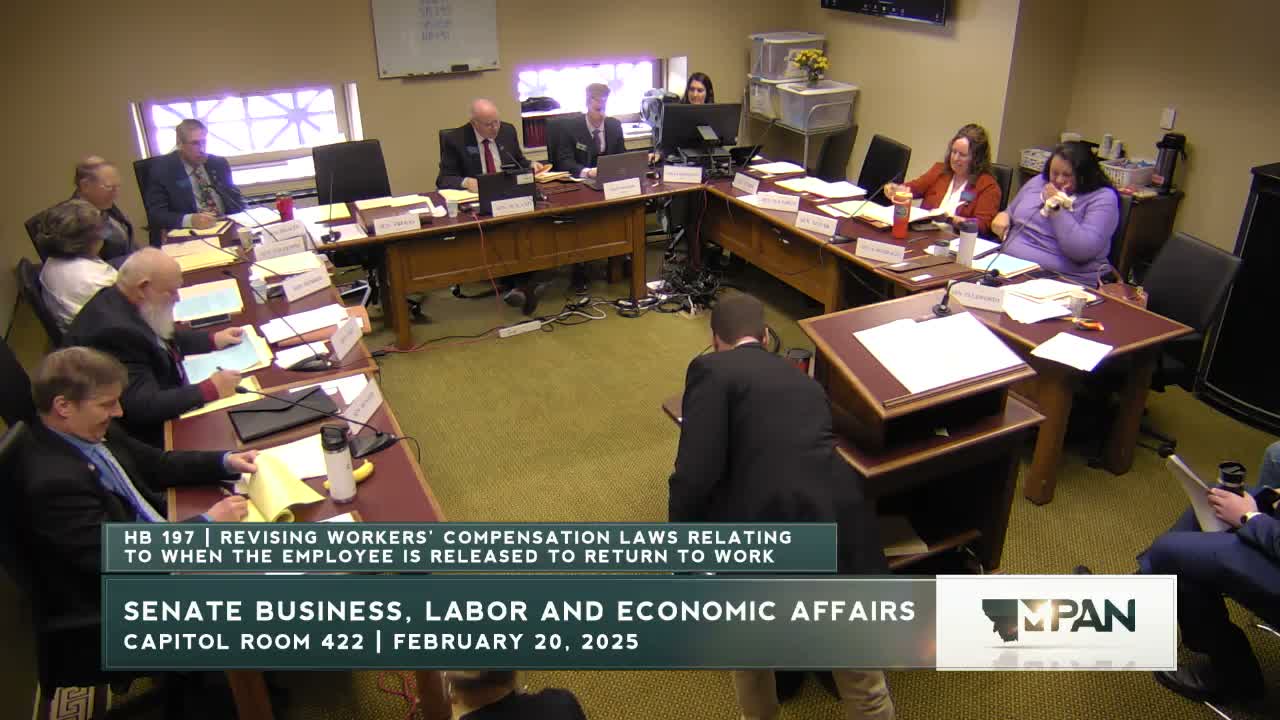
The Business, Labor and Economic Affairs Committee considered House Bill 197, sponsored by Representative Nick Castro, which would clarify that when a treating physician releases an injured worker to full duty, the worker may return to work without a separate vocational job analysis in most cases.
Representative Castro told the panel that a recent workers' compensation court decision (Rainey, 2021) has produced administrative delays and extra cost for simple full-duty releases. Nick Mazanek of Montana State Fund and insurers testified that the job-analysis process imposed by Rainey can take "3 to 4 months" and that the delays correlate with lower return-to-work rates; State Fund estimated tens to hundreds of claims annually are affected and provided extrapolated administrative and benefit exposure figures.
Supporters included insurers, employers, building trades, and the Montana Farm Bureau; they argued the bill restores the pre-Rainey practice, speeds return-to-work, lowers unnecessary claim costs, and trusts the treating physician's opinion when the doctor identifies no restrictions. Opponents from labor voiced concern that immediate termination upon a full-duty release could leave claimants without notice or time to pursue unemployment or other supports if their prior job is not available.
Committee members and stakeholders reached a working compromise: an amendment adds a 14-day written-notice period before benefits terminate for claimants who do not immediately return to a job; it also moves the bill's effective date to 07/01/2025 to allow education and administrative adjustment. Labor representatives said the amendment addressed their primary concerns and withdrew unconditional opposition.
State Fund and other witnesses supported the amendment, and proponents argued the change reduces administrative costs and helps injured workers return to work sooner, improving long-run outcomes. The committee closed the hearing; the bill will proceed with the amendment under consideration and a request for any required fiscal information.