Get Full Government Meeting Transcripts, Videos, & Alerts Forever!
Get email alerts on the Feedlot Renewables topic
No spam. Unsubscribe anytime.
Montana rancher outlines feedlot expansion with methane digesters, renewable natural gas offtake
Summary
Turk Stovall of Stovall Ranches told the Agriculture, Livestock and Irrigation Committee he plans to expand a Shepherd, Mont., feedlot to a confined-barn model that collects manure for anaerobic digesters to produce renewable natural gas, CO2 and digestate-based fertilizer; he said projects could create jobs and local economic activity but depend on capital and infrastructure.
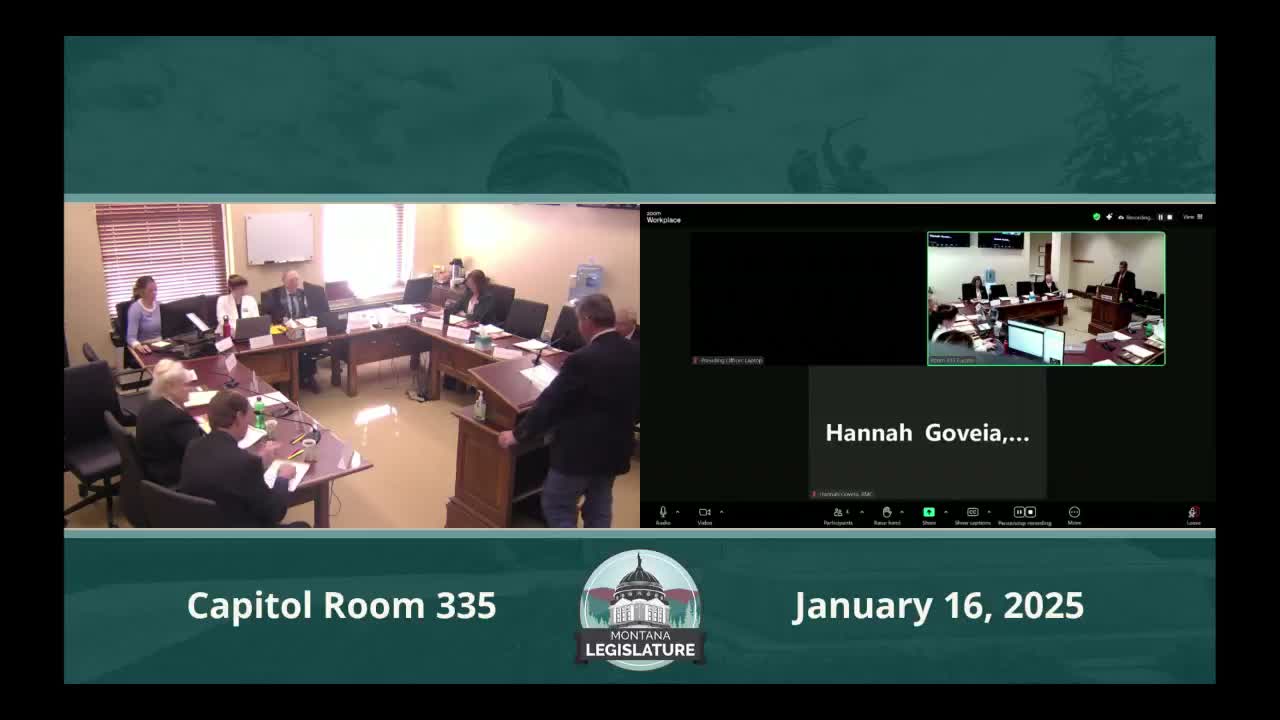
Turk Stovall, representing Stovall Ranches and Yellowstone Eco Solutions, told the Senate Agriculture, Livestock and Irrigation Committee he plans to expand feedlot operations in Shepherd, Montana, from an open feed yard to a confined-barn model that captures manure under slotted floors and routes it to anaerobic digesters.
Stovall said the digester system would capture methane for conversion to renewable natural gas and CO2 and produce digestate that could be processed into organic fertilizer. "We're really trying to be on the forefront of this," he said, describing the project as a joint venture with two renewable-energy partners and engineers. He said the Shepherd feedlot is currently permitted for 25,000 head and the first expansion would add roughly 40,000 head, with two additional sites under consideration.
Why it matters: Stovall argued the combination of onsite renewable energy production and nutrient recovery could both reduce emissions and create local economic opportunities. He estimated a project of this scale would inject substantial dollars into host communities and create permanent jobs: "we're going to have each one is going to take at least another 50 full time employees," he said.
Committee members pressed Stovall on environmental controls, infrastructure costs and market viability. On water, he said reclaimed water would be reintegrated into the production system and become part of the project's carbon accounting; he did not provide detailed water-balance calculations. On odor and ammonia, Stovall described continuous scraping and under-floor collection to limit volatilization and said emissions would be measured as part of the program.
Stovall said the project's pro forma for now does not count carbon-credit revenue, though he is working with NextGen ESG to calculate a carbon score and plans to present verifications to the VERA registry in time. On market demand, he said the voluntary carbon market is expanding but valuation depends on measurement, verification and registry placement.
He acknowledged large up-front costs and infrastructure needs: bringing gas service from East Billings to Shepherd was estimated at about $15 million, and Stovall said economies of scale, offtake contracts and financing are critical to project feasibility. He also outlined existing processing channels: finished cattle from Shepherd currently go to processors in Jerome, Idaho, and out-of-state plants; Stovall said increasing fed cattle in Montana could make in‑state processing more attractive.
The presentation emphasized cooperation with local processors and schools and the potential to support smaller meat processors by aggregating byproducts and volume. Stovall invited committee members to tour the facility and said he has offtake agreements for renewable natural gas and CO2, without disclosing contract specifics.
Next steps: No formal action was taken. Stovall offered contact information and the committee signaled interest in follow-up and potential site visits.