Get Full Government Meeting Transcripts, Videos, & Alerts Forever!
Get email alerts on the Taxation topic
No spam. Unsubscribe anytime.
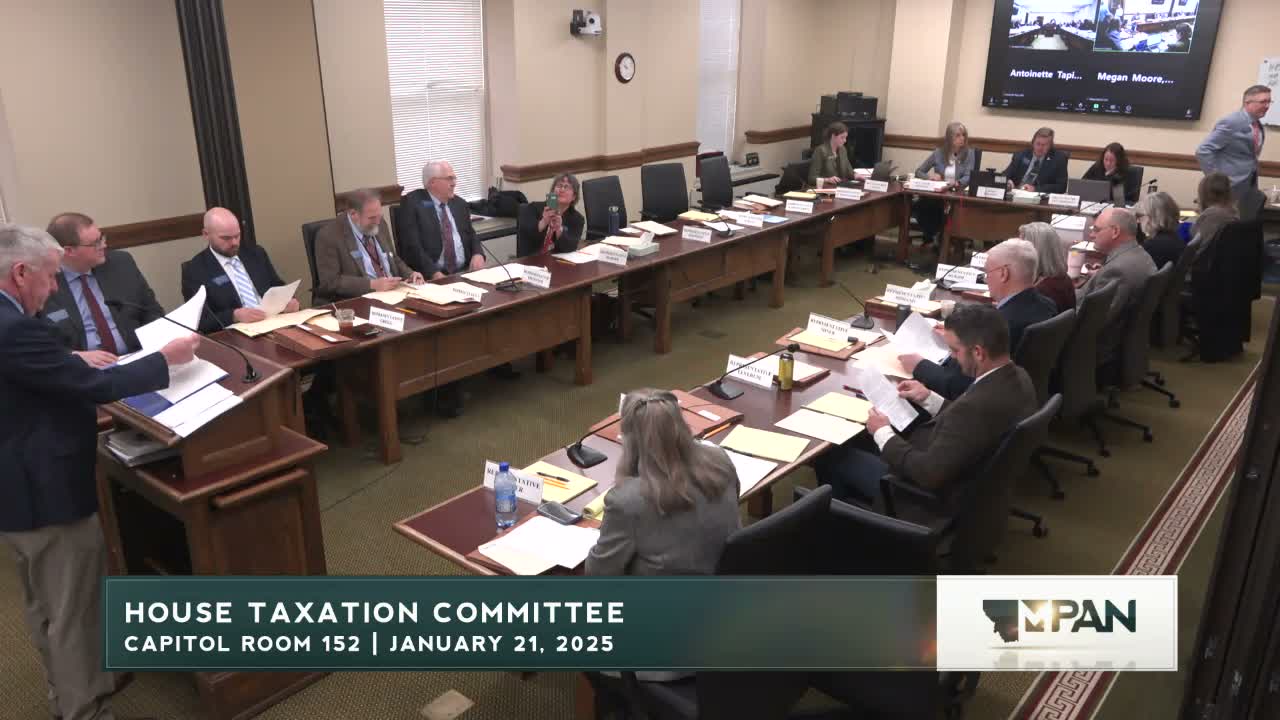
Lawmakers hear sweeping property‑tax overhaul aimed at rebalancing class‑4 burden
Summary
Representative Thane’s House Bill 155 would create tiered property‑tax rates for class‑4 residential properties and exemptions (first $50,000 for residences; $200,000 for commercial), with sponsors saying it rebalances a post‑2023 shift and opponents warning of county‑level tax shifts and unintended increases on ag and commercial taxpayers.
Representative Mark Thane opened House Bill 155 by calling Montana’s property‑tax situation a crisis and proposing a two‑part approach: a homestead/‘commstead’ exemption (first $50,000 residential; $200,000 commercial) and a graduated tax‑rate schedule for class‑4 residential property. Thane framed the bill as a rebalance after the 2023 reappraisal shifted a larger share of the property‑tax burden onto class‑4 properties.
Thane walked committee members through examples. In one, a $750,000 assessed single‑family home at current law would produce a taxable value equivalent to $10,125 and, at 500 mills, a $5,062.50 tax bill; under the proposed exemptions and graduated rates the taxable value would fall to $7,625 and the bill to $3,812.50, which Thane said represents roughly a 25% reduction in that example. For a $750,000 class‑4 commercial example, Thane showed an example yield of a roughly 27% reduction after the proposed $200,000 exemption.
Proponents included Big Sky 55 Plus and the City of Missoula, which described large increases in residential assessments in 2023 and urged targeted relief for fixed‑income households and working families. Opponents ranged from the Montana Taxpayers Association to the Chamber of Commerce and the Farm Bureau, each warning that the bill could cause county‑level tax shifts. Bob Storey (Montana Taxpayers Association) presented Department of Revenue modeling and county examples showing that removing taxable value from many properties could force local mill levies higher and shift burdens to counties with limited commercial bases; the Farm Bureau warned of class‑3 (ag land) increases in some counties.
Department of Revenue property‑assessment staff appeared to answer implementation questions, and committee members repeatedly requested more county‑by‑county modeling. Representative Thane acknowledged he has not produced county‑level analyses but said a fiscal note is pending and that he is open to amendments. He told the committee HB155 is intended to reset the distribution of the tax burden in anticipation of further valuation increases.
The hearing produced extensive technical questioning about who benefits, how the graduated rates would interact with local mills, and whether the proposal would protect long‑time residents while avoiding unintended consequences for counties with large agricultural or centrally assessed property bases. The committee took no action and closed the hearing on HB155.