Get Full Government Meeting Transcripts, Videos, & Alerts Forever!
Get email alerts on the Water Reuse topic
No spam. Unsubscribe anytime.
Committee moves forward study of water reuse in Montana; sponsors and advocates emphasize aquifer recharge and efficiency
Summary
House Natural Resources advanced HJ 74 to study water reuse statewide. Sponsor Representative Bob Carter cited declining precipitation and urged examination of reuse options for drinking, irrigation and stock water; conservation groups and Trout Unlimited supported the resolution and it passed by voice vote with proxies recorded.
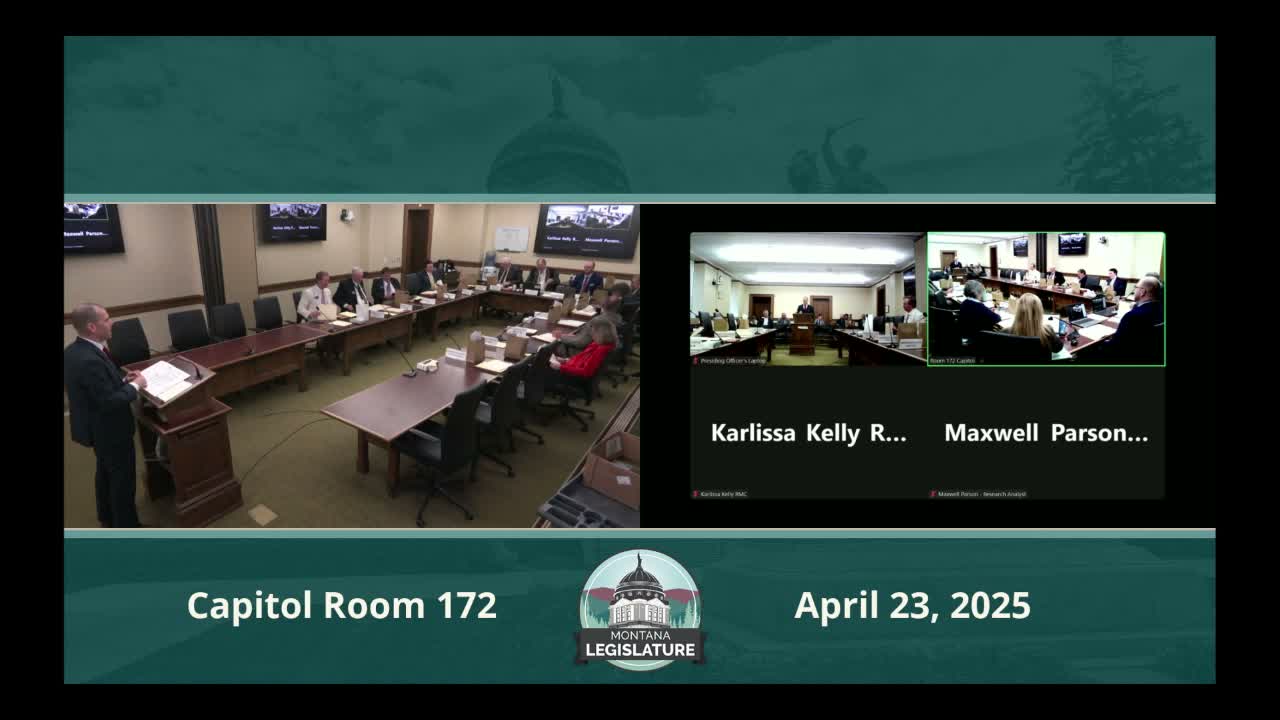
The House Natural Resources Committee voted to advance HJ 74, a resolution directing an interim study of water reuse in Montana.
Sponsor Representative Bob Carter (House District 96) told the committee that fresh water is finite and cited research indicating a roughly 22% decline in statewide annual precipitation since 1981 as part of his rationale. He said the study should assess regional variations, technology readiness, and where reuse could be applied — for stock, irrigation and drinking water — and examine models in other states.
Several environmental and water groups offered proponent testimony. Matt Alsasser, deputy director of Upper Missouri Waterkeeper, said treated water reuse and practices such as converting seasonal water rights to year‑round uses or recharging aquifers could help communities facing limits on surface or groundwater supplies. "There are places in the state that are at their limit so this is going to help the water supply and address pollution issues as well," Alsasser said. Laura Collins of the Montana Environmental Information Center urged the committee to vote yes, calling increased efficiency "wise" as water becomes scarcer. Jeff Lucas of Trout Unlimited also supported the study, recommending an "all of the above" approach to respond to growing demands and shifting supply.
Technical witnesses included Anna Pakenham Stevenson, Water Resources Division Administrator at the Department of Natural Resources and Conservation (DNRC), and Lindsey Krivaruchka, Water Quality Division Administrator at the Department of Environmental Quality (DEQ). Both identified themselves and offered to answer technical questions on reuse and related regulatory or resource issues.
Committee members asked the sponsor to clarify the study scope — including current hydrologic conditions, regional differences, applicability in rural and arid areas, and technology standards — and Carter affirmed those topics should be included. The chair closed the public hearing and the committee moved immediately into executive action.
Vice Chair Marler moved that the committee "do pass" HJ 74; the motion carried on a voice vote. Proxies recorded in the transcript included Representatives Steve Fitzpatrick and Jed Hinkle voting aye by proxy, and Representative Carlin voting aye by proxy. The committee’s action advances the resolution for further consideration during the interim.
The resolution does not itself change water law; it initiates an interim study to gather information that could inform future policy. The study’s scope as described in committee includes technical assessments of regional applicability, technology readiness, and potential uses for treated reuse water.