Get Full Government Meeting Transcripts, Videos, & Alerts Forever!
Get email alerts on the Probation Reform topic
No spam. Unsubscribe anytime.
Committee hears bill to let people on parole earn days off supervision for steady work
Summary
Sen. Daniel Zolnikov and supporters told the committee SB217 would allow probation and parole officers to recommend one day off supervision for every 40 wage‑earning hours worked, excluding lifetime supervision and certain registrants; DOC officials and researchers testified the change would incentivize employment and reduce revocations.
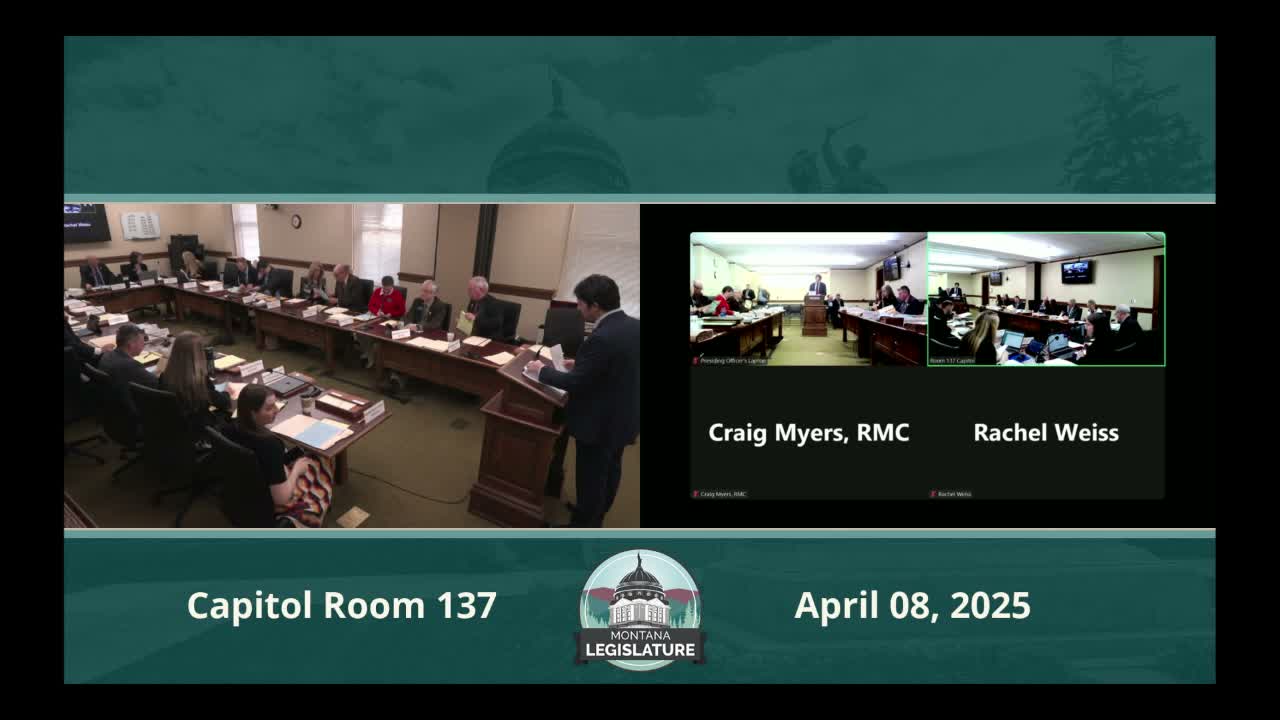
Sen. Daniel Zolnikov opened the hearing on Senate Bill 217, a bill to authorize earned-time credits for people under community supervision. "If you're on parole, and you are working, with the discretion of the parole officer you can get 1 day off for every 40 hour work week of eligible employment," Zolnikov said, describing the change as an incentive to reduce recidivism and to clarify an already-uneven practice.
Jacob Dupuis, visiting fellow with CSIRO Action, testified in support and cited Department of Corrections data and out‑of‑state examples: "Montana Department of Corrections currently has over 10,000 people on probation or parole... Forecast by corrections show the supervised population is expected to rise to 12,000 by 2027... This policy provides a target of incentive for employment, which is the single best predictor of distance from crime." (Jacob Dupuis)
DOC staff and the chief of the Probation and Parole Bureau (Sean Goodell) appeared as informational witnesses to answer eligibility and implementation questions. Goodell confirmed exclusions added in the Senate — lifetime supervision, registered sex or violent offenders, and youth‑court cases — mean some populations would remain ineligible, but that conditional discharge rules could still permit early release for eligible individuals.
Committee members focused on the definition of "eligible employment" and whether the bill should allow pro‑rated credit for part‑time or aggregated hours. Zolnikov said the one‑day‑per‑40‑hour rule was chosen as a simple, meaningful incentive; witnesses noted other states use slightly different thresholds (for example, ~130 hours per month or roughly 30 hours per week as an eligibility floor).
What happens next: The sponsor asked for a do‑pass recommendation. The record shows supportive testimony from corrections experts and think‑tank researchers alongside committee questions about verification, aggregation of part‑time work, and how DOC would document hours.