Get Full Government Meeting Transcripts, Videos, & Alerts Forever!
Get email alerts on the Religion And Government topic
No spam. Unsubscribe anytime.
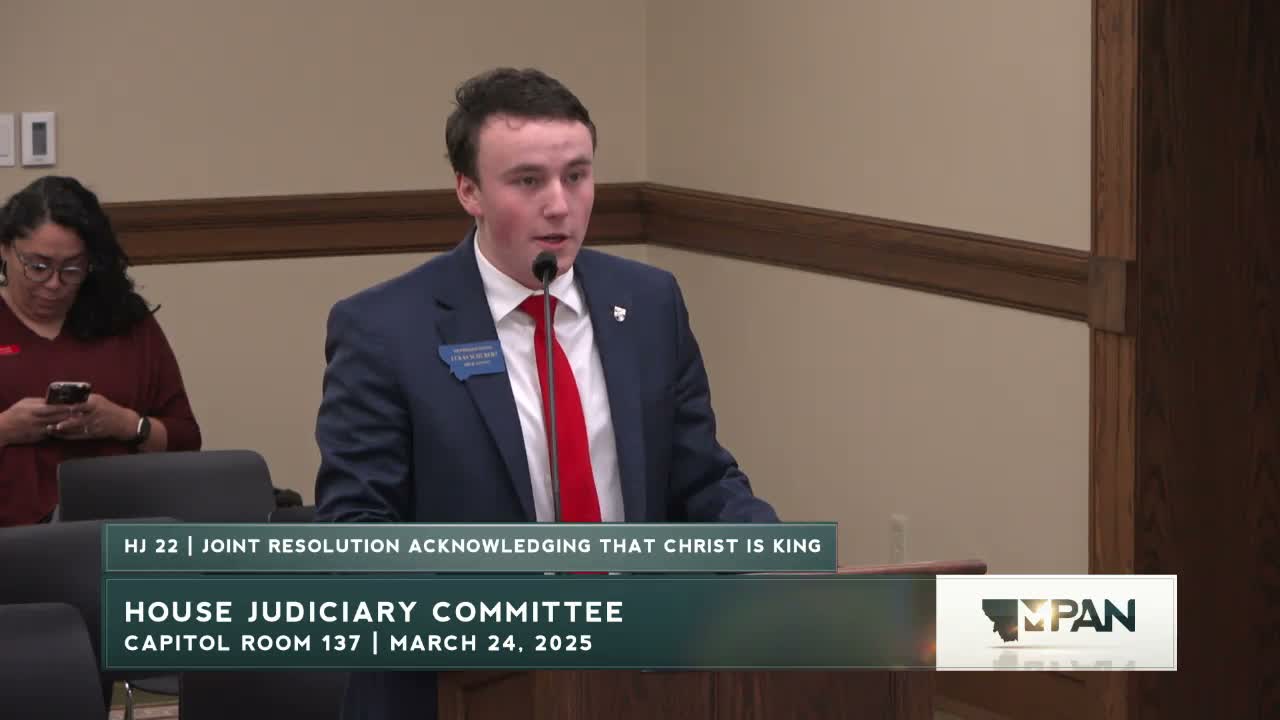
Resolution declaring 'Christ is king' draws tribal, constitutional objections in committee
Summary
House Joint Resolution 22, which would acknowledge Jesus Christ as 'king,' prompted strong opposition from tribal nations and others who called the measure exclusionary and potentially unconstitutional. Supporters characterized it as a nonbinding acknowledgment of Christian heritage.
Lucas Schubert presented House Joint Resolution 22 to the committee, reading a resolution that acknowledges "the kingship of Jesus Christ" and references historical quotations about Christian influence in U.S. jurisprudence. Schubert said the resolution does not change law or appropriate funds and urged the committee to pass it as a statement of heritage and concern about global Christian persecution.
Opponents including Alyssa Snow (representing the Blackfeet Tribe, Fort Belknap Indian community, and Chippewa Cree of Rocky Boy) and other tribal and private witnesses said the resolution is exclusionary and reopens traumatic history. Snow recounted how religion was used in the colonization and forced assimilation of Native Americans, including boarding schools. "Please vote no for HJ22," she told the committee, saying the resolution would be deeply unwelcome by many tribal communities.
Other opponents argued the resolution violates the Montana and U.S. constitutions by effectively endorsing a particular religion and that sending the resolution to tribal nations and federal officials would be perceived as a directive rather than a ceremonial message.
Sponsor Lucas Schubert defended the measure as ceremonial and nonbinding, saying many Montanans identify as Christian and that the resolution is meant to acknowledge heritage and show solidarity with persecuted Christians overseas. Committee members repeatedly pressed the sponsor to explain what "kingship" would mean in practice and whether the resolution compelled others to adhere to Christian belief; the sponsor repeatedly answered that it is an acknowledgment, not an imposition.
What’s next: The hearing closed after extensive testimony and questioning. The committee record includes clear opposition from several tribal governments and civil-liberty concerns from other witnesses.