Get Full Government Meeting Transcripts, Videos, & Alerts Forever!
Get email alerts on the Social Media Safety topic
No spam. Unsubscribe anytime.
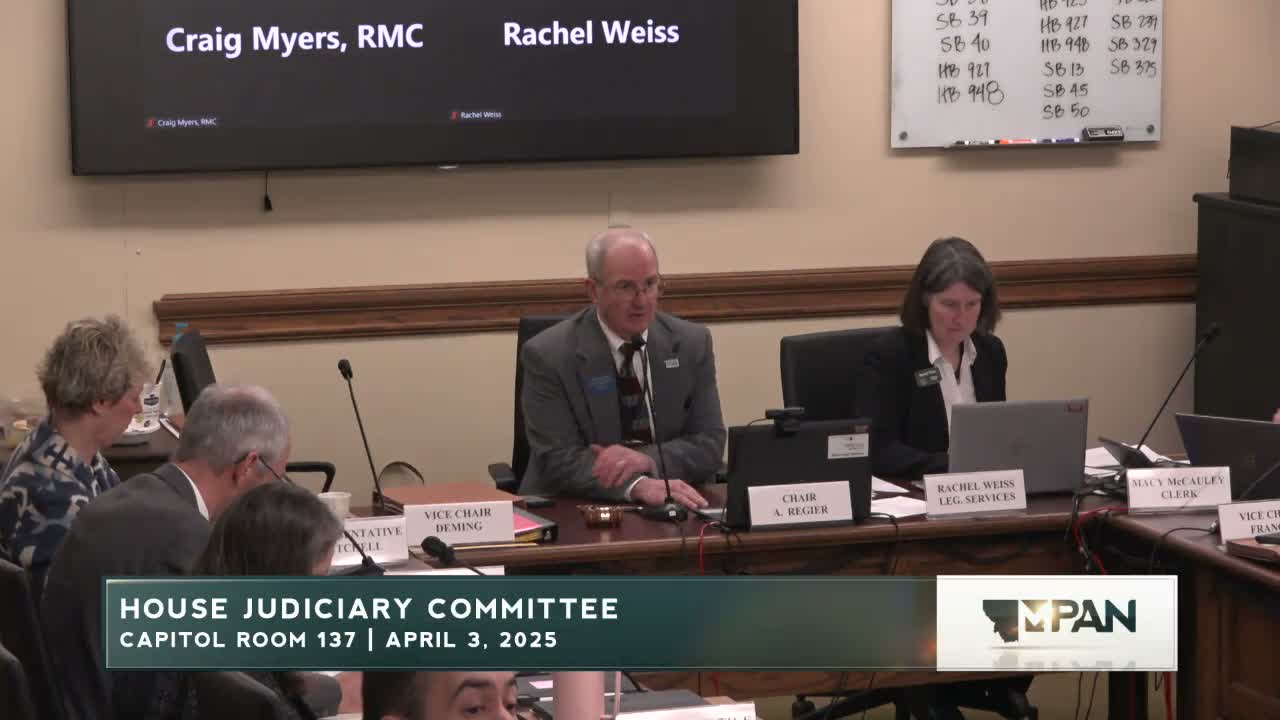
House Judiciary advances Social Media Youth Protection Act after hours of testimony
Summary
The House Judiciary Committee voted 12–8 to pass HB 925, a bill by Rep. Amy Regier that would require social platforms to verify ages, set strong default privacy for minors and offer parental supervision tools. Lawmakers heard hours of testimony on youth mental health, technical feasibility and constitutional risk.
Representative Amy Regier, sponsor of House Bill 925, opened the Judiciary Committee hearing by saying Montana must "prioritize children’s safety online" and described the bill’s core requirements: an age-assurance system, default privacy settings for minor accounts, supervisory tools for parents, and limits on autoplay and push notifications. "This legislation requires social media platforms to implement safeguards for minor account holders and provide parents with tools to regulate their children's social media use," Regier said (Representative Amy Regier, sponsor).
Supporters, including Rachel Green, the governor’s policy director, and Anita Milanovich, the governor’s general counsel, urged lawmakers to pass the bill as a public-health measure. Green cited research on widespread youth social media use and said voluntary industry efforts are insufficient. "Up to 95 percent of kids ages 13 to 17 report using a social media platform," Green told the committee and said the state has a compelling interest in protecting minors from addictive product features. Chief Data Officer Adam Carpenter, an informational witness, told lawmakers the technical tools required are feasible and characterized the bill’s request as similar to longstanding consumer‑safety measures: "If you're gonna serve AI-driven content, make sure you know the age of the person you're serving it to and serve appropriate content" (Adam Carpenter, Chief Data Officer).
Opponents raised constitutional and implementation concerns. Jesse Luther, speaking for Meta, and trade groups such as NetChoice and TechNet argued current litigation in other states shows similar laws have been enjoined. "This bill is modeled after bills that have been enjoined in federal court," Luther told the committee, urging lawmakers to pursue solutions that can withstand legal challenge. NetChoice and others told members the bill’s 95% age-assurance standard would force platforms to collect more identity data unless less invasive estimations are outlined, creating privacy and First Amendment risk.
Informational witnesses described available approaches and tradeoffs. Ian Corby of the Age Verification Providers Association said industry methods such as facial age estimation or other estimation techniques can reach high accuracy without retaining identifying data, and he said vendors can perform checks on-device and not keep biometric data. The bill includes enforcement language referring to the Montana Consumer Protection Act and authorizes DOJ enforcement and a private right of action.
Committee members debated the bill’s merits and legal risk. Some legislators said the harms to youth—mental health effects, trends in self-harm and addictive behavioral design—justify the legislation even if litigation follows. Others urged caution, pointing to injunctions elsewhere and the possibility that a state law could be struck down. Representative Staffman urged the committee to support the attorney general’s ongoing civil litigation instead of adopting language that has been blocked in other states.
After discussion, Vice Chair Deming moved HB 925 do pass out of committee. The Judiciary Committee held a roll-call vote; the motion carried 12–8. The committee reported the bill as passed out of the House Judiciary Committee and sent it forward for further consideration by the full House.
What happens next: HB 925 now goes to the House floor for consideration and possible amendment. Its enforcement mechanism (DOJ authority under the Montana Consumer Protection Act and a private right of action) and the bill’s age‑assurance requirements make it likely to draw legal scrutiny if enacted.