Get Full Government Meeting Transcripts, Videos, & Alerts Forever!
Get email alerts on the Fleeing Eluding topic
No spam. Unsubscribe anytime.
Bill to toughen fleeing-or-eluding elements wins police backing; committee seeks practical clarifications
Summary
HB 503 would add 'aggravated' elements to fleeing or eluding a peace officer — including reckless driving toward people, property damage over $5,000, or repeat offenses — while preserving existing penalties; law-enforcement groups supported the bill as a deterrent, and the committee asked operational questions about hand signals and pursuit policies.
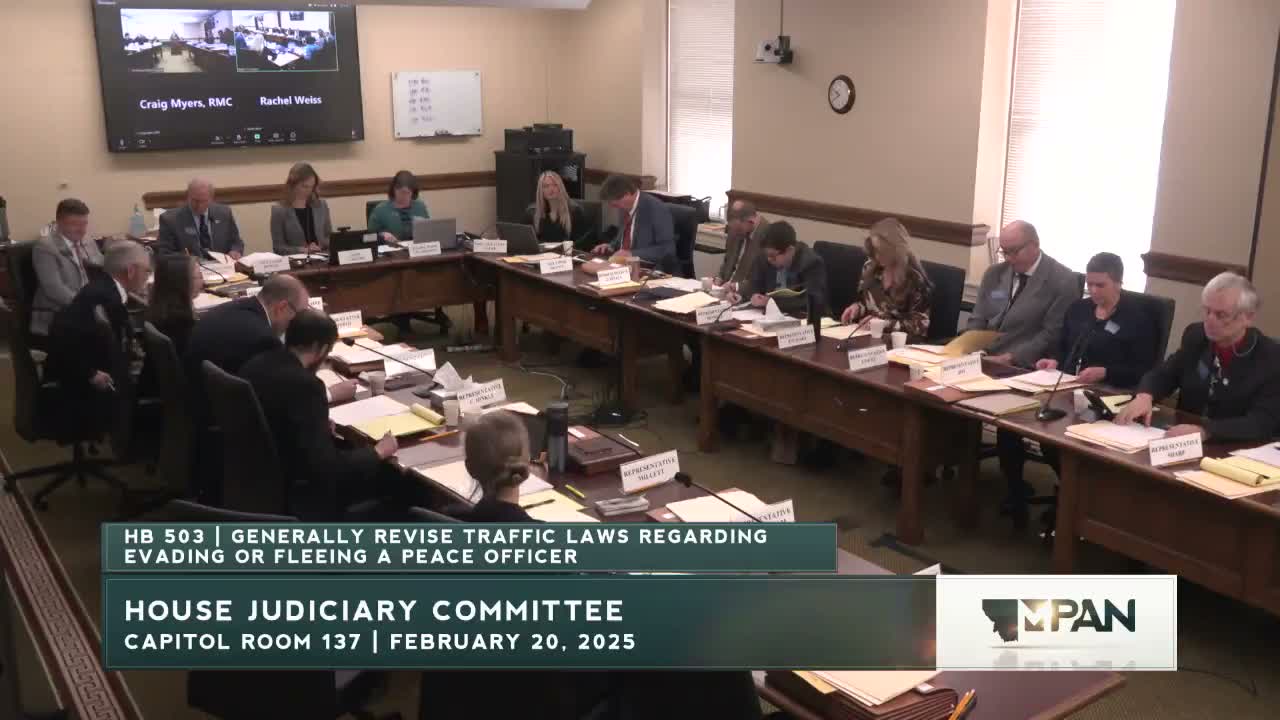
Representative Denise Baum opened the hearing on House Bill 503, which revises elements of fleeing or eluding a peace officer and adds an aggravated-fleeing classification for conduct such as reckless driving toward a person or causing more than $5,000 in property damage. Baum said the bill clarifies misdemeanor and felony components without increasing present fines and penalties.
Proponents included the Montana Sheriffs & Peace Officers Association, the Montana Police Protective Association, the Association of Montana Troopers and the Billings Police Department. Nanette Gilbertson (Montana Sheriffs & Peace Officers Association) said the tool responds to drivers who intentionally flee because many agencies have restrictive pursuit policies. Brandon Woolley, Billings Police Department captain, said a shift to more restrictive pursuits created a perception among some offenders that there will be no consequence for fleeing and that HB 503 would help close that enforcement gap.
Committee members probed practical application. Representative Hinkle asked how an officer would give an audible 'hand' signal when attempting to stop a driver; witnesses explained hand signals are used when officers can parallel or pull alongside a driver and sometimes in multi-lane traffic. Public Defender Division Administrator Brian Smith reviewed the bill and told the committee he did not immediately see traps in the language. Members also discussed whether the bill would unintentionally catch well-meaning drivers who miss lights or elderly drivers who do not see signals; witnesses emphasized the bill targets deliberate evasion.
Sponsor Baum closed by reiterating the bill adds clarifying elements defining aggravated eluding and urged committee support; the committee did not vote on the bill during the hearing.