Get Full Government Meeting Transcripts, Videos, & Alerts Forever!
Get email alerts on the County Reporting topic
No spam. Unsubscribe anytime.
Sponsor proposes 2% entitlement‑share cut for counties that fail to file child‑abuse reports
Summary
Rep. Bill Mercer told the House Judiciary Committee he wants to penalize counties that fail to submit statutorily required child‑abuse reporting by withholding 2% of their entitlement share; county representatives urged alternatives such as funding the reporting or targeting the county attorney salary, and lawmakers raised carve‑out and notice questions.
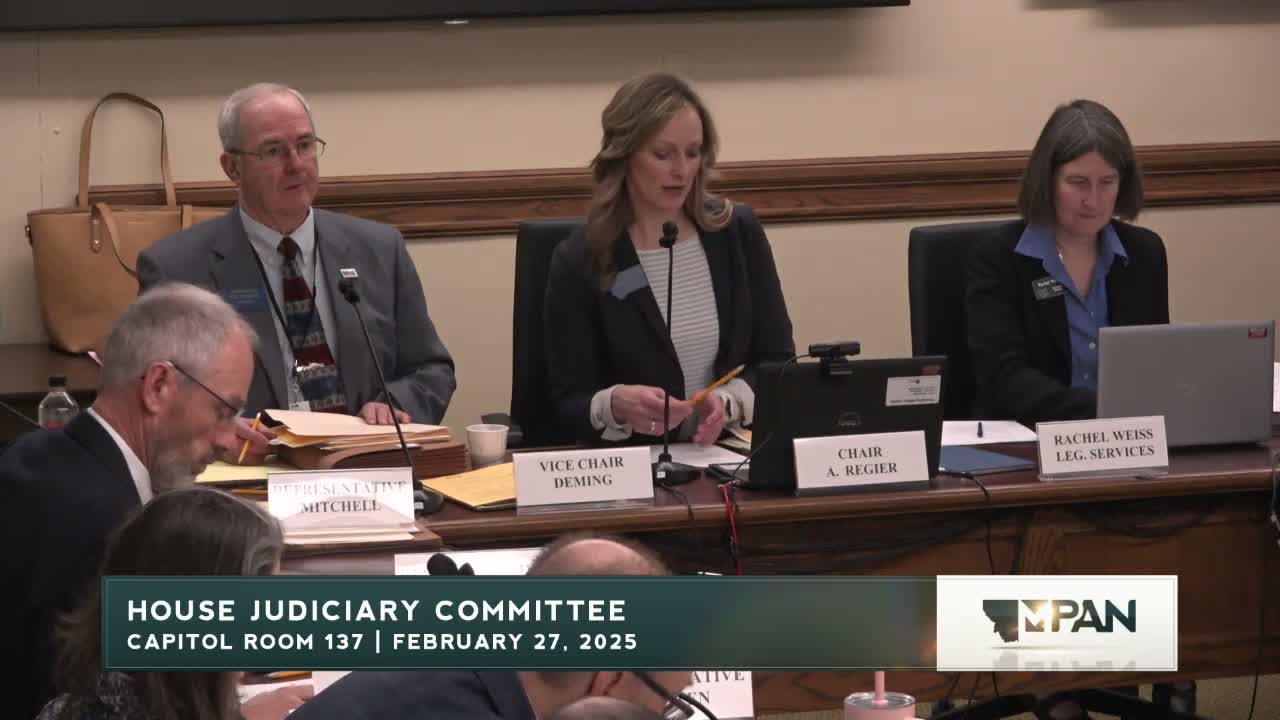
Representative Bill Mercer opened the hearing on House Bill 6 25, proposing to reduce by 2% the state entitlement share payments to any county that fails to file required child‑abuse reporting to the attorney general. "This is the bill. It would, take a 2% reduction of entitlement share that would otherwise go to the county," Mercer said, arguing the measure would incentivize compliance after years of uneven reporting.
Supporters and critics framed the bill differently in committee. Eric Bryson of the Montana Association of Counties thanked the sponsor for acknowledging the reporting problem but called the approach blunt and urged an alternative: require funding to cover the administrative work or withhold only the county attorney's state portion of salary under statute "seven‑four‑two 502," which Bryson read into the record. Bryson said, "If you want to encourage better compliance ... make modifications to 7 4 25 0 2 and do the withholding with the county attorney's state portion of the salary rather than the entitlement share payments."
Advocates for survivors likewise warned against punitive measures that could have downstream harms, and several lawmakers pressed practical questions: how many counties still fail to comply (the sponsor and witnesses cited "four" counties in recent compilations), how large a revenue loss 2% would represent (variable by county), and whether notice or appeal procedures would be offered before a cut. Representative Griffith described a county attorney office that missed a reporting year while dealing with a backlog and asked whether the bill would include carve‑outs for offices in transition; Mercer said there was no carve‑out in the draft but he was open to discussion.
The committee's exchanges also explored whether the attorney general's office could resolve most noncompliance by outreach and whether a legislated penalty would be the most effective or equitable tool. Mercer said he favored a structural incentive at the county level to spur commissioners' oversight: "I tend to think this is Obviously, I hope this solves the problem. And I think we're likely to get greater optics and focus if it's on entitlement share as opposed to the salary of the county attorney." The hearing concluded without a recorded committee vote on the measure.
Next steps: The bill remains in committee for potential amendment; members flagged potential fixes including notice provisions, narrowly targeted withholding, and clearer definitions of the trigger for a reduction.