Get Full Government Meeting Transcripts, Videos, & Alerts Forever!
Get email alerts on the Jury Trials In Constitutional Challenges topic
No spam. Unsubscribe anytime.
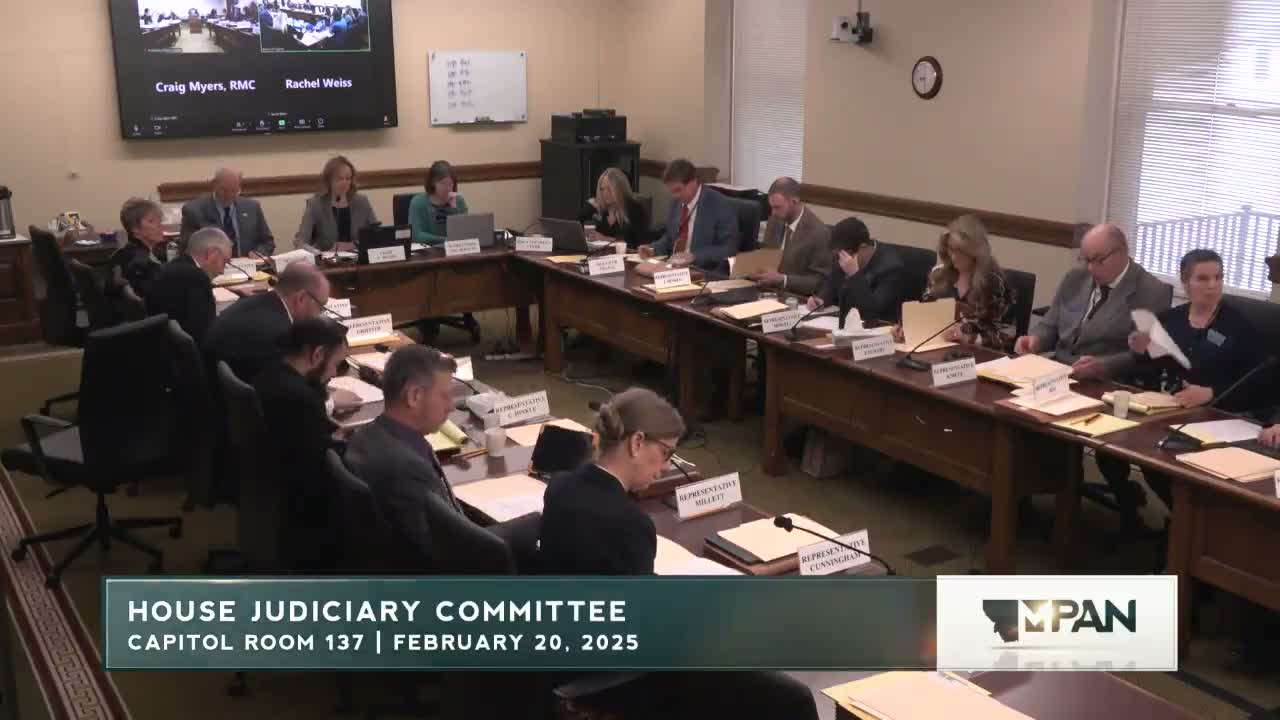
Bill to expand jury fact-finding in constitutional challenges draws partisan debate
Summary
HB 480 would allow parties in constitutional challenges and ballot disputes to demand jury trials on disputed facts; the bill drew support from the Secretary of State’s office and the Montana DOJ and opposition arguing constitutional and procedural problems, with extended committee questioning about past cases and practical effects.
Brandon Lier, sponsor of House Bill 480, told the Judiciary Committee the bill aims to "curtail trial courts' ability to unilaterally dictate the outcome of a constitutional challenge" by allowing juries to decide disputed facts. Lier argued juries bring "common sense" and community perspective to factfinding in politically charged cases.
Austin James, appearing on behalf of the Secretary of State, described prior litigation experiences in which the availability of a jury produced different factual findings than those reached by courts relying on expert testimony. "A jury provides a better outcome due to the possibility of the administration of justice through a well thought out decision due to the contributions of an empaneled voters," he said.
Michael Russell, civil bureau chief at the Montana Department of Justice, urged passage and pointed to the Montana Constitution and the Uniform Declaratory Judgments Act as supporting a statutory clarification that parties may demand jury trials on factual disputes in constitutional challenges. Russell cited the PSC redistricting challenge (Montana Conservation Voters v. Jacobson) as a case in which the court ultimately empaneled an advisory jury and that jury produced a 9–3 verdict.
Opponents, including John Marshall, said the statutory change risks running afoul of constitutional constraints and that a constitutional amendment would be the proper vehicle for altering jury rights. He warned the measure "will not pass constitutional muster."
Committee questions focused on how the bill interacts with Article II, Section 26 of the Montana Constitution ("the right of trial by jury is secured") and the Declaratory Judgment Act; how jury pools would be drawn (by judicial district); whether juries are competent to decide complex intent questions; and how the bill would affect ballot initiative litigation and the timing of challenges. DOJ witnesses argued juries decide disputed facts while courts decide questions of law; opponents stressed longstanding precedent and constitutional structure.
The sponsor closed urging a due pass and said the bill is intended to reduce what he termed judicial overreach by returning disputed factual determinations to citizen juries. The committee did not vote on the measure during the hearing.