Get Full Government Meeting Transcripts, Videos, & Alerts Forever!
Get email alerts on the Juvenile Justice topic
No spam. Unsubscribe anytime.
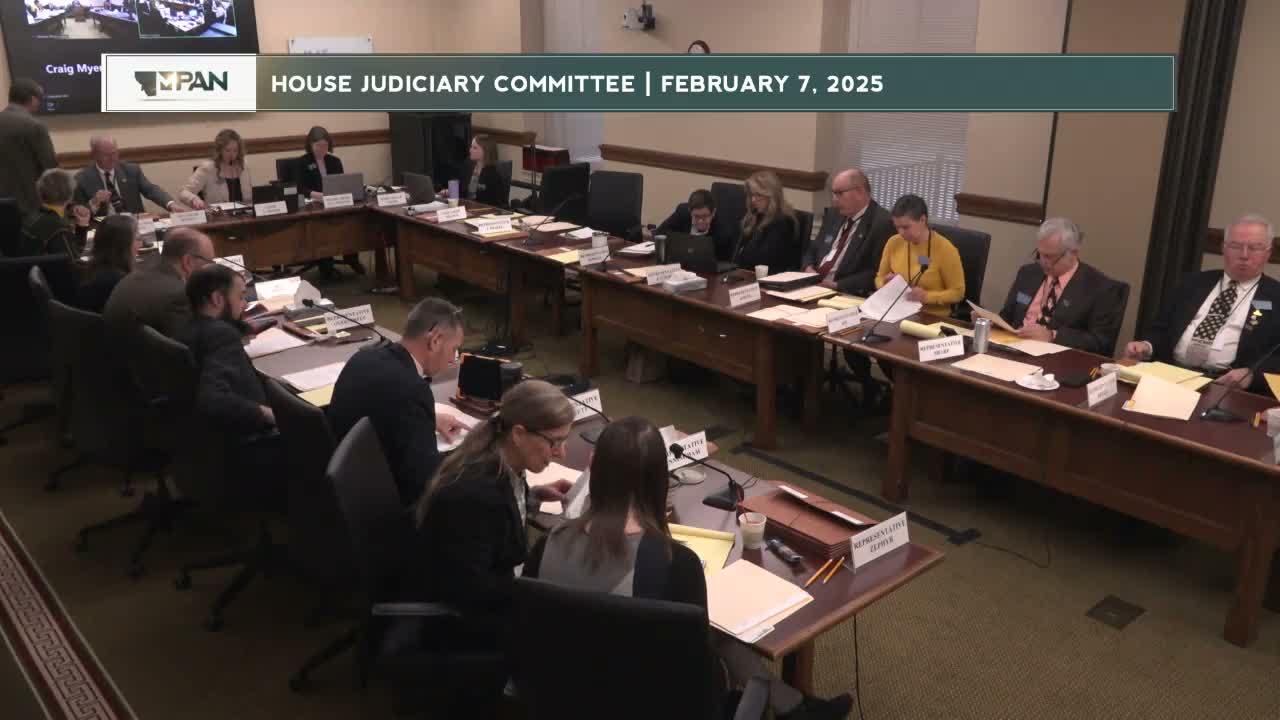
House panel hears bill to update Youth Court Act, expand prosecutorial direct‑file for certain violent offenses
Summary
Supporters said HB332 modernizes statutory references and lets county attorneys seek adult court for newly defined violent offenses; opponents including legal defenders and child‑advocacy groups warned it risks prosecuting younger children in adult court and imposes significant fiscal and safety costs.
Representative Bill Mercer urged the House Judiciary Committee to approve House Bill 332, saying the measure ‘‘is a cleanup bill’’ that updates the Youth Court Act to reflect offenses added to state law since the statute was written. Mercer and supporters told the committee some newly enumerated violent offenses — including strangulation and aggravated forms of sexual assault and kidnapping — should be eligible for direct filing in district court rather than handled exclusively in youth court.
Proponents included Hallie Bishop, a deputy chief in the Yellowstone County Attorney’s Office, who described the bill as technical fixes to correct cross‑references and to close procedural gaps the office encounters frequently. Bishop said the bill clarifies how consent adjustments and consent decrees operate and ensures judges and prosecutors have the transfer tools the legislature intended. Dan Brooks of the Billings Chamber of Commerce said business leaders see rising youth violent crime locally and support changes to ensure public safety.
Opponents, led by the ACLU of Montana and national juvenile‑defense groups, urged the committee to reject HB332 in its current form. Henry Seaton of the ACLU pointed to research showing that prosecuting children in adult court ‘‘harms public safety’’ and raises the risk of victimization and recidivism. Testifying for national youth‑defense groups, Amy Borror said decades of studies find transfer laws do not reduce youth crime and can instead impede development and rehabilitation.
Several attorneys and youth‑court practitioners urged caution about lowering the threshold for direct filing. Michelle Lyday, who practices in youth court, said the bill could increase the number of children — in some statutory constructions down to age 12 — who might be ‘‘direct filed’’ into district court and that change would raise serious due‑process and counsel‑availability questions. Committee members pressed proponents on the fiscal note; the public defender office and fiscal estimates cited an added per‑case cost range of roughly $5,000 to $30,000 for additional transfer hearings and expert evaluations, while witnesses acknowledged that statewide counts of transfer hearings are not yet tracked comprehensively.
Sponsor Mercer and proponents repeatedly emphasized prosecutorial discretion and the transfer hearing process: county attorneys still must show probable cause and district court judges must hold a transfer hearing and may return cases to youth court if the transfer factors are not met. Proponents also noted that mandatory minimums for adults do not automatically apply to juvenile defendants and that juveniles sentenced in district court have statutory review opportunities before age 21.
The committee did not take a vote on HB332. The hearing record shows broad agreement that the statute needs technical updating, and sharp disagreement over whether the bill’s changes are likely to produce safer outcomes or expand harmful adult processing of children. The bill will move forward to additional work and possible amendment if the committee elects to do so.