Get Full Government Meeting Transcripts, Videos, & Alerts Forever!
Get email alerts on the Criminal Justice topic
No spam. Unsubscribe anytime.
House Judiciary hears 'Bobby’s Law' to create aggravated vehicular homicide tied to aggravated DUI
Summary
Proponents, including victims' family members and advocacy groups, urged the House Judiciary Committee to pass House Bill 267 to create an aggravated vehicular homicide offense tied to aggravated DUI (commonly a 0.16% BAC or other aggravated factors), add a three-year mandatory minimum and prevent deferred sentencing; committee discussion focused on an amendment to remove a negligence element and practical effects for prosecution.
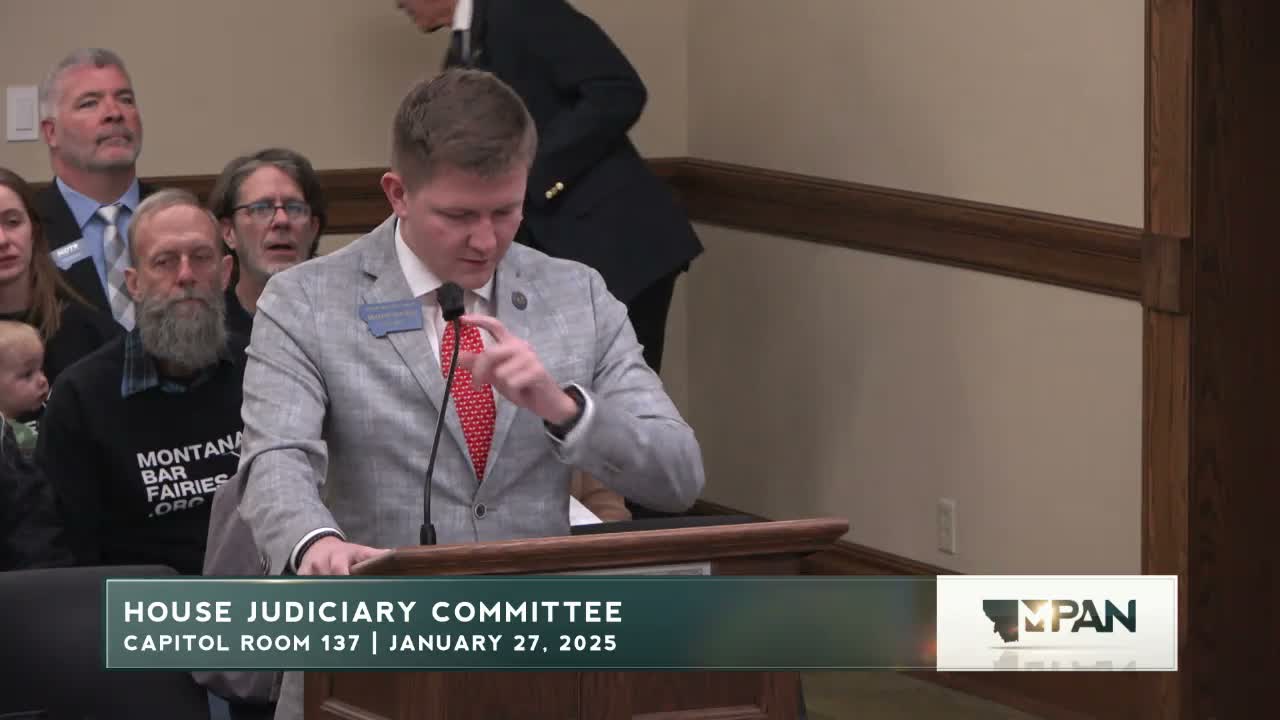
Representative Braxton Mitchell opened a House Judiciary Committee hearing on House Bill 267 on behalf of victims and families who say Montana’s existing DUI laws let some drivers who cause deaths face only minimal penalties. The bill would create a new offense—aggravated vehicular homicide while under the influence—tied to existing aggravated-DUI definitions and impose a mandatory minimum prison term of three years and fines between $10,000 and $50,000.
Why it matters: Montana ranks near the top nationally for drunk-driving fatalities per capita, according to witnesses at the hearing, and proponents said the bill closes a gap prosecutors have identified. “Montana leads the nation in drunk driving fatalities per capita,” Representative Mitchell said in his opening remarks, arguing the change would make roads safer and ensure stronger accountability. Families of several victims described short sentences they say were insufficient and urged lawmakers to act.
What the bill would do: As introduced and as explained in committee, the bill adds a new section that makes it an aggravated vehicular homicide to cause a death while committing an aggravated DUI (the sponsor and witnesses tied that to the statutory aggravated-DUI definition that commonly applies when a driver’s blood-alcohol concentration is 0.16% or higher or when other aggravating factors are present). The draft includes a mandatory minimum term of imprisonment of no less than three years and a maximum of 30 years; fines listed in committee testimony range from $10,000 up to $50,000. Sponsor and witnesses said an amendment is expected that would remove the word “negligently” from the new section so prosecutors need not prove separate negligence when the state shows the aggravated-DUI elements and causation.
Proponents’ testimony: Dozens of family members and community members testified in support. Elizabeth McBride, whose son was struck and killed while trying to get a sober ride, told the committee she was frustrated that the driver in her son’s case received misdemeanor-level sentences and an 18-month county jail term. “My son Bobby was struck and killed... he had been out with his friends celebrating his 20th birthday,” McBride said, describing the family’s loss and urging passage. Advocacy groups including Mothers Against Drunk Driving and the Association of Montana Troopers also backed the bill, arguing it would better align penalties with harm and act as a deterrent.
Informational testimony and prosecution concerns: Flathead County Attorney Travis Honor and Sheriff Brian Haino described the practical challenges prosecutors face under current law. Honor told the committee that because the statute requires proof of negligence in some cases, experienced impaired drivers who comply with traffic rules can be difficult to convict under existing vehicular-homicide language. Honor said the amendment that would remove the negligence element and instead require proof of aggravated DUI would address that gap by focusing on impairment thresholds or other aggravated factors. Honor also cautioned that language about mandatory minimums and whether time must be served in incarceration are drafting issues the sponsor and prosecutors are still negotiating.
Questions from lawmakers: Committee members pressed witnesses on several points, including how the bill would affect juveniles and whether treatment courts could be used instead of prison. Honor said treatment-court eligibility varies by county and that many treatment courts do not accept violent or homicide-level offenses, so prosecutorial discretion and local court structures affect whether a defendant can be diverted to treatment. Members also discussed current penalties under existing law (45-5-106), which can carry up to 30 years in prison but may allow judges to impose minimal incarceration absent a statutory minimum.
Next steps: The chair announced the committee will plan executive action on Wednesday and asked members to review materials in committee folders. No vote occurred at the hearing; the bill remains subject to amendment and formal committee action later in the week.
What was not decided: The committee did not vote on the bill; several drafting questions remain, including the final text of the amendment (removing “negligently”) and whether the three-year sentence must be served as incarceration rather than allowed as deferred or suspended time. Lawmakers asked for exact Flathead County DUI statistics that witnesses offered to provide.
The hearing closed after sponsor remarks and the committee adjourned with executive action scheduled for Wednesday.