Get Full Government Meeting Transcripts, Videos, & Alerts Forever!
Get email alerts on the Public Law 280 topic
No spam. Unsubscribe anytime.
Bill would fund Lake County during transition off Public Law 280
Summary
Rep. Tracy Sharp introduced HB 366 to provide $2.5 million a year to Lake County until the Flathead Reservation (CSKT) completes a retrocession and stands up its own judicial system; tribal representatives say they want more consultation and some opposition urges greater tribal input.
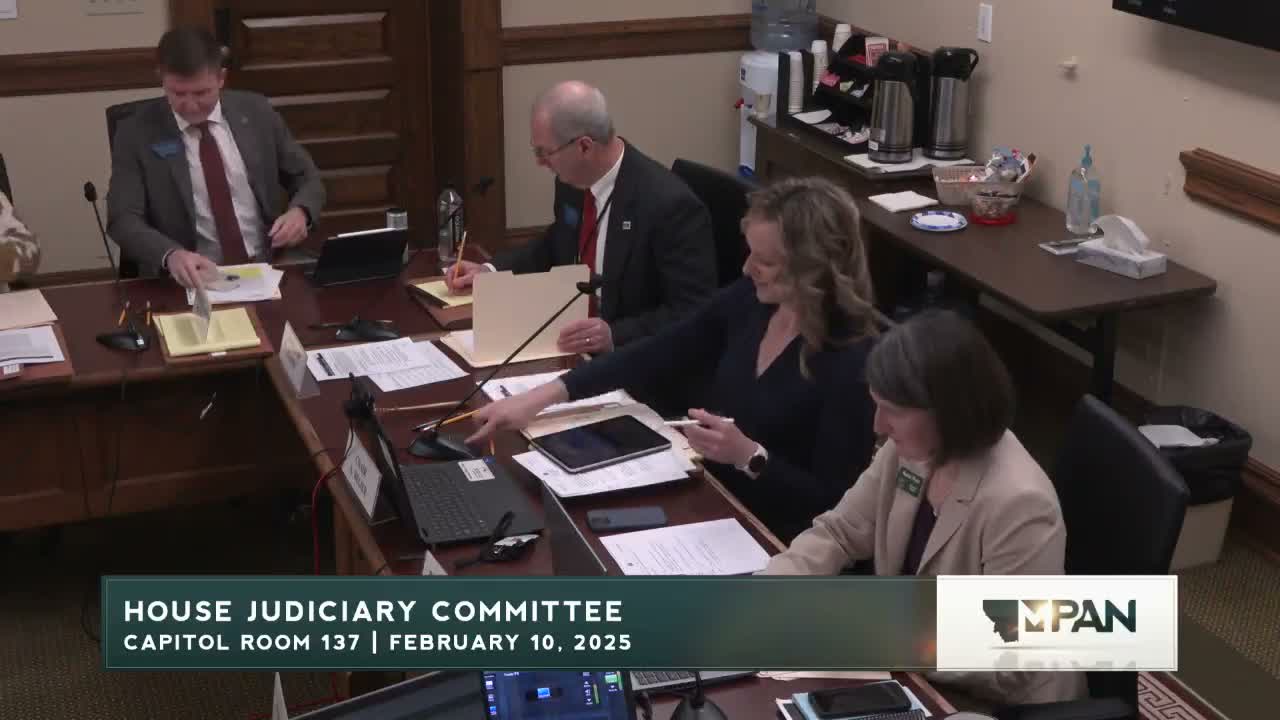
Representative Tracy Sharp, sponsor of House Bill 366, told the House Judiciary Committee the appropriation is designed to ease Lake County's financial burden while the Confederated Salish and Kootenai Tribes (CSKT) and local authorities build a tribal judicial system. "Lake County and Lake County's taxpayers, tribal and non tribal simply cannot afford to bear the financial burden of Public Law 280 any longer," Sharp said during her opening remarks.
Why it matters: Public Law 280 transferred certain federal criminal and civil jurisdiction to states in the 1950s. Sharp said Montana's implementation on the Flathead Reservation created a long-running arrangement under which Lake County absorbs many costs — adjudication, jail operations and mental-health care — while roughly 60% of reservation land is held in federal trust and not subject to local property taxation.
What the bill would do: HB 366 requests an appropriation of $2,500,000 per year "until retrocession," Sharp said, and she added that other estimates place potential long-term state costs as high as $4,000,000 annually if the state ultimately assumes full responsibility. Sharp said HB 656, now codified in Montana law, gives Lake County authority to retrocede from Public Law 280 and that the statutory sunset tied to that process is June 30, 2027; if a tribal judicial system is in place by the deadline, the transitional payments would end.
Support and concerns: Sharp said she has met with the lieutenant governor, CSKT and Lake County commissioners and expects amendments to the bill based on ongoing coordination; she emphasized the appropriation is intended to be temporary rather than an open-ended commitment. Keaton Sunchild of Western Native Voice, who registered online as an opponent, said his organization's position was a "soft opposition" and asked for "more consultation with the tribes as we go forward." Several committee members asked for written confirmation of the governor's and CSKT's positions before a floor vote.
What was not decided: The committee heard testimony and questions but did not take a final vote on HB 366 during the hearing. Sponsor Sharp said she would provide committee members with additional county cost details and expected bill amendments following coordination among the parties.
Next steps: The hearing was closed without a committee recommendation recorded in the transcript. Any amendments recommended after stakeholder coordination and any formal scheduling of the bill for committee action were not recorded in this hearing.